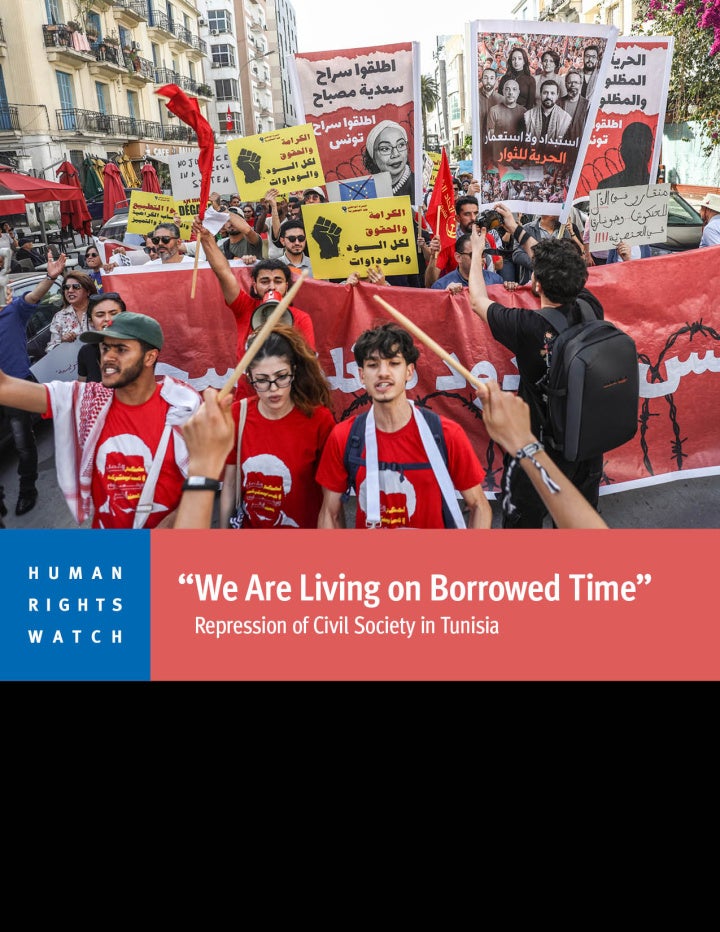
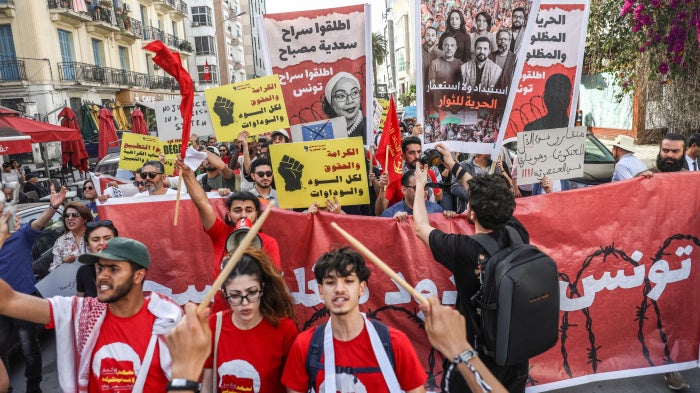
The 49-page report, “‘We Are Living on Borrowed Time’: Repression of Civil Society in Tunisia” documents the Tunisian authorities’ escalating repression of local and international civil society groups, workers, members, and affiliates through the weaponization of abusive prosecutions, arbitrary arrests, detention, financial and criminal investigations, mass suspensions, and threats of dissolution.
Chile's record on freedom of expression has improved little since the end of military rule, Human Rights Watch charged in this report. Although the country has made great progress in prosecuting the abuses of the Pinochet dictatorship, the same repressive defamation laws that the military regime regularly employed against its critics are still in use.
On February 14-15, Bahraini citizens will cast "yes" or "no" votes for a National Charter drafted late last year on the instructions of the country's ruler, or amir (prince), Shaikh Hamad bin Isa Al Khalifa.
When Jean-Bertrand Aristide is sworn in for a second term as Haitian president on Wednesday, February 7, he will face a number of pressing challenges in the areas of human rights and democracy.
If Yemeni voters cast a "yes" vote in the constitutional referendum on February 20, Field Marshall Ali Abdallah Saleh's term as president will be extended for two years and enable him to be re-elected in 2006 for another seven years.
Denial of Rights of Bidun, Women, and Freedom of Expression in Kuwait
Human Rights Watch today called on Kuwait to revoke laws that discriminate against women and long-term non-citizens of Kuwait. In a report issued before the opening of the Kuwaiti National Assembly on October 28, Human Rights Watch also called on Kuwait to amend its Penal Code and Printing and Publications Law to protect freedom of expression.
This report documents the Chinese government’s reaction to the efforts of a small number of democracy activists in 1998 and 1999 to take the first steps toward establishing a legal opposition party.
Six parties will contest elections to the lower chamber of a new bicameral parliament in Tajikistan on February 27, 2000. The vote will mark the first multiparty elections since the June 1997 peace agreement that ended Tajikistan's civil war, and are seen as the culmination of the peace process.
On December 5, Uzbekistan's voters will go to the polls for the second time since independence in 1991 to elect 250 deputies to the Olii Majlis, or parliament. Despite government claims that elections will be free and pluralistic, the parliamentary and local council elections will be a highly-controlled exercise in Potemkin democracy.
Despite legislation protecting freedom of speech and the press in Tajikistan, in practice freedom of expression is severely limited. For six years major opposition parties and their newspapers were banned. The government of Tajikistan continues to employ a variety of tactics to limit political content in the remaining media.
In a new report released ahead of this week's parliamentary elections in Kazakhstan, Human Rights Watch charged that the government was repeating the manipulation used in the January election of President Nazarbaev. These tactics, which include the banning of opposition candidates and censoring the media will taint the polls for the lower house of parliament, to be elected on October 10.
The Internet dramatically empowers persons in the exercise of their right to seek, receive, and impart information and ideas regardless of frontiers. Online communication must therefore be fully protected by international guarantees of the right to freedom of expression. In the Middle East and North Africa, Internet use is growing rapidly after a slow start.
This report by Human Rights Watch details how President Aleksandr Lukashenka's government has suppressed research on controversial topics, re-centralized academic decision- making, and maintained a ban on political activity on campuses.
This report examines the state of free expression in Turkey. It focuses largely on the print and broadcast media, and to a lesser extent on freedom of speech in politics.
Under the pretext of “depoliticizing” the campuses, the Serbian parliament in May 1998 enacted a law that removed basic protections for academic freedom and destroyed the autonomy of universities in Serbia.
Freedom of Expression and the Public Debate in Chile
Since the 1980s, the term “transition to democracy” has been used to describe those processes of political change that aim toleave behind a dictatorial past, a situation of internal armed conflict or another type of radical breakdown of the political orderor absence of the rule of law, and to advance toward the foundation or reconstruction of a democratic system.