Reports

Bans on Gender-Affirming Care for Transgender Youth in the US

The 98-page report, “‘They’re Ruining People’s Lives’: Bans on Gender-Affirming Care for Transgender Youth in the US,” documents the devastating consequences of these bans for transgender youth, including increased anxiety, depression, and, in seven reported instances, suicide attempts. Human Rights Watch found that these laws contribute to an increasingly hostile, anti-trans climate, compelling youth to hide their identities and socially withdraw. The bans also destabilize health care systems and undermine civil society and create geographic and financial challenges in accessing care. The impact has intensified since early 2025, when the administration of President Donald Trump took a series of executive actions escalating federal attacks on transgender rights.

Gender dysphoria illustration
A woman looks out of the window of a damaged building

Search

  • May 25, 2021

    Momentum to Revise Japan’s Legal Gender Recognition Process

    The 43-page report, “‘The Law Undermines Dignity’: Momentum to Revise Japan’s Legal Gender Recognition Process,” documents the persistent barriers transgender people face in Japan under the Gender Identity Disorder (GID) Special Cases Act. The procedure for changing one’s legally recognized gender, which requires sterilization surgery and an outdated psychiatric diagnosis, is anachronistic, harmful, and discriminatory. Many transgender people in Japan and domestic medical, legal, and academic experts, as well as international health and human rights bodies, have said that the law should be substantially revised.

    video content
    202105asia_japan_lgbt_cover
  • December 4, 2020

    Human Rights Violations in Sex Testing of Elite Women Athletes

    The 120-page report, “‘“They’re Chasing Us Away from Sport’”: Human Rights Violations in Sex Testing of Elite Women Athletes,” documents the experiences of more than a dozen women athletes from the Global South who have been affected by sex testing regulations. Human Rights watch found that global regulations that encourage discrimination, surveillance, and coerced medical intervention on women athletes result in physical and psychological injury and economic hardship. The International Olympic Committee – the supreme body in global sports – is developing guidelines to address human rights violations caused by sex testing policies.

    video content
    202012sex_testing_athletes_cover
  • October 7, 2020

    Violence and Discrimination Against LGBT People in El Salvador, Guatemala, and Honduras, and Obstacles to Asylum in the United States

    The 138-page report, “Every Day I Live in Fear”: Violence and Discrimination against LGBT People in El Salvador, Guatemala, and Honduras, and Obstacles to Asylum in the United States, documents violence experienced by LGBT people in the three Northern Central American countries collectively known as the Northern Triangle, including at the hands of gangs, law enforcement officials, and their own families. Human Rights Watch found that Northern Triangle governments fail to adequately protect LGBT people against violence and discrimination, and that they face major obstacles if they attempt to seek asylum in the United States.

    video content
    202010lgbt_central america_us_cover
  • July 29, 2020

    Sexual Violence Against Men, Boys, and Transgender Women in the Syrian Conflict

    The 77-page report, “‘They Treated Us in Monstrous Ways’: Sexual Violence Against Men, Boys, and Transgender Women in the Syrian Conflict,” found that men and boys have been vulnerable to sexual violence in the Syrian conflict since it began. People Human Rights Watch interviewed said that gay and bisexual men, transgender women, and nonbinary people were subject to increased violence based on their actual or perceived sexual orientation or gender identity. Transgender women are often perceived as gay men in Syria and are targeted for the same reasons.

    202007mena_syria_lgbt_cover
  • February 12, 2020

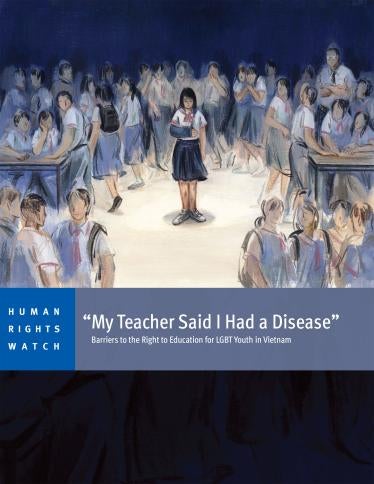
    Barriers to the Right to Education for LGBT Youth in Vietnam

    The 65-page report, “‘My Teacher Said I Had a Disease’: Barriers to the Right to Education for LGBT Youth in Vietnam,” documents how LGBT youth in Vietnam face stigma and discrimination at home and at school over myths such as the false belief that same-sex attraction is a diagnosable, treatable, and curable mental health condition. Many experience verbal harassment and bullying, which in some cases leads to physical violence. Teachers are often untrained and ill-equipped to handle cases of anti-LGBT discrimination, and their lessons frequently uphold the widespread myth in Vietnam that same-sex attraction is a disease, Human Rights Watch found. The government of Vietnam should fulfill its pledges to protect the rights of LGBT people.

    202002LGBT_Vietnam_cover
  • February 3, 2020

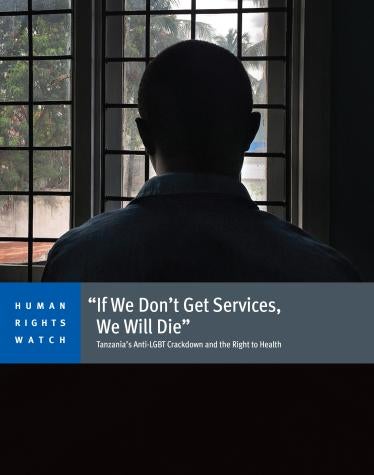
    Tanzania’s Anti-LGBT Crackdown and the Right to Health

    This report documents how since 2016 the government of Tanzania has cracked down on LGBT people and the community-based organizations that serve them. The Health Ministry in mainland Tanzania has prohibited community-based organizations from conducting outreach on HIV prevention to men who have sex with men and other key populations vulnerable to HIV. It closed drop-in centers that provided HIV testing and other targeted and inclusive services, and banned the distribution of lubricant, essential for effective condom use for HIV prevention among key populations and much of the wider public.

    202002LGBT_Tanzania_cover
  • September 3, 2019

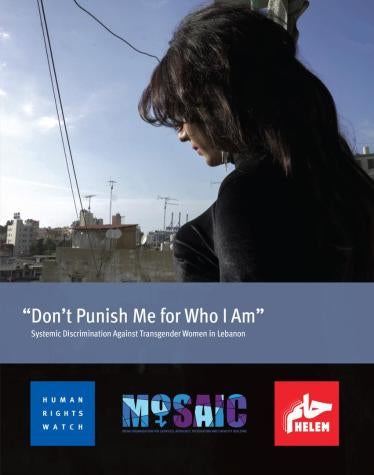
    Systemic Discrimination Against Transgender Women in Lebanon

    Lebanese General Security has banned a group of activists and academics from re-entering Lebanon following their participation in a September 2018 conference on gender and sexuality, Human Rights Watch, the Arab Foundation for Freedoms and Equality (AFE), and Legal Agenda said today. General Security officers attempted to unlawfully shut down the conference and took names of all conference participants from the hotel registry, including those from highly repressive countries. The agency apparently used the information to create a list of people who are not welcome in Lebanon. This appears to be the first time Lebanon has imposed a collective ban on individuals for participating in a conference.

    Lebanon Report Cover LGBT
  • March 19, 2019

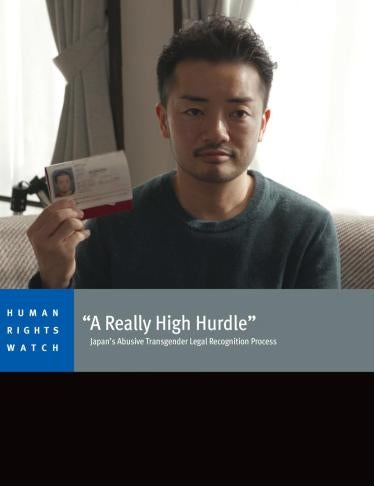
    Japan’s Abusive Transgender Legal Recognition Process

    This report documents how Japan’s Gender Identity Disorder Special Cases (GID) Act harms transgender people who want to be legally recognized but cannot or do not want to undergo irreversible medical procedures like sterilization. 

    Cover
  • December 11, 2018

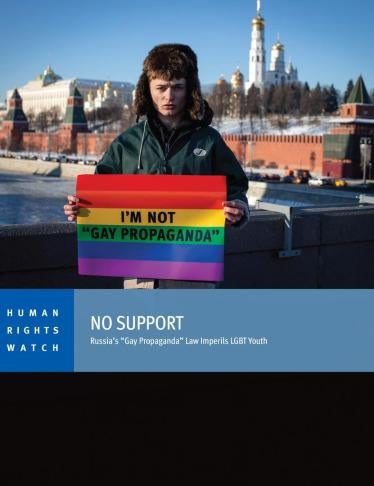
    Russia’s “Gay Propaganda” Law Imperils LGBT Youth

    This report documents how Russia’s “gay propaganda” law is having a deeply damaging effect on LGBT children. Human Rights Watch interviewed LGBT youth and mental health professionals in diverse locations across Russia, including urban and rural areas, to examine the everyday experiences of the children in schools, homes, and in public, and their ability to get reliable and accurate information about themselves as well as counseling and other support services. 

    Cover
  • October 26, 2018

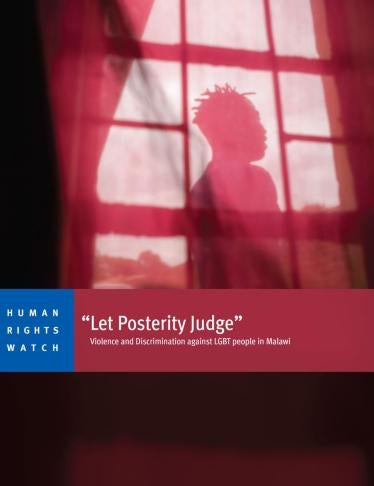
    Violence and Discrimination against LGBT people in Malawi

    This report shows how the lack of clarity about the legal status of same-sex conduct leaves LGBT people vulnerable to arbitrary arrests, physical violence, and routine discrimination. The justice minister issued a moratorium on arrests for adult consensual same-sex conduct in 2012, but there are divergent views about its legality. 

    map content
    Cover
  • July 23, 2018

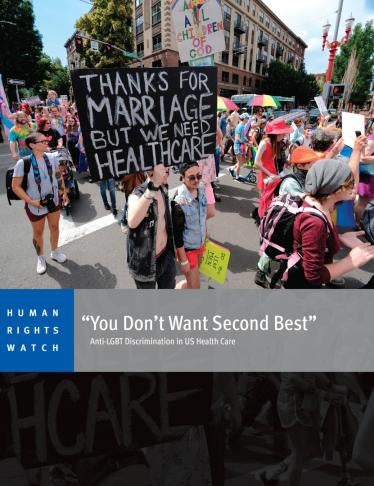
    Anti-LGBT Discrimination in US Health Care

    This report documents some of the obstacles that LGBT people face when seeking mental and physical healthcare services. Many LGBT people are unable to find services in their area, encounter discrimination or refusals of service in healthcare settings, or delay or forego care because of concerns of mistreatment.

    Cover
  • July 1, 2018

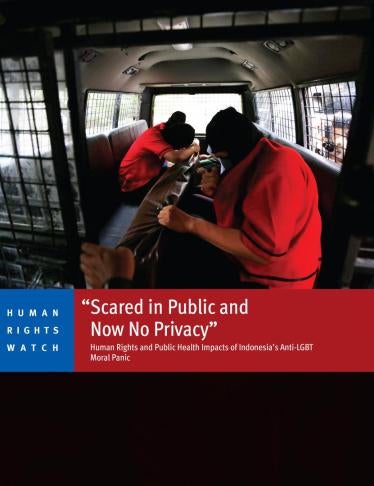
    Human Rights and Public Health Impacts of Indonesia’s Anti-LGBT Moral Panic

    This report documents how hateful rhetoric has translated into unlawful action by Indonesian authorities—sometimes in collaboration with militant Islamist groups—against people presumed to be LGBT. Based on in-depth interviews with victims and witnesses, health workers, and activists, this report updates a Human Rights Watch August 2016 report that documented the sharp rise in anti-LGBT attacks and rhetoric in Indonesia that began that year. It examines major incidents between November 2016 and June 2018, and the far-reaching impact of this anti-LGBT “moral panic” on the lives of sexual and gender minorities and the serious consequences for public health in the country.

    Cover of the LGBT Indonesia report
  • April 16, 2018

    LGBT Activism in the Middle East and North Africa

    In this report, activists tell their stories and describe how they are building their movements. To confront myths and counteract the isolation of many LGBT people in the region, Human Rights Watch and AFE teamed up to produce the videos featuring Arabic-speaking LGBT activists describing their journeys of self-acceptance. Through the video series, they offer messages of support and encouragement to LGBT people throughout the Arabic-speaking world. 

    Cover of the LGBT MENA report in English
  • March 21, 2018

    Discriminatory Laws against LGBT People in the Eastern Caribbean

    This report covers seven countries: Antigua and Barbuda, Barbados, Dominica, Grenada, Saint Kitts and Nevis, Saint Lucia, and Saint Vincent and the Grenadines. All seven countries have versions of buggery and gross indecency laws, relics of British colonialism, that prohibit same-sex conduct between consenting persons. The laws have broad latitude, are vaguely worded, and serve to legitimize discrimination and hostility toward LGBT people.

    map content
    Cover of the Eastern Caribbean LGBT report
  • February 19, 2018

    Religious Exemptions and Discrimination against LGBT People in the United States

    This report documents how recent laws carve out space to discriminate against LGBT people in adoption and foster care, health care, and access to some goods and services. These laws fail to balance moral and religious objections to LGBT relationships and identities with the rights of LGBT people themselves, Human Rights Watch found. The findings illustrate that these exemptions encourage discriminatory refusals, discourage LGBT people from seeking out services, and harm people’s dignity.

    map content
    Cover of the US LGBT report