The Inhumane Effects of White Phosphorus Munitions and the Need for Stronger Law
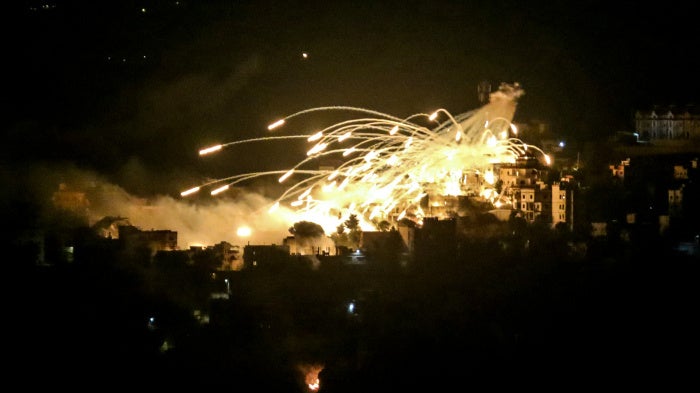
The 45-page report, “Uncontrolled Burn: The Inhumane Effects of White Phosphorus Munitions and the Need for Stronger Law,” documents 23 verified incidents of Israeli use in southern Lebanon between March and May 2026. The report also details the horrific harm the munitions have caused in armed conflicts in recent years. White phosphorus munitions, which produce fire when their payload is exposed to oxygen, are not currently regulated by a specific treaty.
New lists of prisoners supplied by former inmates and smuggled out of the Tibet Autonomous Region substantially increase the known number of political prisoners in Tibet. In this report, Asia Watch and the Tibet Information Network present the cases of some 275 prisoners with all extant biographical material.
Across northern Iraq, Kurds, freed for now from President Saddam Hussein's grip, have begun revealing the horrors of nearly a quarter of a century of repressive rule. In former Iraqi police stations and prisons, Kurdish officials have discovered torture chambers and execution sites where they say thousands of political prisoners died under torture or were shot in the 1980s.
Abuse of the Legal System Under the PNDC Government
Soon after it came to power, Ghana's ruling Provisional National Defence Council (PNDC) established a "revolutionary" court system. Consisting of Public Tribunals which operate within the country's judicial system, this parallel system for the administration of justice has shown a cavalier disregard for normal judicial procedures.
Major human rights violations go far to explain the ouster of Georgian President Zviad Gamsakhurdia. Helsinki Watch hopes that the new rulers of Georgia are mindful of these violations as they consolidate power and establish a new government. There are, however, several disturbing incidents which suggest that this may not be the case.
Over 60 East Timorese, many of them students, remain in detention in Jakarta and Dili, capital of East Timor in the aftermath of the November 12 massacre in Dili in which upwards of 75 demonstrators were killed when Indonesian troops opened fire. All are facing trial, some on criminal charges, some on charges of subversion.
Asia Watch has studied the preliminary report of the National Commission of Inquiry prepared by the seven-person team appointed by President Suharto to investigate the killings in Dili, East Timor on November 12, 1991, when Indonesian armed forces opened fire on unarmed demonstrators.
Helsinki Watch has documented scores of cases of torture in Turkey since 1982, and Turkish lawyers who represent detainees claim that police routinely torture between 80 and 90 percent of political suspects and about 50 percent of ordinary criminal suspects, including children. Nothing Unusual documents the torture of children under the age of eighteen in Turkey.
Human Rights Violations by the Government of Zviad Gamsakhurdia
Helsinki Watch has sent two fact-finding missions to Georgia in recent months that have documented severe violations of human rights on the part of the Gamsakhurdia government, including violations of freedom of speech and the press, violations of the right to free assembly, the imprisonment of political opponents, some of whom have not used or incited others to violence, the torture and mistreatm
The trial of nine Salvadoran army soldiers and officers accused in the November 1989 murders of six Jesuit priests, their housekeeper and her daughter took place in San Salvador on September 26-28, 1991, in front of a host of international observers including Americas Watch.
On November 12, 1991 in Dili, the capital of East Timor, anywhere from 75 to 200 people are estimated to have been killed when Indonesian troops opened fire on a demonstration. The demonstrators were calling for the independence of East Timor, the former Portuguese colony of some 700,000 people on the eastern half of the island of Timor, off the north Australian coast.
A decade ago, on December 4, 1981, the South African government declared that the Ciskei, an arbitrarily defined area in the south east of the country, had joined three other "national states" in receiving "independence." No other state recognizes the independence of Ciskei or of the other homelands.
The Cairo-based Arab Women's Solidarity Association (AWSA) was ordered dissolved by an administrative decree dated June 15, 1991. The action was taken pursuant to the 1964 Law of Associations which regulates private voluntary organizations in Egypt. AWSA actively promotes women's rights in Egypt and the Arab world. The founder and president of AWSA, Dr.
A Personal Statement by Dr Mohamed Mostafa Mandour
Dr. Mohamed Mandour, an Egyptian medical doctor and psychiatrist, was administratively detained by the Egyptian security authorities for sixteen days in February 1991. He was brought from his home after midnight to State Security Intelligence headquarters at Lazoughly, Cairo. He was held there for ten days, from the early morning hours of February 8 until the morning of February 17.
While torture by the police in Argentina is viewed as a serious problem by its citizens, and efforts have been made to curb its use, it is still widespread.
The government of Jean-Bertrand Aristide compiled a record on human rights which showed much promise but which was also marked by certain troubling practices.