The Inhumane Effects of White Phosphorus Munitions and the Need for Stronger Law
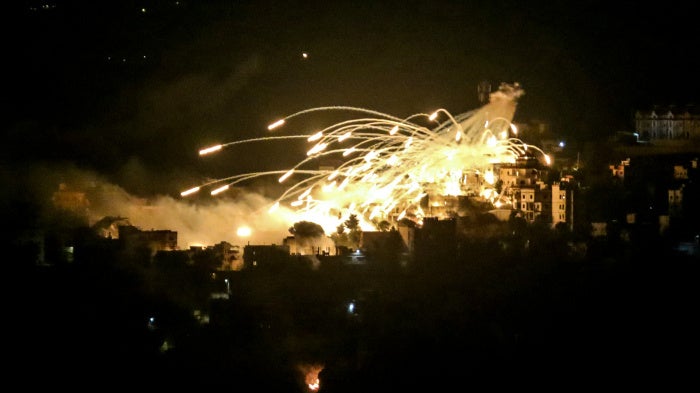
The 45-page report, “Uncontrolled Burn: The Inhumane Effects of White Phosphorus Munitions and the Need for Stronger Law,” documents 23 verified incidents of Israeli use in southern Lebanon between March and May 2026. The report also details the horrific harm the munitions have caused in armed conflicts in recent years. White phosphorus munitions, which produce fire when their payload is exposed to oxygen, are not currently regulated by a specific treaty.
Although ethnic Macedonians in northern Greece make up a large minority with their own language and culture, their internationally-recognized human rights and even their existence are vigorously denied by the Greek government. Free expression is restricted; several Macedonians have been prosecuted and convicted for the peaceful expression of their views.
In April 1994, tens of thousands of workers took to the streets in Medan, Indonesia, demanding higher wages, improved benefits and freedom of association. Notable for their size and anti-Chinese violence, the protests underscored the Indonesian government's urgent need to address worker's rights issues.
President Clinton's policy of disregarding fundamental human rights issues to resolve Haiti's political crisis, combined with his inhumane and illegal practice of summarily returning Haitian refugees, has contributed to a human rights disaster that has tarnished his presidency and discredited its stated commitment to democracy and human rights around the world.
Since 1989, tens of thousands of black Mauritanians have been forcibly expelled and hundreds more have been tortured or killed. An undeclared military occupation of the Senegal River Valley — where many of the blacks live — subjects those who remain to harsh repression.
The Greek government views the term "Macedonian" as a geographic term that describes all Greek citizens living in the Macedonian region in northern Greece.
Six War Criminals Named by Victims of "Ethnic Cleansing"
In detailing gross violations of human rights and humanitarian law in Bosanski Samac, this report identifies six war criminals — known as Stevo Todorovic, Slavko and Makso, Goran, Lugar, and Cika Tralija — and calls for immediate action by the international tribunal on war crimes in the former Yugoslavia.
In spite of the peace accord signed in October 1992 between government forces and RENAMO rebels, innocent civilians are maimed and killed by landmines in Mozambique on a daily basis.
Violations of Human Rights and Humanitarian Law during the Armed Revolt in Chiapas, Mexico
This report examines the underlying causes of the New Year’s Rebellion, the Mexican government’s two-phase response, and the most serious human rights and humanitarian law violations that occurred to date during the conflict.
While paramilitary groups carry out punishment shootings and beatings, the government is responsible for the failure to ensure that police officers and soldiers are held accountable for the use of lethal force, unfair trials, and ill-treatment in detention, among other violations.
Kosovo is a police state. Police raids on homes and marketplaces occur daily and Serbian authorities have stepped up a drive to push Albanians out of Serbian-populated areas. Heavily armed Serbian police, paramilitary troops and regular army forces spread their terror.
Physician Participation in Executions in the United States
This report documents that physicians continue to be involved in executions, in violation of ethical and professional codes of conduct. This involvement is often mandated by state law and specified in departmental regulations about execution procedures.
Human Rights on the Eve of the March 1994 Elections
As El Salvador winds up the campaign for presidential, legislative, and municipal elections scheduled for March 20, 1994, no issue represents a greater threat to the peace process than the rise in political murders of leaders and grassroots activists belonging to the Farabundo Martí National Liberation Front (FMLN).
Researched and written prior to the 1994 elections in South Africa, this report describes how the former South African government failed to fulfill its obligations to protect its citizens from violence and guarantee the exercise of their political rights in two homelands.
While visiting over twenty prisons as well as lockups in at least five different cities throughout South Africa, we found significant improvements had been made since the political climate began to change in 1990.
A campaign to curb pornography has backfired dangerously in Canada, leading not toward its ostensible goal of gender equality, but to a weakening of fundamental liberties for women and gay men. The cornerstone of this campaign is R. v. Butler, an anti-pornography decision issued by the Canadian Supreme Court in 1992 that sets forth a litmus test for determining obscenity and has been used to prosecute a lesbian magazine, to destroy books intended for gay consumers, and to confiscate an array of political and erotic works.