The Inhumane Effects of White Phosphorus Munitions and the Need for Stronger Law
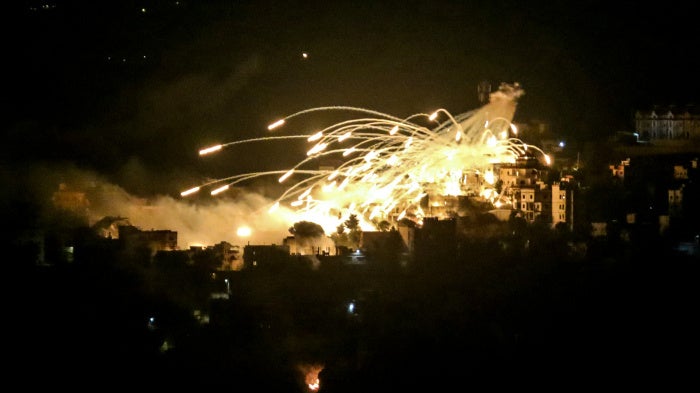
The 45-page report, “Uncontrolled Burn: The Inhumane Effects of White Phosphorus Munitions and the Need for Stronger Law,” documents 23 verified incidents of Israeli use in southern Lebanon between March and May 2026. The report also details the horrific harm the munitions have caused in armed conflicts in recent years. White phosphorus munitions, which produce fire when their payload is exposed to oxygen, are not currently regulated by a specific treaty.
Eastern Slavonia, the only remaining Serb-held region of Croatia, was scheduled to revert to Croatian control by July 15, 1997. Some 120,000 to 150,000 Serbs who lived in that region will come under the authority of their bitter opponent during the war. While the transition of authority in Eastern Slavonia was designed to be carried out peacefully under the auspices of a U.N.
The level of racist incidents reported to the police in the U.K. has increased dramatically over recent years. Between 1989 and 1996 the number rose more than 275 percent, from 4,383 to 12,199.
Eastern Slavonia, the only remaining Serb-held region of Croatia, is scheduled to revert to Croatian control by July 15, 1997. Some 120,000 to 150,000 Serbs living in that region will then come under the authority of their bitter opponent during the war.
Lebanon's airwaves had long been unregulated, with scores of unlicensed private broadcasters that ranged in political diversity from the radio station of the Lebanese Communist Party to the television station of Hizballah. The broadcasting community included 52 television stations and over 120 radio stations for a population of three million.
Nearly seven years ago, on April 24, 1990, President Mobutu Sese Seko ostensibly gave in to mounting pro-democracy pressure by announcing the end of the one party state and the beginning of transition to multiparty democracy in Zaire. Seven years into the transition, there have been at least ten different governments but no transition.
Unaccompanied Children Detained by the U.S. Immigration and Naturalization Service
The U.S. Immigration and Naturalization Service (INS) violates the rights of hundreds of unaccompanied children each year, some as young as eight, contrary to international law as well as INS regulations. Children are arrested, imprisoned, and deported, all by the same agency charged with protecting their rights.
In this document, Human Rights Watch seeks to raise concerns about some disturbing trends in the protection of refugees it has observed in the course of researching human rights abuses.
This report documents a pattern of torture—according to internationally recognized definitions of the term—and mistreatment of security detainees by the Anti-Terror Branch (Teror 'le Mucadele Subesi) of the Security Directorate of Turkey’s Ministry of the Interior.
Disproportionate Sentences for New York Drug Offenders
In the past decade, the U.S. Congress and many state legislatures have established harsh criminal penalties for a wide range of drug offenses, often using the vehicle of mandatory minimum prison sentences. As a consequence, drug offenders in the United States face sentences that are uniquely severe among constitutional democracies.
A two-person Human Rights Watch delegation traveled to Guatemala in January 1997. The visit focused on reports of the discriminatory treatment of trade unionists at the assembly plants there of the U.S.-based corporation Phillips-Van Heusen (PVH), and allegations of obstacles posed by the company and the Guatemalan labor ministry to the union’s recognition for purposes of collective bargaining.
A two-person Human Rights Watch delegation traveled to Guatemala in January 1997. The visit focused on reports of the discriminatory treatment of trade unionists at the assembly plants there of the U.S.-based corporation Phillips-Van Heusen (PVH), and allegations of obstacles posed by the company and the Guatemalan labor ministry to the union's recognition for purposes of collective bargaining.
Human Rights Watch has uncovered evidence that the Yugoslav National Army (JNA) had an extensive and sophisticated chemical weapons program prior to the breakup of Yugoslavia in 1991; that the army of the Federal Republic of Yugoslavia (Serbia and Montenegro) inherited much of this program; and that the army of the Republic of Bosnia and Hercegovina produced crude chemical munitions during the Bos