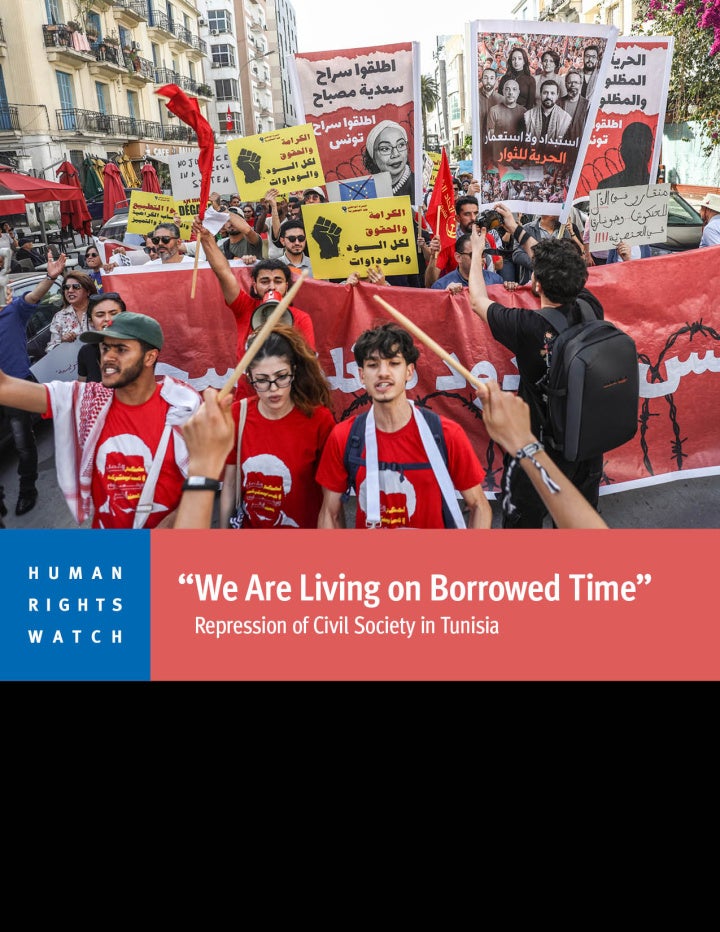
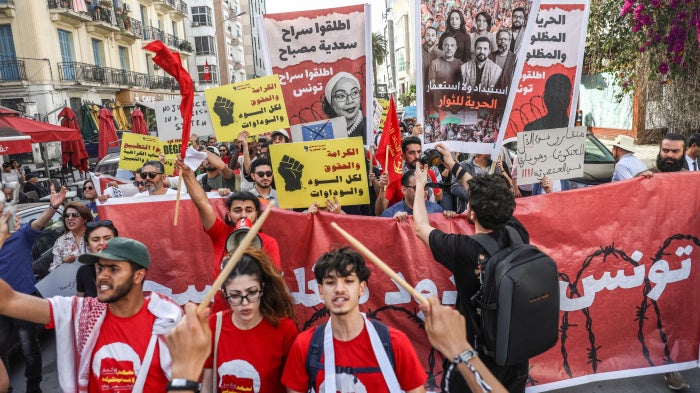
The 49-page report, “‘We Are Living on Borrowed Time’: Repression of Civil Society in Tunisia” documents the Tunisian authorities’ escalating repression of local and international civil society groups, workers, members, and affiliates through the weaponization of abusive prosecutions, arbitrary arrests, detention, financial and criminal investigations, mass suspensions, and threats of dissolution.
On July 15 and 16, 1998 Israel presented its initial report to the United Nations Human Rights Committee, the U.N. body of independent experts responsible for monitoring implementation of the International Covenant on Civil and Political Rights (ICCPR) and its two Optional Protocols.
Arms Transfers to all Sides in the Civil War in Sudan
More than one million people may have died, with millions more forcibly displaced, since today's ongoing civil war broke out in Sudan in 1983. This conflict is spreading to other regions of the country and is linked to guerrilla wars in neighboring Eritrea, Ethiopia, and Uganda.
Ethnic discrimination in the Russian Federation has persisted and perhaps even worsened since the break-up of the Soviet Union. The government has failed to combat discrimination and is in many ways responsible for perpetuating discriminatory practices.
On July 20-21, 1998, an Algerian government delegation met with the United Nations Human Rights Committee to discuss Algeria's second periodic report regarding its implementation of the International Covenant on Civil and Political Rights (ICCPR).
A nationwide student protest movement played an instrumental role in forcing the resignation of President Soeharto on May 21, 1998 and in opening the door to democratic reform in Indonesia.
In a report released today, Human Rights Watch condemns the war of terror now underway against civilians in Sierra Leone, and calls on the international community to take emergency measures to end the killings, amputations, and abductions taking place in that civil war.
Human Rights Watch background Paper On The 1998 Famine In Bahr El Ghazal
Massive human rights abuses by muraheleen raiders in exactly the same locations were primary causes of the 1988 famine, in which an estimated 250,000 (mostly Dinka) perished.
The Foca municipality was the site of some of the most brutal crimes committed during the 1992-1995 war in Bosnia and Hercegovina. Bosnian Serb civilian, police, and military officials established a wartime government called the "Crisis Committee," much like those established in many towns in Bosnian Serb-controlled territory, to plan and carry out the expulsion of the non-Serb population.
President Aleksandr Lukashenka continues to steer Belarus back toward Soviet-era repression by leading a government that is engaged in violations of a broad spectrum of basic civil and political rights. His four years in office have witnessed the reversal of modest improvements in respect for human rights that followed the perestroika period and the break-up of the Soviet Union.
Police Brutality and Accountability in the United States
Police brutality is one of the most serious, enduring and divisive human rights violations in the United States. Unjustified shootings by police, severe beatings, fatal chokings, and unnecessarily rough treatment of detainees occur in cities throughout the country.
Politics & the Policing Agenda of the UN International Police Task Force
The United Nations mission to Bosnia and Hercegovina-with over 2,000 international police monitors-has the opportunity to make an important contribution to lasting peace and respect for human rights in the country. The U.N.
The present political environment in Cambodia, in which opposition parties are not able to operate freely and safely, is in no way conducive to the holding of free, fair, and credible elections. The primary obstacle is neither logistical nor technical, but rather the determination of the ruling Cambodian People's Party (CPP) to control the electoral process and restrict basic freedoms.
The pattern of systematic human rights violations that characterized former President Suharto's thirty-two year rule is perhaps best symbolized by the people he imprisoned for political activities.
Political tensions began to rise in Zambia soon after the conclusion of the June 1997 Consultative Group (CG) meeting on Zambia. Two weeks after the meeting closed, the opposition United National Independence Party (UNIP) found its Lusaka headquarters besieged by police and filled with tear gas.
Since gaining independence from the Soviet Union in 1991, the Republic of Uzbekistan has made little progress in moving away from Soviet-style repression of human rights.