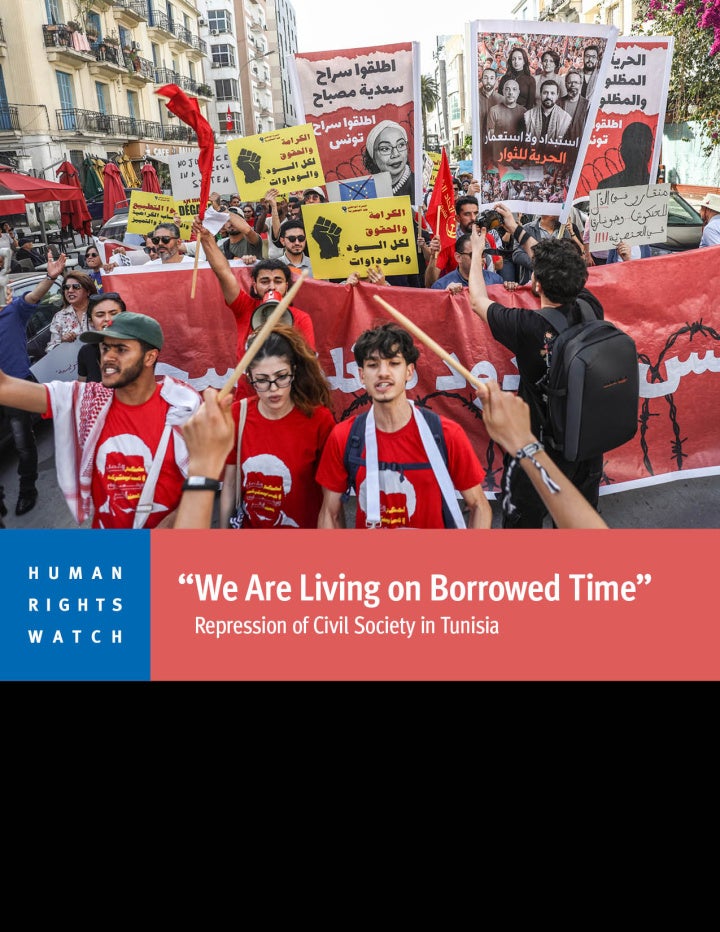
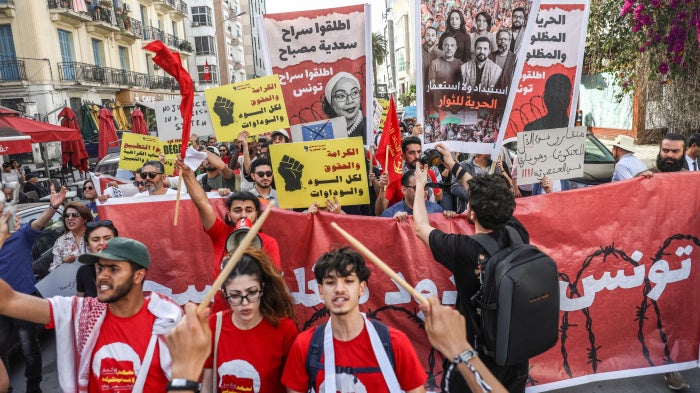
The 49-page report, “‘We Are Living on Borrowed Time’: Repression of Civil Society in Tunisia” documents the Tunisian authorities’ escalating repression of local and international civil society groups, workers, members, and affiliates through the weaponization of abusive prosecutions, arbitrary arrests, detention, financial and criminal investigations, mass suspensions, and threats of dissolution.
The Chinese government's refusal to allow independent trade unions is fueling worker protests, Human Rights Watch said in this new report.The 50-page report, "Paying the Price: Worker Unrest in Northeast China," analyzes in detail the demonstrations that took place from March through May 2002 in three cities in northeastern China, and the government response to them.
After one year in office, President Megawati's administration has restored a degree of political stability in Indonesia. But her efforts to secure support and stability have led to a retrenchment of many of the old interests of the Soeharto regime that ruled for three decades, most notably the military.
During much of 2001, there was increased tension between Buddhist and Muslim communities in Burma, at times erupting into violence. News of the violence was quickly suppressed, however, and little detailed information about what took place reached the outside world.
A Human Rights Watch Briefing Paper on Sierra Leone
After ten years of brutal civil war, the people of Sierra Leone went to the polls on May 14 and re-elected President Ahmed Tejan Kabbah and his Sierra Leone People’s Party for a further five-year term.
Police Harassment Of HIV/AIDS Outreach Workers In India
Widespread police abuse of front-line AIDS prevention workers in India is undermining efforts to contain one of the worst epidemics in the world, Human Rights Watch said today.Several organizations in India have succeeded in empowering women in prostitution to demand condom use of their clients.
The Arbitrary Application of Spanish Immigration Law
The Human Rights Watch report, "Discretion Without Bounds: The Arbitrary Implementation of Spanish Immigration Law," criticizes the Spanish authorities' uncoordinated and ad hoc application of Spanish Law 8/2000.
Former President Jimmy Carter will travel to Venezuela on July 6, 2002, to mediate talks between the government and the country's political opposition. President Carter has an invaluable opportunity to help overcome the political impasse that has existed since the failed coup of April 12, 2002.
In the next few weeks, the Bulgarian parliament is due to enact important changes to the country's arms trade law. The legislation would amend the Law on the Control of Foreign Trade Activity in Arms and Dual-Use Goods and Technologies, which was adopted in 1995.
The Sri Lankan government and the Liberation Tigers of Tamil Eelam are preparing for negotiations aimed at resolving more than two decades of conflict over political control of the island's Tamil-dominated north and east. Talks are to be held in Thailand, possibly as early as July.
Police Harassment of HIV/AIDS Outreach Workers in India
Women in prostitution in India are treated with disdain and commonly subjected to violations of their fundamental rights by the police, both at the time of their arrest and while in detention. Peer educators providing HIV/AIDS outreach to these women frequently suffer many of the same abuses.
Women's rights activists throughout the world - of every political stripe, faith, sexual orientation, nationality, and ethnicity - mobilized at each step of the International Criminal Court (ICC) process. They have worked to create an independent court to afford women greater protection from violations of human rights and humanitarian law.
Eight months after the collapse of the Taliban, northern Afghanistan remains on a dangerous precipice. Factional rivalries periodically erupt into open hostilities, jeopardizing civilian security, aid delivery, and the resettlement of displaced communities.