The Persecution of Environmentalists and Indigenous Leaders in Indonesia
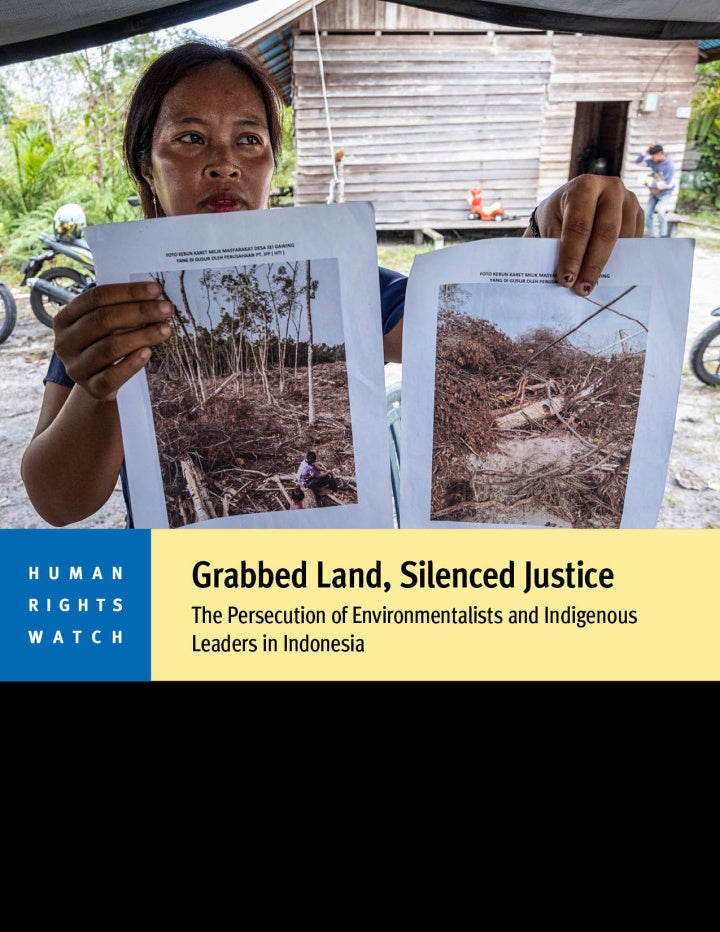
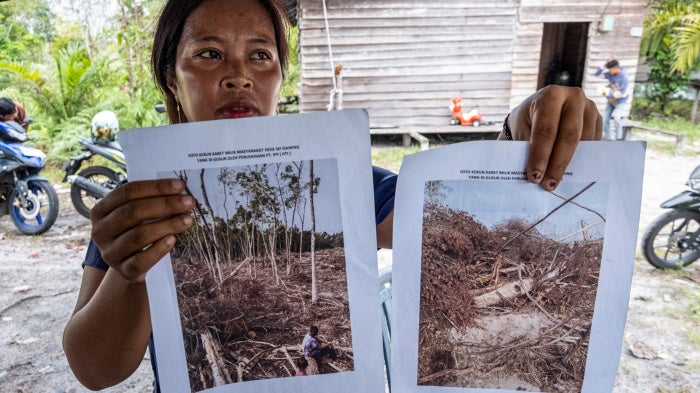
The 70-page report, “Grabbed Land, Silenced Justice: The Persecution of Environmentalists and Indigenous Leaders in Indonesia,” documents how Indonesian police have responded to complaints filed by company officials or politicians by silencing Indigenous villagers who demand their customary land rights and the activists who defend them. The authorities have targeted environmental and Indigenous community defenders using the criminal code and other laws to bring charges ranging from defamation to “spreading communism” to silence protest over environmental harm.
In this thirty-five page report released today, Human Rights Watch called on China's President Jiang Zemin to release more than thirty people imprisoned for their role in the China Democracy Party and all others who have been detained in China for peaceful political activities. The Chinese President will be in the U.S. on September 7 to meet world leaders at the opening of the U.N.
After fleeing systematic discrimination, forced labor, and other abuses in Burma, ethnic Rohingya in Malaysia face a whole new set of abuses in Malaysia. These include beatings, extortion, and arbitrary detention. The refugees are forced to live in poverty and constant fear of expulsion from the country.
Workers' basic rights are routinely violated in the United States because U.S. labor law is so feebly enforced and so filled with loopholes, Human Rights Watch said in this report. Human Rights Watch examined workers' rights to organize, to bargain collectively, and to strike under international norms. It found widespread labor rights violations across regions, industries and employment status.
Human Rights Watch welcomes Kuwait's submission of its first periodic report on implementation of the International Covenant on Civil and Political Rights (ICCPR) but wishes to draw to the attention of the Human Rights Committee certain deficiencies relating to the report and to Kuwait's application of the Covenant.
Human Rights Watch urged President Clinton to keep the promise he made in 1994 to ban antipersonnel landmines by joining the 1997 Mine Ban Treaty.
"Clinton's Landmine Legacy," the 42-page report from Human Rights Watch, details U.S. policy and practice on antipersonnel mines and recommends a dozen steps the president should take before leaving office.
Although the government of Burundi has promised Nelson Mandela that it will close its squalid "regroupment" camps, that promise has not yet been fulfilled, Human Rights Watch charged in this report. The former South African president is leading a new round of the Burundi peace talks, opening tomorrow.
United States Failure to Protect Child Farmworkers
Agricultural work is the most hazardous and grueling area of employment open to children in the United States.3 It is also the least protected. Hundreds of thousands of children and teens labor each year in fields, orchards, and packing sheds across the United States. They pick lettuce and cantaloupe, weed cotton fields, and bag produce.
International humanitarian law categorically prohibits hostage-taking. On April 12, 2000 Israel's highest court ruled that the administrative detention of Lebanese nationals as "bargaining chips" -- hostages -- was illegal under Israeli domestic law, making Israel's continued detention of Lebanese nationals as hostages a violation of Israeli domestic law as well.
On February 5, 2000, Russian forces engaged in widespread killing, arson, rape and looting in Aldi. The victims included an eighty-two-year-old woman, and a one-year-old-boy with his twenty-nine-year-old mother, who was eight months pregnant.
During May 2000, the Serbian government intensified its efforts to silence opposition to the government of Yugoslav President Slobodan Milosevic. The government has intensified efforts to prevent or break up peaceful assemblies by the opposition, sometimes using brutal means.
Prisoners cannot simply be left to languish for weeks, possibly months, locked up in their cells, and this regardless of how good material conditions might be within the cells. European Committee for the Prevention of Torture, 2nd General Report on the Committee for the Prevention of Torture's activities covering the period January 1 to December 31, 1991.
The current crisis in Sierra Leone, in which rebels with the Revolutionary United Front (RUF) have clashed with U.N. peacekeepers and pro-government forces, suggests that the fragile peace agreed to in July 1999 is rapidly unraveling.
The U.S. war on drugs has been waged overwhelmingly against black Americans, Human Rights Watchcharged in a new report released today. In ten states, black men are sent to prison on drug charges at 27 to 57 times the rate of white men.
The Rwandan army and its Congolese allies have massacred and raped civilians in eastern Congo, Human Rights Watch said in a report released today. Their opponents, Hutu and Mai Mai armed groups, are also committing atrocities against the civilian population.The RCD launched a rebellion against the government headed by Laurent Kabila in August 1998.