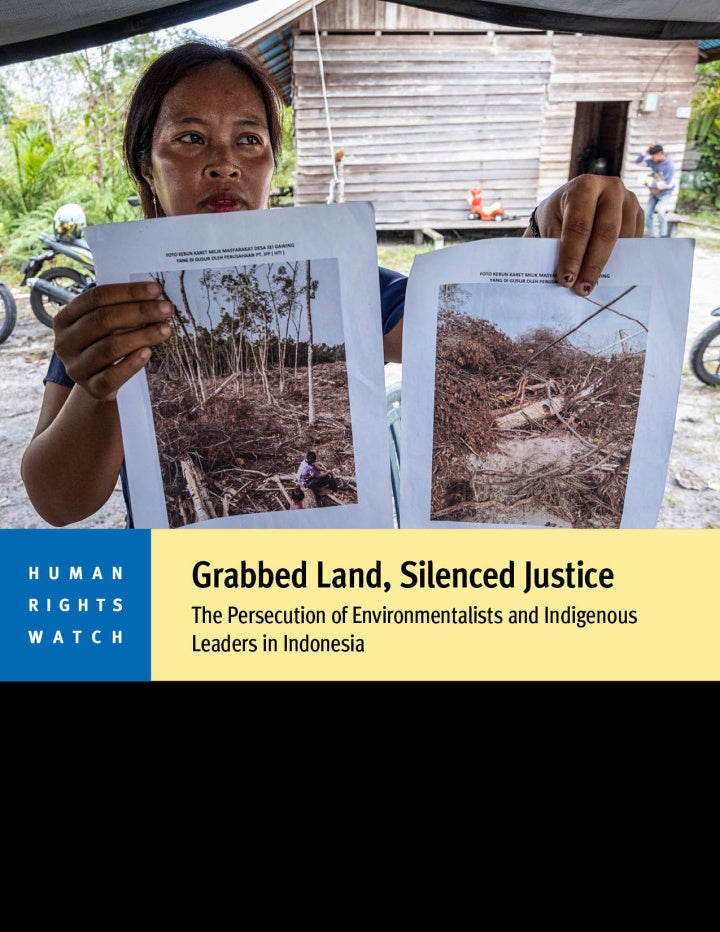
The Persecution of Environmentalists and Indigenous Leaders in Indonesia
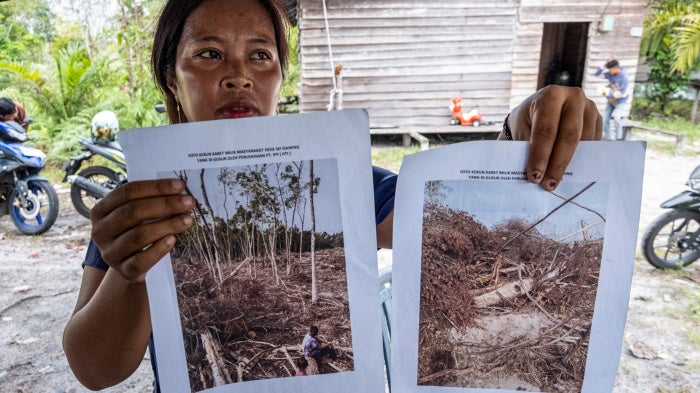
The 70-page report, “Grabbed Land, Silenced Justice: The Persecution of Environmentalists and Indigenous Leaders in Indonesia,” documents how Indonesian police have responded to complaints filed by company officials or politicians by silencing Indigenous villagers who demand their customary land rights and the activists who defend them. The authorities have targeted environmental and Indigenous community defenders using the criminal code and other laws to bring charges ranging from defamation to “spreading communism” to silence protest over environmental harm.
Why the International Community Should Reject Australia's Refugee Policies
The government of Australia has taken increasingly aggressive measures in recent years to prevent unauthorized asylum seekers from reaching its shores. One year ago, on September 26, 2001, it enacted new legislation that extended the legal basis for its policies, which are among the most restrictive in the developed world.
Akaev won the presidency of independent Kyrgyzstan in 1991 and consolidated power through a presidential referendum in 1994. Akaev was re-elected to his second term of office in 1995. Despite a constitutional provision limiting the head of state to two terms in office, Akaev ran for president again in 2000.
For much of the 1990's Kyrgyzstan was described as an "island of democracy" in a region with corrupt and repressive political leaders. But after the country's first decade of independence following the breakup of the Soviet Union, its government, under President Askar Akaev, appeared to tighten its grip on power at the expense of fundamental rights.
HIV/AIDS, Human Rights And Federally Funded Abstinence-Only Programs In The United States
Programs teaching teenagers to "just say no" to sex before marriage are threatening adolescent health by censoring basic information about how to prevent HIV/AIDS, Human Rights Watch charged in a new report released today.
Human Rights Watch recently returned from a research and advocacy mission to Guatemala. During the mission, Human Rights Watch representatives met with President Alfonso Portillo, government ministers, and human rights defenders, among others.
The Response of Rwandan-backed Rebels to the May 2002 Mutiny
In mid-May of 2002, soldiers and police officers in Kisangani, the third largest city in the Democratic Republic of Congo (DRC), mutinied against their commanding officers and the local authorities of the Congolese Rally for Democracy, Goma faction (RCD).1 The RCD depends on the military and political support of neighboring Rwanda to exercise control over some thirty to forty percent of eastern Co
For years the government of Uzbekistan has violated the right to freedom of conscience by imprisoning and persecuting independent Muslims—Muslims whose peaceful practice of their faith falls beyond government controls.
Commentary regarding the European Commission Green Paper on a Community Return Policy on Illegal Residents
This briefing paper constitutes Human Rights Watch’s commentary on the Commission Green Paper. Drawing on research on the current treatment of migrants in several E.U. member states, the commentary identifies some of the key human rights standards that should be at the core of any Community return policy.
Human Rights Abuses Of Post-September 11 Detainees
On September 11, 2001, hijackers turned four airplanes into instruments of terror. Their horrific crime left some 3,000 dead, devastated the lives of many thousands more, destroyed the World Trade Center, and created a sense of urgency about protecting the United States from future terrorists attacks. September 11 was not just an assault, however, on lives and buildings.
Political Psychiatry in China Today and its Origins in the Mao Era
The Chinese government should immediately release anyone held in institutions for the mentally ill based on a politically motivated diagnosis, Human Rights Watch and the Geneva Initiative on Psychiatry said in this report. The government should also end the longstanding practice of using psychiatric incarceration for political ends.
The Chinese government's refusal to allow independent trade unions is fueling worker protests, Human Rights Watch said in this new report.The 50-page report, "Paying the Price: Worker Unrest in Northeast China," analyzes in detail the demonstrations that took place from March through May 2002 in three cities in northeastern China, and the government response to them.
After one year in office, President Megawati's administration has restored a degree of political stability in Indonesia. But her efforts to secure support and stability have led to a retrenchment of many of the old interests of the Soeharto regime that ruled for three decades, most notably the military.
During much of 2001, there was increased tension between Buddhist and Muslim communities in Burma, at times erupting into violence. News of the violence was quickly suppressed, however, and little detailed information about what took place reached the outside world.
A Human Rights Watch Briefing Paper on Sierra Leone
After ten years of brutal civil war, the people of Sierra Leone went to the polls on May 14 and re-elected President Ahmed Tejan Kabbah and his Sierra Leone People’s Party for a further five-year term.