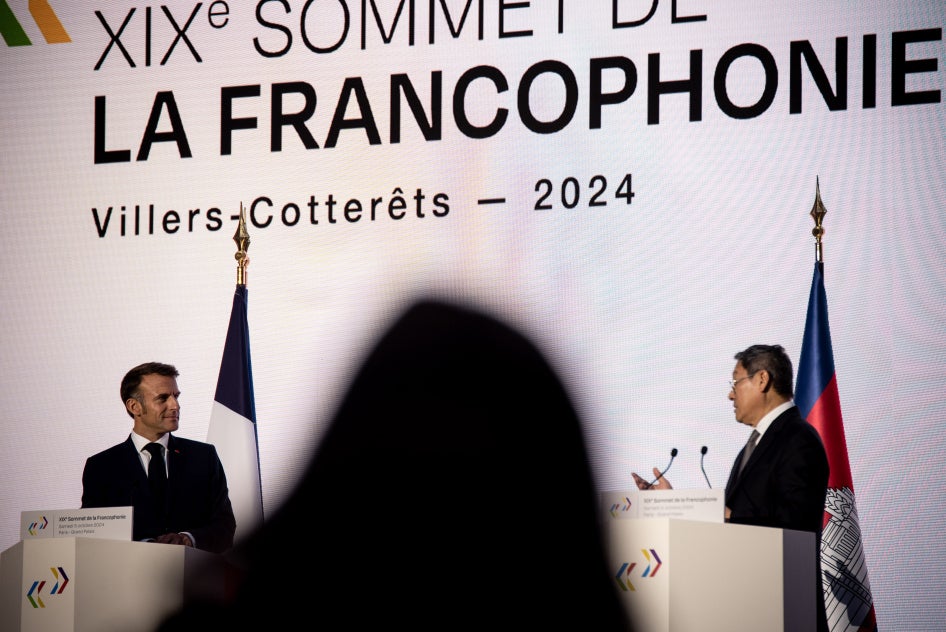
A summit devoted to peace and shared prosperity in Southeast Asia should not ignore escalating abuses targeting political activists and dissidents across international borders. When leaders of Francophonie countries gather in Phnom Penh on November 15 and 16, French President Emmanuel Macron should press the governments of Cambodia, Vietnam, Laos, and Thailand to end transnational repression.
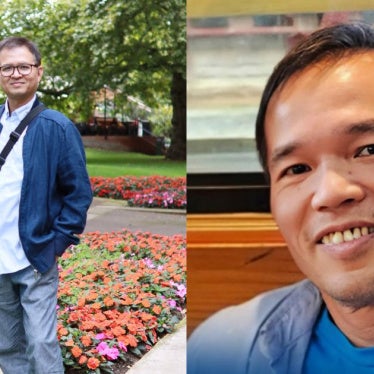
It is an urgent issue. In September, three men disappeared in Cambodia: a Norwegian citizen, Nguyen Duc Thuan; an Australian citizen, Tran Hiep; and a Vietnamese national, Thai Cong Truong Son. All are members of Viet Tan, a political organization that advocates for democratic change in Vietnam and operates lawfully in many countries, although Hanoi has outlawed it.
Ten days after the men vanished, Vietnamese police announced that the three were in custody, charged with terrorism over their association with Viet Tan and document forgery. Police claimed that they had entered Vietnam using false papers. The men’s relatives are adamant they did not enter Vietnam and Viet Tan says they were abducted in Cambodia. Cambodian authorities have yet to provide a credible account of what happened on their territory.
The case is not isolated. In January 2025, a gunman shot dead Lim Kimya, a former Cambodian opposition lawmaker and French citizen, on a Bangkok street in front of his wife, shortly after he had arrived by bus from Cambodia. A Thai court convicted the gunman and issued arrest warrants for two Cambodian suspects, one of them an adviser to Hun Sen, Cambodia’s former prime minister and current Senate president. Both suspects remain at large. Cambodia has not meaningfully investigated the allegations surrounding the two suspects.
Cambodian dissidents in neighboring countries have also faced intimidation and violence. In 2023, several Khmer-speaking men attacked an opposition activist, Phorn Phanna, in Rayong, Thailand, until bystanders intervened. In the preceding months, Cambodian officials had repeatedly urged him to return home and defect from the political opposition, offering him senior government positions and money. He refused, and anonymous online threats escalated in the week before the assault.
This September, a Lao activist and asylum seeker in Thailand, Khieo Lapchanh, disappeared in Samut Sakhon province following his shift at the restaurant where he worked and a day before his interview with the United Nations refugee agency. Thai authorities have yet to provide any information regarding his whereabouts.
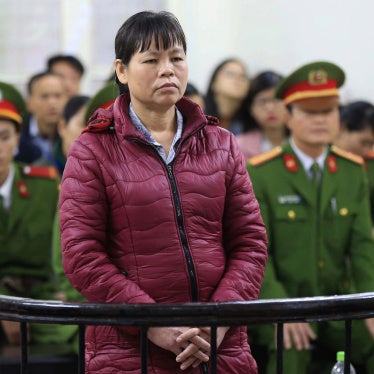
At times, Thai authorities have done more than fail to protect exiled dissidents: they have returned them to danger. In September 2026, a Cambodian court sentenced three activists to seven years in prison on baseless charges. Thai authorities had summarily deported two of the activists from Thailand in November 2024, even though the UN refugee agency had recognized them as refugees.
This pattern of selective enforcement extends beyond political dissent. Cambodia’s government has been implicated in enabling the growth of cyber-scam compounds, where trafficking victims are forced to scam people abroad. Recent raids have disrupted some criminal networks. Yet ruling Cambodian People’s Party (CPP) senators facing internationalsanctions over alleged links to these operations have impunity at home. The contrast is revealing: the authorities can somehow reach across borders to exert control over their critics but are reluctant to pursue well-connected figures within their borders.
The Francophonie summit should be more than just a celebration of the French language and shared cultural ties. Cambodia chose the language of “peace” and “shared prosperity” for the meeting. Those principles ring hollow if participating governments remain silent when states pursue peaceful critics across borders, cooperate in unlawful returns, or shield politically connected criminal networks.
President Macron should use the meetings in Phnom Penh to press his counterparts on the escalating transnational repression. Cambodia should release its investigation into the enforced disappearance of the three alleged Viet Tan members; Vietnam should release them and drop all charges. Cambodian authorities should arrest the two suspects wanted by Thailand in connection with Lim Kimya’s killing and, in accordance with due process, extradite them. And Cambodia should pursue scam-compound operators and their protectors, regardless of their political connections.
The French government should urge Thailand, Vietnam, Cambodia, and Laos to end cross-border deals that expose refugees and dissidents to detention, disappearance, or death. Quiet diplomacy has not stopped these abuses – if anything, it has emboldened abusers. A public, principled intervention at the summit would signal that the Francophone community’s stated values apply not only in speeches and slogans, but also to people whose safety depends on them.