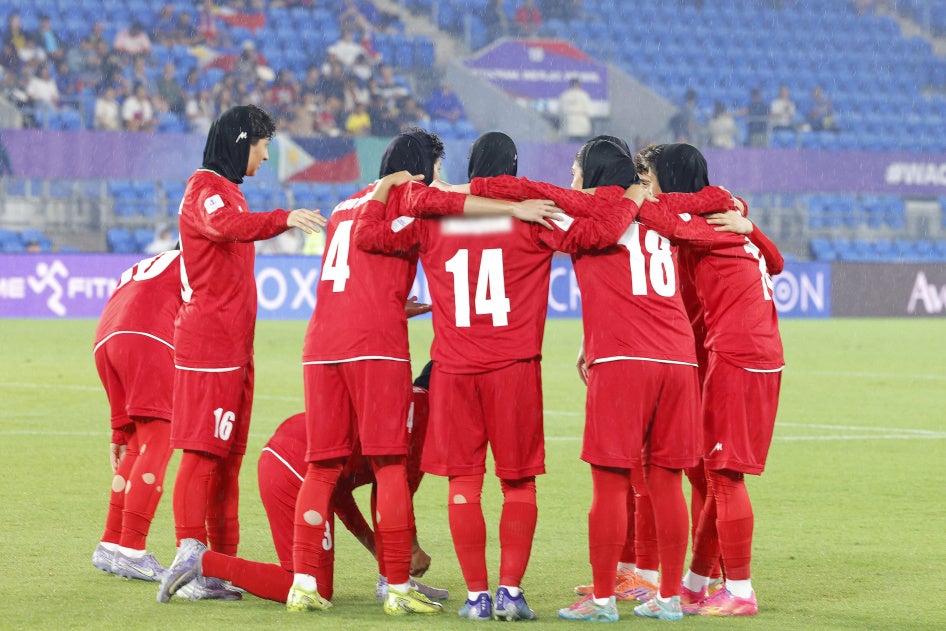
The Australian government’s decision to grant asylum to five members of the Iranian women’s national football team and one official shows the importance of protecting courageous athletes who stand up for what they believe.
The six Iranians sought protection in Australia after their final match of the Asian Women's Cup on March 8. In their opening match against South Korea on March 2, the players had, in protest, refrained from singing the national anthem of the Islamic Republic, prompting Iran’s state television to call the squad “wartime traitors.”
The women’s team’s silent protest echoed that of the Iranian men's team at the 2022 Qatar World Cup, following Iranian authorities’ repression of the “Woman, Life, Freedom” uprising after the death in custody of Jina Mahsa Amini. Australia has in the past offered a safe haven to members of Afghanistan’s women’s national football team after the Taliban banned all sport for women and girls.
Since arriving in Australia, days before the conflict in Iran started on February 28 and the Iranian authorities’ ongoing internet shutdown, players on the team have reported being followed by Iranian security and handlers. Iranian athletes have previously told Human Rights Watch how government political “minders” travel with the national team to monitor them.
FIFPRO, the global players’ union, has said the Asian Football Confederation (AFC) and the Fédération Internationale de Football Association (FIFA) should have foreseen the risk and have done too little to protect the players. By permitting political officials who restrict women’s rights to travel with delegations, the AFC and FIFA do not merely tolerate abuse, they provide it a platform beyond its country of origin.
The implications extend beyond Australia. The 2026 FIFA Men’s World Cup, to be held in the United States, Canada, and Mexico, comes amid a rights crisis in the US that includes a widespread immigration crackdown, threats to freedom of expression, and a wider slide towards authoritarianism.
Before the World Cup begins in June, FIFA needs to put in place safeguarding protocols including a grievance mechanism, confidential referral pathways, and prohibitions on political minders in football federations who actually restrict the rights of the athletes they are accompanying. This will protect athletes who choose to exercise their right to protest human rights abuses.