Human Rights Watch (HRW) welcomes the opportunity to contribute to the thematic report of the Independent Expert on protection against violence and discrimination based on sexual orientation and gender identity on violence and discrimination experienced by lesbian, bisexual, and queer (LBQ) women. This submission draws on Human Rights Watch’s global research documenting human rights violations against LBQ women and non-binary people across diverse legal, cultural, and political contexts.
This submission focuses on two interrelated human rights concerns 1) the right to freedom from violence and discrimination on the basis of sexual orientation and gender identity; and 2) the right to health.
Violence and Discrimination Against LBQ Women
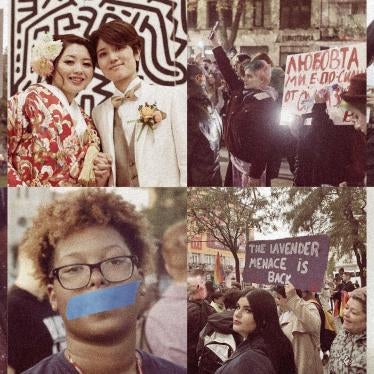
In February 2023, Human Rights Watch published a global report based on more than 60 interviews across 26 countries documenting the distinct and intersecting forms of violence and discrimination experienced by LBQ women and non-binary people.1 The research found that abuses against LBQ women are frequently rooted in gender-based violence and compounded by discrimination based on sexual orientation and gender expression. These harms are often rendered invisible in legal and policy frameworks that fail to account for the unique vulnerabilities LBQ people experience.
The report documented systemic denial of rights across key areas essential to living safely and with dignity, including freedom from violence based on gender expression; freedom of movement and the ability to appear in public without fear of harm; and access to justice.
Human Rights Watch documented cases in which LBQ women and couples were murdered, sexually assaulted, or violently attacked because of their real or perceived sexual orientation.2 The risk and incidence of violence against LBQ couples remains chronically under-documented, in part because many women conceal their relationships to avoid harm. In cases Human Rights Watch documented, interviewees consistently describe avoiding public spaces, suppressing physical affection, and restricting their movement to reduce the risk of violence and discrimination.
In Nepal, Human Rights Watch reported on the harassment and forced separation of a lesbian couple in early 2025 when they sought to register their marriage following the Supreme Court’s June 2023 ruling permitting same-sex marriage.3 Officials delayed the registration process, while family members of one partner filed a missing persons report, resulting in police returning her to relatives under circumstances she described as abusive. Both women reported being mocked by police officers and subjected to degrading comments about their relationship. One family member told a partner, “Even if you die or become disabled, I’ll still make you marry a man.” The marriage registration was ultimately accepted following civil society advocacy.4
In St. Vincent and the Grenadines, Human Rights Watch documented LBQ women experiencing sexual violence, sexual harassment, and other abuses linked to their sexual orientation, gender expression, gender, or a combination thereof.5 Interviewees described non-consensual touching by men who explicitly referenced their lesbian
“There is more violence against masculine women because they look like men.”6
In Argentina, three lesbian women were killed and another severely injured in May 2024 after a man threw a Molotov cocktail into their boarding house.7 Local human rights organizations reported that escalating anti-LGBT rhetoric by prominent political figures contributed to a broader climate of hostility. A 2023 report by the Buenos Aires LGBT Ombudsman found that disparaging political speech “built a climate of segregation, rejection, and discrimination; the most fertile ground for violence against historically vulnerable groups.”8 In addition to escalating anti-LGBT rhetoric, gender-based violence is also rising in Argentina, which also affects LBQ women.9
Violations of the Right to Health
LBQ women and non-binary people worldwide face persistent barriers to accessing quality, safe, affordable, and non-discriminatory health care. Human Rights Watch research has documented gaps in access to sexual and reproductive health services; fertility treatment; and gender-affirming care.10
These barriers are driven by discriminatory laws and policies, stigma within health systems, and the absence of legal recognition of same-sex relationships, in violation of states’ obligations under international human rights law to ensure access to health care free from discrimination on the basis of prohibited grounds, including sex and sexual orientation and gender identity.11
Discrimination In and Economic Access Barriers to Fertility Services
Discriminatory laws and private practices, including exclusionary health insurance policies, and prohibitive costs prevent many LBQ women and couples from accessing fertility services such as in vitro fertilization (IVF), egg freezing, and sperm donation.12 These discriminatory and economic barriers to accessing these services interferes with the right to found a family,13 and can violate the right to health, particularly when access to fertility services are conditioned on marital status, sexual orientation, or gender identity.
In Italy, Human Rights Watch documented how restrictions on medically assisted reproduction exclude lesbian couples from fertility treatment,14 forcing many to travel abroad to access care or give birth.15 This imposes significant financial, physical, and emotional burdens and reinforces inequality in access to reproductive health services.
In Japan, Human Rights Watch documented the advancement of policies attempting to limit single women from accessing IVF. Because same-sex marriage is not legally recognized in Japan, lesbian couples face barriers accessing fertility treatment, even though similarly situated heterosexual women may more easily access these services through marriage.16 These policies discriminate on the basis of sexual orientation and marital status and demonstrate how lack of legal recognition of same-sex marriage can directly undermine access to health care.
Barriers to Sexual and Reproductive Health Services
Studies suggest that LBQ women face a higher risk of unintended or unwanted pregnancy than heterosexual women, including due to sexual violence.17 Data from the US National Survey of Family Growth (2017–2019) found that more than 25 percent of bisexual women and more than 20 percent of lesbian women who had been pregnant had obtained an abortion, compared with 15.4 percent of heterosexual women.18 The same study found that bisexual women, and heterosexual women with a history of same-sex partners, were more than twice as likely as exclusively heterosexual women to have ever had an abortion.19
Legal and practical barriers to accessing abortion and family planning services thus have specific negative impacts on LBQ women.
In the United States, Human Rights Watch and If/When/How: Lawyering for Reproductive Justice documented how state laws requiring parental notification or judicial bypass for abortion cause harmful delays and block access to care for young people.20 These laws are particularly harmful for LBQ adolescents, who may face family rejection related to their sexual orientation or gender identity. As one youth advocate explained, LGBTQ youth may feel judged “not for their decisions, but for who they are as a person,” deterring them from seeking a judicial bypass.21
In Romania, Human Rights Watch documented the erosion of access to abortion and family planning services despite abortion being legal up to 14 weeks of pregnancy.22 A growing number of doctors and public hospitals refuse to provide abortion services due to conscientious objection, while authorities have facilitated so-called “crisis pregnancy centers” that have been documented to use deceptive and unethical practices. These developments have occurred alongside renewed state attacks on the rights of LGBT people, creating intersecting barriers to LBQ women.23
Barriers to Gender-Affirming Care
LBQ transgender women and girls face particular barriers to accessing health care. Research indicates that transgender women are more likely to identify as lesbian, bisexual, or queer than cisgender women.24
In the United States, as of 2025, 27 states have enacted bans on gender-affirming care for transgender youth,25 severely restricting access to medically necessary treatment for LBQ transgender girls. Human Rights Watch has documented the profound mental and physical harm these bans inflict on transgender youth, their families, and health care systems, including increased anxiety, depression, and suicidality, provider shortages, and a chilling effect on care.26 In addition to state-level bans, federal actions have sought to curtail access to and funding for gender-affirming care nationwide, further threatening the right to health for LBQ transgender women and girls.27
Recommendations
In light of the findings presented, Human Rights Watch urges the Independent Expert to consider the following recommendations in the preparation of the report:
- States should prevent and address violence and discrimination against LBQ women by ensuring effective investigation into and accountability for such cases, whether perpetrated by private persons including, family members or by state actors.
- States should protect LBQ human rights defenders and improve data collection on violence against LBQ women.
- States should repeal laws that restrict access to fertility services based on marital status and/or sexual orientation and enact comprehensive anti-discrimination protections for LBQ women.
- States should repeal laws which create barriers to accessing reproductive care and take steps to improve sexual health education in line with international guidelines on best practice.
- States should repeal laws which ban or restrict access to gender-affirming care and enact anti-discrimination protections for LBQ transgender women in health care settings.
1 Human Rights Watch, “This is Why We Became Activists”: Violence Against Lesbian, Bisexual, and Queer Women and Non-binary People,” February 14, 2023, https://www.hrw.org/report/2023/02/14/why-we-became-activists/violence-against-lesbian-bisexual-and-queer-women-and-non.
2 Ibid. pp. 120-126.
3 Human Rights Watch, “Nepali Lesbians Harassed While Registering Marriage,” May 13, 2025, https://www.hrw.org/news/2025/05/13/nepali-lesbians-harassed-while-registering-marriage.
4 Himalayan Times, “Nepal, first country in South Asia to recognise a lesbian couple,” February 14, 2024,
https://thehimalayantimes.com/nepal/nepal-first-country-in-south-asia-to-recognise-a-lesbian-couple.
5 Human Rights Watch, “They Can Harass Us Because of the Laws,” Violence and Discrimination Against LGBT People in Saint Vincent and the Grenadines, July 20, 2023, pp. 24-26. https://www.hrw.org/report/2023/07/20/they-can-harass-us-because-laws/violence-and-discrimination-against-lgbt-people.
6 Ibid.
7 Human Rights Watch, “Lesbian Women Set on Fire in Argentina,” May 14, 2024, https://www.hrw.org/news/2024/05/14/lesbian-women-set-fire-argentina.
8 Federación Argentina LGBT, Defensoría LGBT, et. al, “Observatorio de Crimenes de Odio [Lgbt+] Motivados por discriminación por orientación sexual, expresión e identidad de género,” 2023, https://drive.google.com/file/d/1MxCDJPPKscZFjIRkHmOng8VYotsUvt--/view .
9 Human Rights Watch, “Women in Argentina Face Rising Violence,” December 1, 2025, https://www.hrw.org/news/2025/12/01/women-in-argentina-face-rising-violence.
10 Human Rights Watch, “This is Why We Became Activists”: Violence Against Lesbian, Bisexual, and Queer Women and Non-binary People,” February 14, 2023, pp. 134-138, 152-166.
https://www.hrw.org/report/2023/02/14/why-we-became-activists/violence-against-lesbian-bisexual-and-queer-women-and-non.
11 International Covenant on Economic, Social and Cultural Rights (ICESCR), adopted December 16, 1966, G.A. Res. 2200A (XXI), 21 U.N. GAOR Supp. (No. 16) at 49, U.N. Doc. A/6316 (1966), 993 U.N.T.S. 3, entered into force January 3, 1976; UN Committee on Economic, Social and Cultural Rights, General Comment No. 20: Non-Discrimination in Economic, Social and Cultural Rights, U.N. Doc. E/C.12/GC/20, July 2, 2009, para. 32.
12 Human Rights Watch, “This is Why We Became Activists”: Violence Against Lesbian, Bisexual, and Queer Women and Non-binary People,” February 14, 2023, pp. 134-138.
13The Yogyakarta Principles +10, November 10, 2017, principle 24(a) https://yogyakartaprinciples.org/principle-24/.
14 Fertility Clinics Abroad, “IVF Italy,” https://www.fertilityclinicsabroad.com/ivf-abroad/ivf-italy/#:~:text=IVF%20laws%20in%20Italy&text=Preimplantation%20Genetic%20Diagnosis%20(PGD)%20is,allowed%20only%20for%20medical%20reasons.
15 Human Rights Watch, “Italy’s Mounting Attack on Lesbian Parents,” July 24, 2023, https://www.hrw.org/news/2023/07/24/italys-mounting-attack-lesbian-parents.
16 Human Rights Watch, “Proposed Japanese Fertility Law Discriminates Against Lesbians, Single Women,” December 6, 2022, https://www.hrw.org/news/2022/12/06/proposed-japanese-fertility-law-discriminates-against-lesbians-single-women.
17 Everett BG, McCabe KF, Hughes TL. Sexual Orientation Disparities in Mistimed and Unwanted Pregnancy Among Adult Women. Perspect Sex Reprod Health. 2017;49(3):157-165. doi:10.1363/psrh.12032; Charlton, Brittany M., et al. “Sexual orientation differences in pregnancy and abortion across the lifecourse.” Women’s Health Issues, vol. 30, no. 2, Mar. 2020, pp. 65–72, https://doi.org/10.1016/j.whi.2019.10.007.
18 2017-2019 NSFG: Public-Use Data Files, Codebooks, and Documentation. National Center for Health Statistics, CDC, U.S. Department of Health & Human Services. Available at: https://www.cdc.gov/nchs/nsfg/nsfg_2017_2019_puf.htm.
19 Ibid. See also: Human Rights Campaign, “Human Rights Campaign Fact Sheet: Lesbian, Bisexual, Queer Women Who Have Been Pregnant Are More Likely to Need Abortion Services; Demonstrates Impact Roe Reversal Would Have on LGBTQ+ People,” June 2, 2022, https://www.hrc.org/press-releases/human-rights-campaign-fact-sheet-lesbian-bisexual-queer-women-who-havebeen-pregnant-are-more-likely-to-need-abortion-services-demonstrates-impact-roe-reversal-would-have-on-lgbtq-people.
20 Human Rights Watch, “Whose Abortion Is It? The Harms of State-Mandated Parental Notification for Abortion and Judicial Bypass in the United States,” October 29, 2025, https://www.hrw.org/report/2025/10/29/whose-abortion-is-it/the-harms-of-state-mandated-parental-notification-for.
21 Ibid., pp. 74.
22 Human Rights Watch, “‘It’s Happening Even Without You Noticing’ Increasing Barriers to Access Sexual and Reproductive Health Care in Romania,” April 7, 2025, https://www.hrw.org/report/2025/04/07/its-happening-even-without-you-noticing/increasing-barriers-accessing-sexual-and.
23 Ibid., pp. 27.
24 Pew Research Center, “The Experiences of LGBTQ Americans Today,” May 29, 2025, pp. 33, https://www.pewresearch.org/wp-content/uploads/sites/20/2025/05/ST_2025.5.29_LGBTQ-experiences_report.pdf.
25 Movement Advancement Project, “Bans on Best Practice Medical Care for Transgender Youth,” https://www.lgbtmap.org/equality-maps/healthcare/youth_medical_care_bans.
26 Human Rights Watch, “‘They’re Ruining People’s Lives’ Bans on Gender-Affirming Care for Transgender Youth,” June 3, 2025, https://www.hrw.org/report/2025/06/03/theyre-ruining-peoples-lives/bans-on-gender-affirming-care-for-transgender-youth.
27 Human Rights Watch, “Trump Moves to Restrict Gender-Affirming Care to Federal Workers, Families,” September 9, 2025, https://www.hrw.org/news/2025/09/09/trump-moves-to-restrict-gender-affirming-care-to-federal-workers-families.