
The killing of Renee Nicole Good in Minneapolis by Immigration and Customs Enforcement (ICE) agents (News, Viewpoint 16 January) offers a stark warning to the UK Government of the danger in treating civic action as a security threat and a public-order problem rather than as a fundamental right and cornerstone of a free and functioning democracy.
The British Government likes to model itself as a country in which free speech, protest, and civic engagement are protected as core rights. The reality looks increasingly different. In the UK, as in the United States, democratic participation is becoming a progressively riskier exercise.
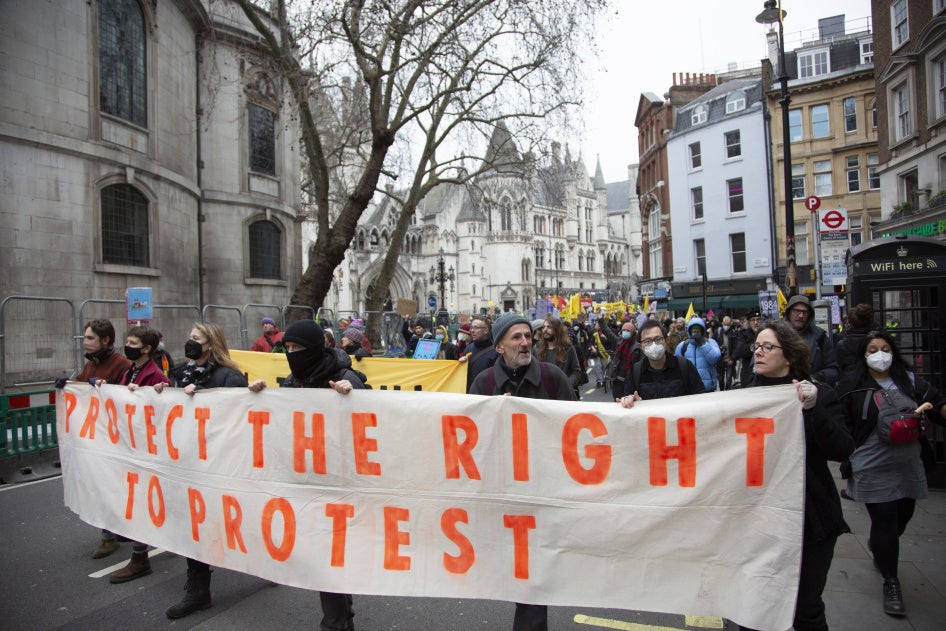
Human Rights Watch’s new report, Silencing the Streets, documents how protest rights in the UK are being steadily undermined — not through a single dramatic rupture, but through a series of incremental changes that collectively make it far easier to police and punish protests, and far harder for people to exercise their right to peaceful assembly.
During recent years, laws such as the Police, Crime, Sentencing and Courts Act 2022 and the Public Order Act 2023 have handed the police sweeping powers to restrict demonstrations that are deemed too noisy or disruptive, on the basis of deliberately vague and broad definitions. Peaceful tactics, such as slow marching and carrying protest materials, have been reclassified as criminal offences. Arrests for non-violent actions are increasingly common.
Even places of worship, including churches, which have traditionally offered both moral leadership and practical sanctuary when civic space has narrowed, are treated as a threat.
In a deeply troubling development, a peaceful meeting of youth activists discussing the climate crisis and Palestine at a Quaker meeting house, in London, was shut down, despite Quakers’ longstanding commitment to pacifism and non-violence. More than two dozen Metropolitan Police officers, some armed with stun guns, reportedly smashed down the door of the building and arrested the young women who had gathered.
The Recording Clerk for Quakers in Britain, Paul Parker, said that no one in living memory had been arrested in a Quaker meeting house. The intervention sent a chilling signal: even gatherings in places of worship devoted to peaceful discussion and witness could be treated as suspect.
The targeting of such spaces underscores just how far the reframing of protest as a security threat has gone: no longer confined to streets and public squares, but now extending into places traditionally understood as protected forums for conscience and collective moral expression.
Members of faith communities in Minnesota — from Emmanuel Christian Center to the Metropolitan Community Church and Peace United Church of Christ — have spoken out strongly against the circumstances of Ms Good’s killing, calling for peace, unity, and justice.
In the UK, the proscription of the group Palestine Action as a terrorist organisation marked a further and alarming escalation in the Government’s treatment of protest as a security offence (Comment, 29 August 2025). This misuse of terrorism legislation to stifle legitimate activism has led to the arrest of more than 2700 people, the vast majority simply for holding signs (News, 15 August 2025).
This reframing of legitimate activism as terrorism has also provided cover for the extended pre-trial detention of pro-Palestinian activists, some held for well over a year — three times the maximum period that a person should ordinarily spend on remand — in conditions that, UN experts have warned, raise serious concerns under international human-rights law. Three of those held are currently on prolonged hunger strike. At least two, Heba Muraisi and Kamran Ahmed, are, at the time of writing, at imminent risk of death.
Renee Good, her wife explained, was on the street in Minneapolis to support her community by monitoring immigration enforcement officers operating in the area.
The lesson from Minneapolis is clear: when civic engagement and dissent are treated as threats and authorities are handed sweeping powers, participation becomes dangerous, and the space for legitimate disagreement narrows. In the US, while attention is now focused on Minnesota, the federal law-enforcement response to dissent in cities such as Los Angeles and Chicago paints a broader picture of the active suppression of civil action.
In the UK, rising fines, prison sentences, and ever-widening discretion over who can be stopped, searched, or arrested for protesting show that the same flawed logic is already at work.
Officials should remember that many of the rights that people enjoy today were won through protests that were disruptive, controversial, and directly opposed by the governments of the day. Recasting those same forms of action as inherently suspect risks forgetting that history and hollowing out the very rights that those struggles secured. The party in government would be well served to remember the part that protest and collective action played in its own foundation.
Britain risks failing to learn the lesson that the shooting in Minneapolis has made painfully clear. When authorities treat civic participation as a threat rather than an exercise of fundamental rights in a democratic society, abuses of power become more likely — sometimes with devastating human cost.