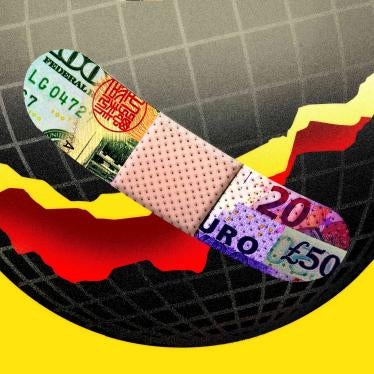
(New York) – Major donor nations dealt a devastating blow to the right to health for millions of people worldwide when they cut support for the Global Fund to Fight AIDS, Tuberculosis and Malaria, Human Rights Watch said today. Only US$11.85 billion has so far been pledged for 2026-2028 of an urgently needed US$18 billion. All but one of the 10 leading donors reduced their pledges.
“People will die because of donor nations’ decisions to cut pledges to the Global Fund,” said Julia Bleckner, senior health researcher at Human Rights Watch. “Donor nations should immediately step up and close this funding gap.”
The Global Fund provides nearly two thirds of all international financing for tuberculosis programs, more than half for malaria programs, and more than a quarter for HIV programs. Since it began in 2002, the Global Fund estimated it has saved 70 million lives. In 2024 alone, the Global Fund said it treated 25.6 million people with HIV and another 7.4 million with tuberculosis.
Human Rights Watch interviewed 47 nongovernmental organization workers, health care outreach workers, and aid recipients affected by recent cuts to global health financing in Indonesia, Laos, and Nepal, focusing specifically on HIV/AIDS prevention and care. Human Rights Watch found that global health funding cuts in 2025 have already had a dire impact, especially for marginalized groups that face systemic discrimination and barriers to health care, including men who have sex with men, transgender people, sex workers, and people who use drugs.
Those populations that are at greatest risk of HIV/AIDS transmission and illness are also often those systematically discriminated against by their governments and for whom community-based programs supported by the Global Fund and other international global health mechanisms are a sole lifeline to accessing HIV/AIDS testing, prevention, and care. HIV education, counseling, testing, support, and medication distribution by community-based organizations is a proven evidence-based approach to protecting the health of these groups.
By following the US in divestments from global health, donors are creating a cascading collapse in global health infrastructure that threatens millions of lives dependent on both bilateral assistance and multilateral funding, especially for communities facing barriers to health created by their own governments, Human Rights Watch said.
At the Fund’s Replenishment Summit on November 21, 2025, in Johannesburg, France and the European Commission made no concrete financial commitments, though they had been major donors. As of writing, France and the EU have yet to make any public commitments. Human Rights Watch wrote to the European Commission, French President Emmanual Macron, and Swedish Prime Minister Ulf Kristersson raising concerns, but has received no reply from France or the EU.
Sweden committed after the summit but significantly cut funding by $200 million from its previous funding cycle. The Government replied to Human Rights Watch that it is still committed to the Global Fund and confirmed a smaller commitment of $74.2million (683 million SEK) for 2026. The United States reduced its pledge to $4.6 billion from $6 billion. Japan decreased their pledge by more than half, Germany by more than a quarter and the Netherlands by almost a fifth. The United Kingdom, Canada, and Italy also cut back their pledges. Of the most recent top 10 donors, only Norway increased its pledge from $193.18 million to $195.7 million.
Donors’ retreat from the Global Fund is particularly alarming in light of the United States’ massive and abrupt cuts to bilateral health aid in 2025. The human impact of these cuts are profound, with estimates of more than 740,000 people having died because of the US aid cuts to date.
Major donors to global health should increase support for multilateral efforts to promote the right to health, rather than follow the United States’ retreat, Human Rights Watch said. Notably, India increased its pledge by 20 percent, Côte d'Ivoire by 30 percent, and South Africa by more than 100 percent.
International aid to support community-based non-governmental programming is critical to carrying out a rights-based approach to health care that addresses stigma and discrimination faced by many marginalized populations. “Just leaving the house as a trans person is scary,” Aika, an HIV positive transgender outreach worker in Indonesia. “Without an outreach worker, the person will be alone, and they won’t get care.”
Nongovernmental organization and health care outreach workers who serve these populations said that the reductions in Global Fund resources would mean that these communities will simply lose access to life-saving care with no alternative source of support. “If the Global Fund stops, new cases will skyrocket,” the director of a group in Indonesia said. Interviewees also said that a reduction in resources will affect monitoring, thus hiding the impact of the funding reductions.
“We are witnessing a coordinated abandonment of the world’s most vulnerable populations that will reverse decades of progress against HIV, tuberculosis, and malaria,” Bleckner said. “Donors should invest in the Global Fund before millions of people die preventable deaths.”