Ahead of the first session of the Conference Preparatory Committee and the Working Group for the negotiations of a Convention on the Prevention and Punishment of Crimes against Humanity, which will meet from 19 to 30 January 2026, the undersigned organizations urge all states to enable full, effective and broad participation of persons with disabilities and their representatives and ensure the protection and rights of persons with disabilities in the future Convention.
In December 2024, the UNGA adopted Resolution 79/122, deciding to advance to formal negotiations on a Convention on Crimes against Humanity, but deferred the decision on the participation of stakeholders other than non-governmental organizations (NGOs) in consultative status with the Economic and Social Council (ECOSOC) to the first Preparatory Committee meeting. To ensure the voices of persons with disabilities, among others, are fully and effectively included in the negotiations, states should ensure individuals and organizations without ECOSOC status are permitted to participate and make reasonable accommodations to ensure their equal participation.
Resolution 79/122 also provides that the International Law Commission’s (ILC) 2019 Draft Articles on Prevention and Punishment of Crimes against Humanity (Draft Articles), as well as a compilation of proposals for amendments to the Draft Articles to be submitted by governments to the UN Secretary General by 30 April 2026, will serve as the basis for negotiations. While the ILC Draft Articles provide a good basis to open negotiations, they can be strengthened through more expressly recognizing crimes against humanity against persons with disabilities and ensuring measures to prevent, punish and provide remedies and reparations for crimes against humanity meaningfully and effectively include them.
States should enable full, effective and broad civil society participation in the negotiations, including of Persons with Disabilities
The undersigned organizations strongly believe that the nature and subject of the negotiations for this Convention necessitates as wide a civil society participation as possible in the Conference, the Preparatory Committee, the Working Group and any other related meetings. In our view, such an approach also follows from Resolution 79/122 itself, which calls for “developing an instrument enjoying the broadest possible support” (OP 4) and “the need to ensure the widest possible and effective participation in the Conference” (OP 13). Wide participation would contribute to having a fair and balanced representation of observers, including geographically, and an open, accessible, inclusive and transparent treaty-making process.
An instrument like the planned Convention, addressing one of “the most serious crimes of concern to the international community as a whole”, can only benefit from broad and meaningful civil society engagement, which strengthens multilateral negotiations by bringing expertise and lived experience, as well as technical and academic knowledge into the drafting process. This understanding was recognized and implemented already in the context of the 1998 Rome Statute Preparatory Commission and during the actual Rome Conference. Other recent international practice has confirmed this, such as the negotiations of the UN Convention against Cybercrime adopted in December 2024 and the High-level Conference on the Situation of Rohingya Muslims and Other Minorities in Myanmar in September 2025, which allowed for participation of civil society actors without existing ECOSOC consultative status, as well as the Ljubljana-The Hague Convention on cooperation for international crimes. In these precedents a broad, inclusive and participatory approach was chosen to maximize available expertise, transparency and stakeholder involvement, including the meaningful participation of specific groups, such as women and children. They show that negotiations are most effective when states and civil society consistently interact in all stages of the treaty-making process.
An effective and purposeful Convention must allow for participation of those most affected, among others. The views of victims and survivors are central to the negotiations and their participation should be ensured throughout the negotiations, alongside other civil society representatives from countries that are particularly affected by the commission of crimes against humanity. As a practical observation, acquiring new ECOSOC accreditation in the time available before the Conference would be all but impossible for many respective organizations, given the administrative and resource eligibility requirements, especially if coming from the Global South.
To guarantee the full and effective participation of persons with disabilities and their representative organizations, including those representing women and children with disabilities, states should ensure that all elements of the treaty negotiations, including the procedural framework for the Conference, the Preparatory Committee, the Working Group and any other related meetings, are fully inclusive and accessible. The exclusion, de facto or otherwise, of relevant representatives would be particularly problematic in these negotiations because crimes against humanity can disproportionately impact and have historically targeted persons with disabilities. They also face persistent barriers to access to justice, including physical, communication, institutional, and attitudinal barriers that undermine their right to a seat at the negotiating table and prevent their full and meaningful involvement in decision-making processes.
Enabling effective participation includes proactively addressing obstacles to such participation in the negotiations, including accessibility. Reasonable accommodations should be provided when necessary to facilitate the participation of persons with disabilities, and appropriate and accessible information provided. Such measures would be aligned with the principles and obligations set out in the almost universally ratified Convention on the Rights of Persons with Disabilities and the unanimously adopted UN Security Council Resolution 2475 (2019) on the protection of persons with disabilities in conflict. Statesshould further include disability experts in their negotiation teams.
More generally, the undersigned organizations advocate for the negotiation process to be inclusive, accessible and participatory, as well as representative, diverse, broad, meaningful and safe for civil society, including from historically marginalized and underrepresented groups. Robust and constructive civil society engagement has contributed to the development of the Draft Articles and start of the negotiating process and is essential to the success of the future Convention. After adoption, civil society will advocate for ratification and implementation, support investigations and prosecutions, and help build prevention mechanisms. A framework limiting civil society participation to those with a formal status at the UN would only serve as a barrier to entry for the negotiations and could undermine the broad acceptance of the eventual Convention as envisioned by Resolution 79/122.
The undersigned organizations therefore recommend that:
- the 2026 Preparatory Committee enables the full, effective and broad civil society participation in the negotiations, with recognition of due geographical representation and gender parity, including NGOs and other civil society actors without ECOSOC consultative status;
- the 2026 Preparatory Committee enables the full, effective and broad participation of persons with disabilities and their representatives in the negotiations, including by taking reasonable measures to ensure any barriers to meaningful participation are mitigated;
- civil society stakeholders are given sufficient opportunity to submit requests to participate in the Conference, including the Preparatory Committee, the Working Group and any other related forums, and are able, should they so choose, to participate in person, without undue restrictions and in sufficient numbers; and
- additional observers are given the same rights of participation, including to effectively address all formal meetings, as those observers already admitted.
States should recognize crimes against humanity committed against persons with disabilities in the future Convention
States should also propose amendments to the ILC Draft Articles for the future Convention to effectively recognize crimes against humanity committed against persons with disabilities, to ensure better prevention, punishment and remedies and reparations for victims and survivors of such crimes.
Proposals to amend the text of the ILC Draft Articles should secure protections for and make visible the harms experienced by and unique needs of persons with disabilities. Historically, persons with disabilities have faced specific crimes against humanity, including but not limited to enforced sterilization and forced abortions, mass imprisonment, targeted killings, torture and other ill-treatment, including non-consensual medical experimentation, of 100.000s of people by the German Nazi regime in the 1930s and 1940s, as recognized by the Nuremberg trials; as well as the widespread targeting or other serious abuses against persons with disabilities in Cambodia, Colombia, the DPRK, the former Yugoslavia, Rwanda and Sierra Leone, and the Ukraine and Israel/Gaza conflicts most recently.
The Convention should reflect the rights of persons with disabilities to be effectively protected against crimes against humanity, recognizing they may be targeted on the basis of a disability, and promote their full and equal participation in processes to seek redress for such crimes. By strengthening cooperation between states, the future Convention expands access to justice for victims and survivors — including marginalized groups such as people with disabilities, who frequently face additional barriers to reporting crimes, participating in investigations, or obtaining reparations. Explicitly recognizing disability in the future Convention would be a marked step forward in aligning international criminal law with present-day international human rights law and create a legal foundation for future jurisprudence and advocacy.
Recommendations in this regard include:
- Adding strong general non-discrimination, substantive equality and human rights interpretation provisions. These should be drafted as broadly as possible to include the prohibition of discrimination on the basis of disability.
- In addition to other proposals for revision the crime of persecution, a revised paragraph 2(1)(h) should include disability as another express ground of committing the act. While the residual category of the crime of persecution (“other grounds that are universally recognized as impermissible under international law”) already includes disability, making this explicit would recognize that persons with disabilities are frequently and deliberately targeted. Referring to “disability” directly would make the unique harms faced by persons with disabilities more visible and ensure they are not overlooked in prosecutions, reinforce protection and better ensure justice for persons with disabilities.
- States should recognize the particular barriers faced by persons with disabilities in accessing justice, including access to effective remedies and reparation. Therefore, provisions for participation in all stages of proceedings as set out by the Convention, such as criminal proceedings against suspects or to obtain reparations, should guarantee participation and protection of persons with disabilities, including through making such processes accessible, with necessary and appropriate procedural and reasonable accommodations, and by ensuring their rights to information, legal representation and recognition of their right to legal capacity and supported decision-making. Under international law, persons with disabilities have the right to legal capacity on an equal basis, which they must not lose, and nobody may be excluded from justice processes because under national law practices they have been denied their right to exercise it.
- The proposed addition of a definition of “victims”, which must be broad enough to include the specific harms suffered by victims and survivors with disabilities of crimes against humanity.
- Reparation measures should be tailored and disability inclusive. Targeted reparations may be necessary for those who have acquired or further acquired a disability including a psychosocial disability as a result of crimes against humanity.
The undersigned organizations therefore recommend that:
- The future Convention should expressly recognize that crimes against humanity are committed against persons with disabilities, including persecution; and provide for their effective access to justice, truth and reparations by calling for prosecution of crimes against humanity committed against persons with disabilities and guaranteeing their rights to procedural and reasonable accommodations.
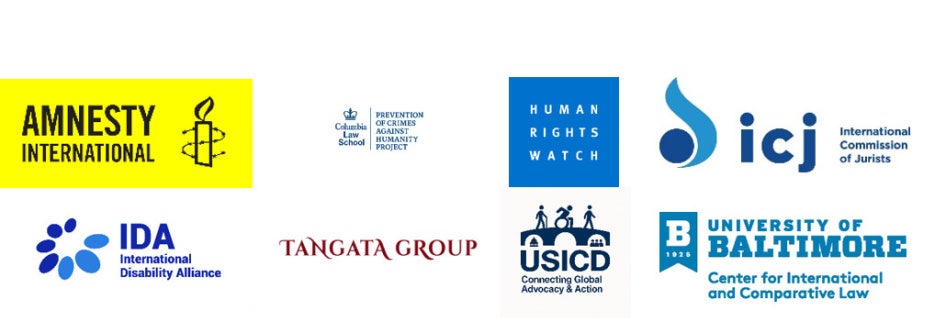
Signatories:
- Amnesty International
- Columbia Law School - Prevention of Crimes against Humanity Project
- Human Rights Watch
- International Commission of Jurists
- International Disability Alliance
- Tangata Group
- United States International Council on Disabilities
- University of Baltimore Center for International & Comparative Law, Disability, Peace and Security Initiative
- ^ UN General Assembly, Resolution 79/122, United Nations Conference of Plenipotentiaries on Prevention and Punishment of Crimes against Humanity, adopted on 4 December 2024, UN Doc. A/RES/79/122.
- ^ See, ILC, Report on the Work of Its Seventy-First Session, adopted on 9 August 2019, UN Doc. A/74/10, Chapter IV, Crimes against humanity, https://legal.un.org/ilc/reports/2019/english/chp4.pdf.
- ^ UNGA Resolution 79/122, 2024 (previously cited), OPs 5 and 9.
- ^ ILC, Draft Articles on Prevention and Punishment of Crimes Against Humanity (previously cited), PP 5.
- ^ NGOs could be granted observer access by ad hoc invitation.
- ^ UN General Assembly, Resolution 79/243, Strengthening International Cooperation for Combating Certain Crimes Committed by Means of Information and Communications Technology Systems and for the Sharing of Evidence in Electronic Form of Serious Crimes, adopted on 24 December 2024, UN Doc. A/RES/79/243.
- ^ UN General Assembly, Resolution 79/278, Scope, modalities, format and organization of the High-level Conference on the Situation of Rohingya Muslims and Other Minorities in Myanmar, adopted on 25 March 2025, UN Doc. A/RES/79/278.
- ^ Ljubljana-The Hague Convention on International Cooperation in the Investigation and Prosecution of the Crime of Genocide, Crimes against Humanity, War Crimes and other International Crimes, adopted in Ljubljana, Slovenia, on 26 May 2023. The convention has been ratified by one state (Latvia) and signed by 39 other states. Under the Rules of Procedure, civil society, upon invitation, could attend the diplomatic conference as one group of ‘observers’, which gave them the rights of attendance, receipt of official documents, and to make statements (subject to invitations and approvals).
- ^ Amnesty International and others, Draft Crimes Against Humanity Convention Must Center Victims and Survivors, 21 November 2023, https://www.globaljusticecenter.net/wp-content/uploads/2023/11/Victims-and-Survivors-Expert-Legal-Brief-CAH-Treaty.pdf
- ^ In particular the inclusive equality principle (“on an equal basis with others”) enshrined throughout the Convention, and Article 29(b), Participation in political and public life including “to represent persons with disabilities at international, national, regional and local levels.”
- ^ UN Security Council, Resolution 2475, adopted on 20 June 2019, UN Doc. S/RES/2475(2019).
- ^ See Initiative for Disability Inclusion in the Convention on Crimes against Humanity, Towards Inclusive Justice: Addressing Persons with Disabilities in the Convention on Crimes against Humanity (November 2025), https://globalrightscompliance.org/towards-inclusive-justice-addressing-persons-with-disabilities-in-the-convention-on-crimes-against-humanity/
- ^ Specifically, making persecution an autonomous crime, and adding age as a specific ground; see, among others, Amnesty International, A Convention on Prevention and Punishment of Crimes against Humanity: Further Recommendations, 20 October 2025, (Index: IOR 40/0303/2025), https://www.amnesty.org/en/documents/IOR40/0303/2025/en/, Section 3.3.1.
- ^ Reasonable accommodation should be provided when necessary to facilitate the participation of persons with disabilities. Under the International Principles and Guidelines on Access to Justice for Persons with Disabilities, procedural accommodation is defined as “all necessary and appropriate modifications and adjustments in the context of access to justice, where needed in a particular case, to ensure the participation of persons with disabilities on an equal basis with others. Unlike reasonable accommodations, procedural accommodations are not limited by the concept of disproportionate or undue burden. United Nations Human Rights Special Procedures, “International Principles and Guidelines on Access to Justice for Persons with Disabilities,” August 2020, www.un.org/development/desa/disabilities/wpcontent/uploads/sites/15/2020/10/Access-to-Justice-EN.pdf
- ^ See also Amnesty International and others, Draft Crimes Against Humanity Convention Must Center Victims and Survivors (previously cited), Section II.