Executive Summary
- This shadow report, based on Human Rights Watch’s research and reporting between 2018 and 2025, documents systematic and recent patterns of arbitrary detention and criminal prosecutions used to crush dissent in Tunisia; a marked deterioration of civic space through broad criminal law instruments and abusive judicial practices; and repeated, serious abuses of migrants, refugees, and asylum seekers by Tunisian security forces, including collective expulsions, beatings, dangerous conduct at sea, theft, and denial of protection. These phenomena are interlinked and have intensified in recent years.
- In keeping with the ACHPR’s 2022 Guidelines on Shadow Reporting, the shadow report aims to provide an alternative perspective on the government’s self-assessment, highlight implementation gaps, and offer constructive recommendations for advancing human and peoples’ rights and the rights and the welfare of women and girls in Tunisia in line with the Protocol to the African Charter on Human and Peoples’ Rights on the Rights of Women in Africa (Maputo Protocol), to which Tunisia is party.
- The State’s legislative and prosecutorial practices (including extensive use of terrorism, conspiracy, public order and cyber-related offenses) and patterns of preventive detention, incommunicado detention, and pretrial detention without adequate judicial safeguards, have had a chilling effect on freedom of expression, association, and assembly. High-profile trials and harsh sentences in cases for alleging conspiracy and undermining state security illustrate how criminal justice processes have been used to target and punish dissent.
- Tunisia’s treatment of Black African migrants and refugees reveals racialized policing and a failure to uphold non-refoulement, access to asylum procedures, and basic protection. Security forces have carried out collective expulsions to Libya and Algeria, forced evictions, and abusive interceptions at sea. They have also failed to provide effective remedies for victims. These patterns raise serious concerns under articles 2 (non-discrimination), 5 (prohibition of torture), 6 (protection from arbitrary arrest and detention), and the State’s obligations to protect refugees and asylum seekers.
- The shadow report proposes questions that the ACHPR can ask the state for more clarity on the implementation of these different rights and proposes recommendations the Commission can make to the state to ensure realization of the African Charter and the Maputo Protocol.
- Introduction
- OBSERVATIONS ON THE STATE REPORT
- Articles 2, 3: Guarantees of Nondiscrimination and Equality
- Article 4: Right to Life – Abolition of the Death Penalty
- Article 5, 12: Abuses against Black African Migrants, Refugees and Asylum Seekers
- Article 6, 7: Protection from Arbitrary Arrest and Detention
- Article 9: Freedom of Expression
- Article 10, 11: Freedom Association and Assembly
- Article 18: Women’s Rights; Protection of Women against Domestic Violence; Rights of the Child
- Articles 20–24: Peoples’ Rights
- Annex 1: Specific Examples of Arbitrary Arrests and Detention; Rampant Violations of Due Process
- Annex 2: Examples of Limited Space for Civil Society to Operate or for Individuals to Participate in Meaningful Political Activities
Annex 3: Examples of Individuals and Media Organizations Targeted for Peaceful Speech
Introduction
- This submission is based primarily on Human Rights Watch reporting and monitoring of Tunisia’s human rights record between 2018 and 2025, including interviews with victims or their family members, lawyers, civil society actors, and a review of court decisions, charge documents, and laws. It focuses on three areas of concern: (1) arbitrary detention and abusive criminal justice practices used to suppress dissent; (2) the progressive shrinking and criminalization of civic space (freedoms of expression, assembly, and association); and (3) abuses against migrants, refugees, and asylum seekers.
- Human Rights Watch is an international nongovernmental organization that conducts research and advocacy on human rights violations in over 100 countries around the world, including in Tunisia.
OBSERVATIONS ON THE STATE REPORT
Articles 2, 3: Guarantees of Nondiscrimination and Equality
- The 1956 Personal Status Law refers to the husband as the head of the family, allowing for discrimination against women as decision makers within the family and discriminates against women with respect to their ability to inherit money equally to men.[1]
Proposed Questions:
- What steps has the government taken to amend the 1956 Personal Status Law to remove provisions discriminating against women?
Recommendations:
- Amend the Personal Status Code to ensure that women and men are equal heads of households and remove gender discrimination in inheritance.
Article 4: Right to Life – Abolition of the Death Penalty
- Tunisia has observed a de facto moratorium on executions since 1991. However, courts continue to hand down death sentences.[2] According to Amnesty International, Tunisian courts imposed more than 12 death sentences in 2024, bringing the total number of people in Tunisia sentenced to death to 148 by the end of 2024.[3]
Proposed Questions:
- How many death sentences have been issued since 2020, and for what offenses?
- Will the government commit to abolishing the death penalty in law and ratify the Second Optional Protocol to the International Covenant on Civil and Political Rights?
Recommendations:
- Establish an official moratorium on death sentences as a first step toward abolition.
- Amend the Penal Code to abolish the death penalty for all crimes.
- Ratify the Second Optional Protocol to the International Covenant on Civil and Political Rights.
Article 5, 12: Abuses against Black African Migrants, Refugees and Asylum Seekers
- President Kais Saied made several inflammatory remarks in February 2023 that triggered a surge of racist attacks and other abuses by security forces and Tunisian citizens—including violent assaults, robberies, arbitrary evictions, and loss of employment—against Black African people across the country.[4]
- Beginning earlier that month, Tunisian police carried out at least 850 arbitrary arrests, seemingly targeting Black African foreign nationals based on their appearance or the neighborhoods in which they lived.[5] Those arrested included both undocumented people and those with legal status, including some registered refugees and asylum seekers.
- The president’s subsequent attempts to mitigate the serious harms of his speech were insufficient in stopping the ensuing racially motivated violence and other abuses.[6] The authorities routinely failed to investigate and prosecute assaults on Black African foreign nationals.
- The attacks were further fueled by a significant rise in anti-Black rhetoric and hate speech on online platforms, partly driven by the Tunisian National Party, which has called for the deportation of all undocumented Sub-Saharan migrants.[7]
- In July 2023, Tunisian security forces collectively expelled several hundred Black African migrants and asylum seekers, including at least 29 children and 3 pregnant women, to a remote, militarized buffer zone at the Tunisia-Libya border where they could neither enter Libya nor return to Tunisia.[8] Migrants and asylum seekers were in some cases tortured during apprehension and forcible transfer.[9] Interviewees said that several people died or were killed at the border area. Some said they witnessed rape, sexual assault, and sexual harassment of women by Tunisian and Libyan security forces, as well as beatings and robberies.[10] These collective expulsions have continued and become virtually systematic after interceptions at sea.
- The State has not ensured robust, independent mechanisms to investigate allegations of torture and ill-treatment and to hold perpetrators of these abuses to account.
Proposed Question:
- What measures has the government taken to investigate serious abuses against Black African migrants in Tunisia? Has anyone been held accountable for these abuses since 2023? If not, why not?
Recommendations:
- Investigate all reported abuses against migrants, asylum seekers, and refugees by authorities or citizens.
- Ensure accountability, including through appropriate legal action; and implement reforms and oversight systems within the police, national guard (including the coast guard), and military to ensure respect for human rights, end racial discrimination or violence, and refrain from contributing to racial hatred or discrimination against Black Africans.
- Produce and publish sex- and nationality-disaggregated data on detainees, prisoners, including detained migrants and refugees. Adopt tailored protection measures for women migrants and survivors of gender-based violence.
- Ensure access to reproductive and maternal health services for detained women, including migrants and refugees.
- Conduct individual legal status assessments in accordance with due process requirements for anyone facing deportation.
Article 6, 7: Protection from Arbitrary Arrest and Detention
- Since President Saied granted himself extraordinary powers in 2021,[11] Tunisian authorities have increasingly relied on prolonged pretrial detention, preventive detention, house arrest, and administrative constraints to detain real or perceived critics of the government, including those from across the political spectrum, activists, lawyers, human rights defenders, social media users, and family members of critics.[12]
- The authorities have leveraged abusive terrorism-related charges against critics, including some that carry the death penalty, such as “undermining external state security” or “chang[ing] the nature of the state.” As of January 2025, over 50 people were detained on political grounds or for exercising their fundamental rights, including political opponents, activists, lawyers, journalists, human rights defenders, and social media users.[13] At least 14 detainees faced a sentence of capital punishment if convicted.
- While in detention, detainees face a range of abuses and ill-treatment, including being held past the 14 months allowed for pretrial detention under Tunisian law, denial of access to health care, and disability support services.
- Existing Tunisian law, including the Military Justice Code, allow military courts to try civilians, such as in cases of “insult” to the military institution. This undermines freedom of expression and contravenes constitutional provisions on the right to a fair trial. At least 20 civilians deemed critical of the government have been tried in military courts since July 2021.[14]
- Authorities undermined the integrity of the October 6, 2024, presidential election to ensure President Kais Saied’s re-election, including by excluding or detaining prospective challengers and amending the electoral law just days before the election.[15]
- Details of cases of people arbitrarily arrested, arbitrarily placed on house arrest, and civilians tried in military courts are provided in Annex 1.
Proposed Questions:
- What steps will the government commit to taking to reduce the use of prolonged pretrial detention, preventive detention, house arrest, and administrative constraints, and abusive prosecutions against those perceived as critics?
- What steps is the government taking to address abuses against those in detention, including ill-treatment, prolonged pretrial detention and denial of access to health care and disability support services? Who, if anyone, has been held accountable for such abuses since 2021?
- What steps is the government taking to remove civilians from military court jurisdiction?
Recommendations:
- End harassment and unjust prosecutions of magistrates, defense lawyers, and all real or perceived peaceful critics of the government.
- Direct prosecutors not to use Decree-Law 2022-54 on Cybercrime, the Telecommunications Code and Penal Code to prosecute people for peaceful speech on matters of public interest, specifically articles 67, 128, 245, and 247 of the Penal Code and article 86 of the Telecommunications Code.
- Repeal existing provisions that allow civilians to be prosecuted before military courts.
- Stop using preventive detention as a general practice and only resort to it in exceptional cases as mandated by international and Tunisian law.
- Guarantee quick, automatic, and regular independent judicial review of each person detained, including in military and preventive detention. Ensure all detainees are promptly brought before a judge or judicial panel within 48 hours to determine the legality and necessity of their detention and to order their immediate release if detention is not lawful or justified.
- Ensure that the General Directorate of Prisons and Rehabilitation ensures humane conditions of detention and provides adequate access to health care and disability support services, including psychosocial support, for detainees.
- Provide redress for detainees who have experienced ill-treatment or who have been denied adequate medical care or mental health services.
- Ensure all restrictions imposed on a person’s freedom of movement in the framework of counterterrorism efforts include a written reason, are for a finite time, and are subject to meaningful judicial oversight and appeal.
- Stop using assigned residence measures arbitrarily. If strictly necessary for security, these measures should be used only with strong safeguards, including written copy of the decision from the Interior Ministry to the affected person, subject to meaningful challenge and judicial review.
Article 9: Freedom of Expression
- Human Rights Watch has documented over 20 prosecutions of bloggers, journalists, and others since 2017 on charges related to their peaceful speech. Authorities have targeted people for comments made online and prosecuted them under the 2001 Code of Telecommunications, the Decree-Law 54 on Cybercrime or the penal code.
- Details of cases of people and media organizations targeted for peaceful speech, online or otherwise, are included in Annex 3.
Proposed Questions:
- Will the government commit to protecting the right to freedom of expression, including by ending abusive prosecutions for peaceful speech and seeking the release of anyone detained or convicted in such cases?
- What steps has the government taken to hold accountable those bringing abusive prosecutions for peaceful speech? Has anyone been held accountable in this regard since 2017?
Recommendations:
- Cease abusive prosecutions of bloggers, journalists, and others for exercising their right to freedom of speech and expression.
- Repeal Decree-Law 2022-54 on Cybercrime, and restrictive, vague, or overbroad provisions of codes used to criminalize free expression and interfere with privacy rights, including in the penal code, the Telecommunications Code, and the Military Justice Code.
Article 10, 11: Freedom Association and Assembly
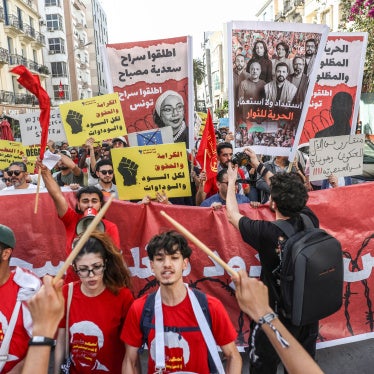
- Since 2024, authorities have increasingly used administrative pressure, registration obstacles, asset controls, and widespread prosecutions to limit civil society organizations and human rights defenders’ work, block meaningful political participation, and shut down peaceful public demonstrations.
- Authorities have targeted several members of civil society groups and activists—especially those who express solidarity with refugees and migrants or provide aid to asylum seekers—with arbitrary arrests, interrogations, and investigations into their financing.
- Examples of the aforementioned abuses are included in Annex 2.
- A draft law on associations submitted by 10 parliamentarians to the Assembly of People's Representatives on October 10, 2023, would violate the right to freedom of association and endanger civic space in Tunisia if adopted.
- The draft law would grant the government pervasive control and oversight over the establishment, activities, operations, and funding of independent groups.[16]
- International organizations would face heightened restrictions, including a requirement for prior authorization from the Foreign Affairs Ministry (articles 8, 19), discretionary suspensions or revocations (article 20), and extensive supervision by state authorities (article 6).
- Domestic associations would also be subjected to prior approval for foreign funding (article 18), surveillance through a state-run digital database (article 14), and mandatory reporting of planned activities (article 13).
Proposed questions
- What steps has the government taken to protect the rights to freedom of association and assembly and the work of civil society organizations in Tunisia?
- What steps has the government taken to secure accountability for authorities who have targeted civil society organizations and activists with abusive arrests and prosecutions?
- Will the government commit to amending the draft law on association to bring it in line with the right to freedom of association under international law?
Recommendations
- Reject or withdraw any draft law on associations that undermines the right to freedom of association and commit to safeguarding freedom of association rights as enshrined in Decree-Law 88 and under international human right law binding on Tunisia.
- Ensure associations can operate without political interference, intimidation, harassment, or undue restrictions.
Article 18: Women’s Rights; Protection of Women against Domestic Violence; Rights of the Child
- Tunisia adopted Law No. 58 (2017) on the Elimination of Violence Against Women, considered among the most progressive frameworks in the region. The law introduced criminal provisions and increased penalties for various forms of violence when committed within the family and criminalized sexual harassment in public spaces.[17] However, poor implementation has undermined the law’s effectiveness.[18]
- Tunisia’s state report notes a total of 4,036 cases of domestic violence involving married women between 2021 and 2022. Of those, 3,445 apparently involve violence perpetrated by their husbands. However, this figure likely underrepresents the scope of the violence. Police often fail to respond to complaints, prosecutors rarely pursue cases, and courts do not consistently apply protection measures.[19] Survivors also face stigma, limited access to shelters, and inadequate state funding for services.[20] Moreover, the figure is limited to married women, whereas non-married women and girls also face domestic violence.
- An electoral law issued unilaterally by President Saied in September 2022 eliminated the principle of gender parity in elected assemblies, which could, in turn, result in future parliament makeups being almost exclusively comprised of men.[21] The law undermines women’s participation in political life, in contravention of article 9 of the Maputo Protocol, which requires that “women are represented equally at all levels with men in all electoral processes.”
- Tunisia’s constitutional provisions require the State “to achieve the purposes of Islam in preserving the soul, honor, property, religion, and freedom,” a provision that could be used to limit women’s rights based on interpretations of religious precept.[22]
- Tunisia has not ratified the African Charter on the Rights and Welfare of the Child.
Proposed Questions:
- What steps has the government taken to ensure implementation of Law No. 58 (2017) on the Elimination of Violence Against Women? What measures has it put in place to ensure the law’s effectiveness?
- What steps has the government taken in response to the 4,036 cases of domestic violence reported involving married women between 2021 and 2022? Has the government collected information about domestic violence involving non-married women and girls? How many cases has the government brought and what accountability has it secured?
- How will Tunisia achieve gender parity in elected assemblies in the absence of the principle of gender parity?
- Will Tunisia restore gender parity in electoral law to guarantee women’s participation?
- Does Tunisia intend to ratify the African Children’s Charter? If not, why not?
Recommendations
- With respect to Law No. 58 (2017) on the Elimination of Violence Against Women:
- Ensure adequate funding and political will to put the programs and policies outlined in the law fully into effect.
- Develop awareness-raising strategies, especially in schools, to dismantle sexist stereotypes and mainstream a zero-tolerance culture in relation to violence against women.
- Ensure specialized police units and relevant members of the judiciary are trained to detect and thoroughly investigate family violence and systematically inform survivors of their rights.
- Establish monitoring and accountability mechanisms to ensure survivors can issue complaints against officials who do not abide by Law No. 58 (2017).
- Ensure availability of adequate shelter, mental health support, legal aid, and other services for survivors of domestic violence.
- Reintroduce gender parity in all elected assemblies and restore gender parity in the electoral law to guarantee women’s participation.
- Fully implement Maputo Protocol articles 9 and 14 on participation and reproductive rights.
- Ratify the African Charter on the Rights and Welfare of the Child.
Articles 20–24: Peoples’ Rights
- Tunisia’s democratic backsliding undermines the people’s right to freely determine their political system (article 20).
- Since July 25, 2021, President Saied has replaced Tunisia’s constitution, dissolved parliament, and granted himself the power to rule by decree. He has also dismantled a number of national institutions, including an independent electoral commission and the High Judicial Council, which were created to safeguard against overreach by governing bodies.[23]
- Tunisian authorities have undermined the integrity of the October 6, 2024, presidential election by amending the electoral law just days beforehand. The authorities excluded or arrested opposition candidates, and took arbitrary measures against political opponents, independent media, and civil society.[24] Tunisian authorities have prosecuted, convicted, or imprisoned at least eight prospective candidates for the election.[25]
Tunisia’s electoral commission confirmed only three candidates for the October 6, 2024, presidential election, including incumbent President Saied and a detained candidate, disregarding major court rulings that had reinstated three other contenders to stand in the polls.[26]
Proposed Questions:
- What steps is the government taking to restore legitimate and transparent democratic process and free and fair elections?
What steps is Tunisia taking to restore judicial independence?
Recommendations:
- Restore democratic checks and balances to protect people’s right to free and fair elections.
- Reverse all policies that compromise the judiciary’s independence from the executive, re-establish the independence of the High Judicial Council, and respect judicial rulings.
Annex 1: Specific Examples of Arbitrary Arrests and Detention; Rampant Violations of Due Process
- A trial for conspiracy against the state that began in March 2025 includes 40 people accused of “conspiracy against internal and external State security” and terrorism for plotting to overthrow the government. The case includes six people detained for discussing political strategy among themselves in person or on messaging apps, or for meeting (or organizing meetings) with foreign diplomats of international NGO staff between 2021 and 2023.[27]
- The trial took place without the presence of the main defendants in the alleged plot, who refused to attend by video as ordered. Detained political opponents of President Saied: Jaouhar Ben Mbarek, Issam Chebbi, Abdelhamid Jelassi, and Khayam Turki, Ennahda opposition party leaders Nourredine Bhiri and Sahbi Atig, as well as lawyers Ridha Belhaj and Ghazi Chaouachi, were not present in their own trial.
- The practice of trial by video is inherently abusive as it undermines detainees’ right to be brought physically before a judge to assess their well-being and the legality and conditions of their detention.
- On October 10, 2024, the Tunis Military Court of Appeal sentenced Chaima Issa, a leading figure of the National Salvation Front opposition coalition, to a six-month suspended sentence for comments she made during a December 2022 radio interview about the military’s role in the 2022 parliamentary elections.
- Rached Khiari, a journalist and former member of parliament for the Islamist coalition al-Karama, has been prosecuted on several occasions since 2021 for criticism of the authorities. He spent more than two years in prison for speech offenses, including following two military court convictions.
- Since 2016, authorities have placed hundreds of Tunisians under assigned residence, a measure used with increasing frequency under President Saied after he granted himself extraordinary powers in July 2021.
- Since then, three parliament members have been imprisoned for speech offenses, and at least 50 Tunisians have been placed under assigned residence, including former officials, a judge, and three lawmakers.[28]
- Former government employees are also subject to these abuses, including former justice minister Nourredine Bhiri and former Ministry of Interior employee Fathi Beldi.[29]
Annex 2: Examples of Limited Space for Civil Society to Operate or for Individuals to Participate in Meaningful Political Activities
- Between May 3 and 13, 2024, security forces arrested at least six members of three legally registered nongovernmental organizations working on migration, asylum, and racial justice: Mnemty, the Tunisian Refugee Council, and Terre d’Asile Tunisie. [30]
- Authorities have imprisoned scores of President Saied’s political adversaries and prominent opposition figures.[31]
- In September 2024, security officers arrested over 100 members or supporters of the Ennahda opposition party under Tunisia’s counterterrorism law.[32] They were released after several days in custody, except for four who were placed in pretrial detention.
- On August 5, 2024, a Tunis court sentenced five other prospective presidential candidates, Abdellatif Mekki, Nizar Chaari, Mourad Messaoudi, Mohamed Adel Dou, and Leila Hammami to eight months in prison and a lifetime ban on running for office, on the same charges.[33]
- Also on August 5, 2024, a Tunis court sentenced Abir Moussi,[34] president of the Free Destourian Party, to two years in prison under Decree-Law 54 on Cybercrime for “spreading fake news” about the electoral commission.[35]
- On August 14, 2024, a Jendouba court sentenced a rapper and prospective candidate, Karim Gharbi, to four years in prison and a lifetime ban on running for office, on charges of buying endorsement signatures.[36] Four people volunteering for Gharbi’s campaign were also sentenced to prison terms.[37]
- On July 18, 2024, a Tunis court sentenced Lotfi Mraihi, leader of the Republican People’s Union and prospective presidential candidate, to eight months in prison and a lifetime ban on running for office for allegedly “making donations in cash or in kind in order to influence voters.”[38] His party’s executive director and three other members were also convicted and sentenced.[39]
Annex 3: Examples of Individuals and Media Organizations Targeted for Peaceful Speech
- On March 7, 2024, a military court sentenced Nasreddine Halimi to seven years in prison under the Cybercrime Law and Tunisia’s military justice code for Facebook posts criticizing the president and the military.[40]
- Between October and November 2024, several social media influencers were sentenced to prison terms in connection with content deemed “offensive to public morals and decency.”[41]
- On July 6, 2024, a Tunis court sentenced Sonia Dahmani, a lawyer and media commentator arrested on May 11, 2024, to a year in prison for critical remarks on a TV show, under Decree-Law 54.[42] On October 24, 2024, she was sentenced in another case to two years in prison for her statements.[43]
- On April 17, 2024, journalist Mohamed Boughalleb was sentenced to six months in prison for defaming an official after he criticized the religious affairs minister. He was arrested in March 2024 and released in February 2025.[44]
- On January 31, 2024, the Monastir Appeals Court sentenced Rached Tamboura to two years in prison under Decree 54, in connection with graffiti showing a portrait of President Saied flanked by the words “racist vassal greed fascist.”[45]
- On January 10, 2024, a Tunis court sentenced journalist Zied El-Heni to a six-month suspended prison sentence for “insulting” the then trade minister, Kalthoum Ben Rejeb, after he criticized her on a radio show.[46]
- Prominent lawyer Abderrazak Kilani and other members of the parliament were prosecuted in military courts in 2022 for speech offenses.[47] Kilani faced charges of “disturbing the public order,” “insulting public officials,” and “inciting violence” in connection with a verbal exchange with security officers who denied him access to his client in the hospital.
- Myriam Bribri, an activist, received a fine and a four-month prison sentence on December 21, 2021, for “knowingly harming or disturbing others via public telecommunications networks” for posting a video on Facebook of police roughly arresting a man.[48]
- On July 26, 2021, police raided and closed the Tunis headquarters of Al Jazeera TV, evicting its staff and confiscating equipment. They have been unable to return to the office, though they continue to report and broadcast from Tunisia. The closure lacked official judicial authorization, written justification, or a clear method of appeal.[49]
- On January 17, 2021, authorities arrested Ahmed Ghram at his home for Facebook posts criticizing police repression, impunity, and corrupt governance, and accused him of “inciting actions of chaos and disorder.”[50]
- Emna Chargui was sentenced to six months in prison in July 2020 for “inciting hatred between religions through hostile means or violence” after allegedly sharing a Facebook video mimicking the style and recitation of a Quranic passage.[51]
- Authorities sentenced blogger Wajdi Mahouechi to two years in prison for “accusing officials of crimes without providing proof,” and “offending others via telecommunications networks,” citing a video posted on Facebook on November 1, 2020, criticizing a Tunis public prosecutor.[52]
- A military court on June 26, 2018, sentenced Yassine Ayari, a member of parliament, to three months in prison for “defaming the army,” citing an April 2017 Facebook post criticizing the army.[53]
[1] “Tunisia: Parliament Should Back Gender Equality in Inheritance, Human Rights Watch news release, December 4, 2018, https://www.hrw.org/news/2018/12/04/tunisia-parliament-should-back-gender-equality-inheritance.
[2] “Tunisia: Presidential statement in favour of death penalty is shocking,” Amnesty International news release, September 29, 2020, https://www.amnesty.org/en/latest/press-release/2020/09/tunisia-presidential-statement-in-favour-of-death-penalty-is-shocking/ (accessed September 17, 2025).
[3] Amnesty International, “Death Sentences and Executions in 2024,” April 8, 2025, http://amnesty.org/en/documents/act50/8976/2025/en/ (accessed September 17, 2025).
[4] “Tunisia: Crisis as Black Africans Expelled to Libya Border,” Human Rights Watch news release, July 6, 2023, https://www.hrw.org/news/2023/07/06/tunisia-crisis-black-africans-expelled-libya-border.
[5] “Tunisia: Racist Violence Targets Black Migrants, Refugees,” Human Rights Watch news release, March 10, 2023, https://www.hrw.org/news/2023/03/10/tunisia-racist-violence-targets-black-migrants-refugees.
[6] “Tunisia: Racist Violence Targets Black Migrants, Refugees,” Human Rights Watch news release, March 10, 2023, https://www.hrw.org/news/2023/03/10/tunisia-racist-violence-targets-black-migrants-refugees.
[7] “Tunisia: Racist Violence Targets Black Migrants, Refugees,” Human Rights Watch news release, March 10, 2023, https://www.hrw.org/news/2023/03/10/tunisia-racist-violence-targets-black-migrants-refugees.
[8] “Tunisia: Crisis as Black Africans Expelled to Libya Border,” Human Rights Watch news release, July 6, 2023, https://www.hrw.org/news/2023/07/06/tunisia-crisis-black-africans-expelled-libya-border.
[9] “Tunisia: No Safe Haven for Black African Migrants, Refugees,” Human Rights Watch news release, July 19, 2023, https://www.hrw.org/news/2023/07/19/tunisia-no-safe-haven-black-african-migrants-refugees.
[10] “Tunisia: No Safe Haven for Black African Migrants, Refugees,” Human Rights Watch news release, July 19, 2023, https://www.hrw.org/news/2023/07/19/tunisia-no-safe-haven-black-african-migrants-refugees; “Tunisia: Crisis as Black Africans Expelled to Libya Border,” Human Rights Watch news release, July 6, 2023, https://www.hrw.org/news/2023/07/06/tunisia-crisis-black-africans-expelled-libya-border.
[11] “Tunisia: President’s Seizure of Powers Threatens Rights,” Human Rights Watch news release, July 27, 2021, https://www.hrw.org/news/2021/07/27/tunisia-presidents-seizure-powers-threatens-rights.
[12] Human Rights Watch, “All Conspirators”: How Tunisia Uses Arbitrary Detention to Crush Dissent, (New York: Human Rights Watch, April 16, 2025), https://www.hrw.org/report/2025/04/16/all-conspirators/how-tunisia-uses-arbitrary-detention-crush-dissent; “Tunisia: Unfinished Rights Business,” Human Rights Watch news release, February 28, 2020, https://www.hrw.org/news/2020/02/28/tunisia-unfinished-rights-business; “Tunisia: Secret Detentions Under Cover of State of Emergency,” Human Rights Watch news release, February 9, 2022, https://www.hrw.org/news/2022/02/09/tunisia-secret-detentions-under-cover-state-emergency.
[13] “Tunisia: Arbitrary Detention Crushes Dissent,” Human Rights Watch news release, April 16, 2022, https://www.hrw.org/news/2025/04/16/tunisia-arbitrary-detention-crushes-dissent.
[14] Human Rights Watch, All Conspirators’: How Tunisia Uses Arbitrary Detention to Crush Dissent, (New York: Human Rights Watch, April 16, 2025), https://www.hrw.org/report/2025/04/16/all-conspirators/how-tunisia-uses-arbitrary-detention-crush-dissent.
[15] “Tunisia: Authorities Undermine Election Integrity,” Human Rights Watch news release, October 3, 2024, https://www.hrw.org/news/2024/10/03/tunisia-authorities-undermine-election-integrity.
[16] “Tunisia: Reject Bill Dismantling Civil Society,” Human Rights Watch news release, November 7, 2023, https://www.hrw.org/news/2023/11/07/tunisia-reject-bill-dismantling-civil-society; “Tunisia: Looming Curbs on Civil Society Must Be Stopped,” Human Rights Watch news release, March 11, 2022, https://www.hrw.org/news/2022/03/11/tunisia-looming-curbs-civil-society-must-be-stopped.
[17] “Tunisia: Unfinished Rights Business,” Human Rights Watch news release, February 28, 2020, https://www.hrw.org/news/2020/02/28/tunisia-unfinished-rights-business.
[18] Human Rights Watch, “So What If He Hit You?”: Addressing Domestic Violence in Tunisia, (New York: Human Rights Watch, December 8, 2022), https://www.hrw.org/report/2022/12/08/so-what-if-he-hit-you/addressing-domestic-violence-tunisia.
[19] Human Rights Watch, “So What If He Hit You?”: Addressing Domestic Violence in Tunisia, (New York: Human Rights Watch, December 8, 2022), https://www.hrw.org/report/2022/12/08/so-what-if-he-hit-you/addressing-domestic-violence-tunisia.
[20] Human Rights Watch, “So What If He Hit You?”: Addressing Domestic Violence in Tunisia, (New York: Human Rights Watch, December 8, 2022), https://www.hrw.org/report/2022/12/08/so-what-if-he-hit-you/addressing-domestic-violence-tunisia.
[21] Human Rights Watch, “Tunisia Tramples Gender Parity Ahead of Parliamentary Elections,” November 2, 2022, https://www.hrw.org/news/2022/11/02/tunisia-tramples-gender-parity-ahead-parliamentary-elections.
[22] Kenza Ben Azouz (Human Rights Watch), “President Saied Derides the Economic and Social Rights of Tunisian Women,” commentary, Nawaat, September 1, 2022, https://www.hrw.org/news/2022/09/01/president-saied-derides-economic-and-social-rights-tunisian-women.
[23] “Tunisia: Arbitrary Dismissals a Blow to Judicial Independence,” Human Rights Watch new release, June 10, 2022, https://www.hrw.org/news/2022/06/10/tunisia-arbitrary-dismissals-blow-judicial-independence.
[24] “Tunisia: Authorities Undermine Election Integrity,” Human Rights Watch news release, October 3, 2024, http://hrw.org/news/2024/10/03/tunisia-authorities-undermine-election-integrity.
[25] “Tunisia: Prospective Presidential Candidates Barred,” Human Rights Watch news release, August 20, 2024, http://hrw.org/news/2024/08/20/tunisia-prospective-presidential-candidates-barred.
[26] Bassam Khawaja, “Tunisia’s Electoral Commission Paves the Way for Kais Saied's Second Term,” Human Rights Watch Dispatch, September 4, 2024, http://hrw.org/news/2024/09/04/tunisias-electoral-commission-paves-way-kais-saieds-second-term.
[27] Human Rights Watch, “All Conspirators”: How Tunisia Uses Arbitrary Detention to Crush Dissent, (New York: Human Rights Watch, April 16, 2025), https://www.hrw.org/report/2025/04/16/all-conspirators/how-tunisia-uses-arbitrary-detention-crush-dissent.
[28] Human Rights Watch Universal Periodic Review Submission, “Universal Periodic Review Submission on Tunisia: Fourth Cycle of the Universal Periodic Review, 41st Submission,” March 30, 2022, https://www.hrw.org/news/2022/03/30/universal-periodic-review-submission-tunisia.
[29] Human Rights Watch Universal Periodic Review Submission, “Universal Periodic Review Submission on Tunisia: Fourth Cycle of the Universal Periodic Review, 41st Submission,” March 30, 2022, https://www.hrw.org/news/2022/03/30/universal-periodic-review-submission-tunisia.
[30] “Tunisia: Deepening Civil Society Crackdown,” Human Rights Watch news release, May 17, 2024, https://www.hrw.org/news/2024/05/17/tunisia-deepening-civil-society-crackdown; Human Rights Watch, World Report 2025 (New York: Human Rights Watch, 2025), Tunisia chapter, https://www.hrw.org/world-report/2025/country-chapters/tunisia.
[31] Human Rights Watch, “All Conspirators”: How Tunisia Uses Arbitrary Detention to Crush Dissent, (New York: Human Rights Watch, April 16, 2025), https://www.hrw.org/report/2025/04/16/all-conspirators/how-tunisia-uses-arbitrary-detention-crush-dissent.
[32] “Tunisia: Authorities Undermine Election Integrity,” Human Rights Watch news release, October 3, 2024, https://www.hrw.org/news/2024/10/03/tunisia-authorities-undermine-election-integrity.
[33] Tarek Amara, “Tunisian court jails four presidential candidates and bars them from elections,” Reuters, August 5, 2024, https://www.reuters.com/world/africa/tunisian-court-imprisons-four-presidential-candidates-bans-them-election-2024-08-05/ (accessed September 16, 2025).
[34] Human Rights Watch, All Conspirators’: How Tunisia Uses Arbitrary Detention to Crush Dissent, (New York: Human Rights Watch, April 16, 2025), https://www.hrw.org/report/2025/04/16/all-conspirators/how-tunisia-uses-arbitrary-detention-crush-dissent;
[35] “Abir Moussi condamnée à deux ans de prison,” Business News, August 5, 2024, https://www.businessnews.com.tn/abir-moussi-condamnee-a-deux-ans-de-prison,520,139878,3 (accessed September 16, 2025).
[36] “K2rhym condamné à quatre ans de prison...,” Mosaïque FM, August 14, 2024, https://www.mosaiquefm.net/fr/national-tunisie/1302188/k2rhym-condamne-a-quatre-ans-de-prison (accessed September 16, 2025).
[37] “Quatre femmes condamnées pour achat de parrainages pour un candidat potentiel présidentielle tunisienne,” August 2, 2024, Voice of America Afrique, https://www.voaafrique.com/a/tunisie-pr%C3%A9sidentielle-quatre-femmes-condamn%C3%A9es-pour-achat-de-parrainages/7727748.html (accessed September 16, 2025).
[38] “Tunisia: Prospective Presidential Candidates Barred,” Human Rights Watch news release, August 20, 2024, https://www.hrw.org/news/2024/08/20/tunisia-prospective-presidential-candidates-barred.
[39] Human Rights Watch, World Report 2025 (New York: Human Rights Watch, 2025), Tunisia chapter, https://www.hrw.org/world-report/2025/country-chapters/tunisia.
[40] The sentence was later reduced to two years, and he was released in June 2024. See: “La peine prononcée contre le bloggeur Nasreddine Halimi allégée en appel,” Business News, June 6, 2024, https://www.businessnews.com.tn/la-peine-prononcee-contre-le-bloggeur-nasreddine-halimi-allegee-en-appel%2C520%2C138477%2C3 (accessed September 16, 2025).
[41] Monia Ben Hamadi, “For influencers in Tunisia, respect for 'public decency' or prison,” Le Monde, November 23, 2024, https://www.lemonde.fr/en/le-monde-africa/article/2024/11/23/for-influencers-in-tunisia-respect-for-public-decency-or-prison_6733781_124.html (accessed September 16, 2025); Agence Tunis Afrique Presse news release, “Content creators appeal prison sentences (Feature),” November 19, 2024, https://www.tap.info.tn/en/Portal-Top-News-EN/18122928-content-creators (accessed September 16, 2025).
[42] Her sentence was later reduced to eight months. “Tunisie : arrestation musclée de Sonia Dahmani à la Maison de l'avocat de Tunis,” May 11, 2024, France 24, https://www.france24.com/fr/vid%C3%A9o/20240511-fr-nw-grab-marilyne-dumas-tunisie-from-20h30-tovmassian-mariam (accessed September 16, 2025); “Tunisie : la peine de Sonia Dahmani réduite d’un an à huit mois de prison,” Kapitalis, September 11, 2024, https://kapitalis.com/tunisie/2024/09/11/tunisie-la-peine-de-sonia-dahmani-reduite-de-un-an-a-huit-mois-de-prison/ (accessed September 16, 2025).
[43] “En Tunisie, deux ans de prison pour Sonia Dahmani à la suite de déclarations médiatiques,” Le Monde Afrique, October 25, 2024, https://www.lemonde.fr/afrique/article/2024/10/25/en-tunisie-deux-ans-de-prison-pour-sonia-dahmani-pour-une-declaration-mediatique_6359526_3212.html (accessed September 16, 2025).
[44] “En Tunisie, le journaliste Mohamed Boughalleb condamné à six mois de prison ferme pour diffamation,” Le Monde Afrique, April 18, 2024, https://www.lemonde.fr/afrique/article/2024/04/18/en-tunisie-le-journaliste-mohamed-boughalleb-condamne-a-six-mois-de-prison-ferme-pour-diffamation_6228490_3212.html (accessed September 16, 2025).
[45] “Tunisie : un jeune muraliste condamné à 2 ans de prison,” Kapitalis, February 3, 2024, https://kapitalis.com/tunisie/2024/02/03/tunisie-un-jeune-muraliste-condamne-a-2-ans-de-prison/ (accessed September 16, 2025).
[46] “Tunisia: Authorities Escalate Clampdown on Media, Freedom of Expression,” Human Rights Watch news release, May 30, 2024, https://www.hrw.org/news/2024/05/30/tunisia-authorities-escalate-clampdown-media-freedom-expression.
[47] Tunisia: Military Court Jails Prominent Lawyer,” Human Rights Watch news release, “March 14, 2022, https://www.hrw.org/news/2022/03/14/tunisia-military-court-jails-prominent-lawyer.
[48] Nissaf Slama, “Tunisian Activist Sentenced to Prison over Criticism of Police,” Human Rights Watch Dispatch, January 25, 2022, https://www.hrw.org/news/2022/01/25/tunisian-activist-sentenced-prison-over-criticism-police.
[49] Eric Goldstein, “Evicted from Their Office, Al Jazeera Works from a Front Yard in Tunisia,” Human Rights Watch Dispatch, November 17, 2021, https://www.hrw.org/news/2021/11/17/evicted-their-office-al-jazeera-works-front-yard-tunisia
[50] Human Rights Watch, World Report 2022 (New York: Human Rights Watch, 2022), Tunisia chapter, https://www.hrw.org/world-report/2022/country-chapters/tunisia.
[51] Ahmed Benchemsi and Nissaf Slama, “Humor Comes at a Price in Morocco and Tunisia,” May 13, 2020, Human Rights Watch Dispatch, https://www.hrw.org/news/2020/05/13/humor-comes-price-morocco-and-tunisia.
[52] “Tunisia: Harsh Sentence Against Blogger,” Human Rights Watch news release, November 24, 2020, https://www.hrw.org/news/2020/11/24/tunisia-harsh-sentence-against-blogger.
[53] “Tunisia: Lawmaker Sentenced for Blog,” Human Rights Watch press release, July 3, 2018, https://www.hrw.org/news/2018/07/03/tunisia-lawmaker-sentenced-blog; “Tunisia: Courts Ramp up Speech Prosecutions,” Human Rights Watch press release, December 23, 2021, https://www.hrw.org/news/2021/12/23/tunisia-courts-ramp-speech-prosecutions.