In the past year, Russian authorities continued not only to enforce but to expand their harsh, retaliatory and arbitrary authoritarian practices. This involved escalating repression and enforced social conformity, executed through the expansion of punitive legislation designed to dismantle all forms of independent civic activity and to isolate independent activists rendering them, in effect, untouchables. The government branded even more individuals and organizations “undesirable” or “foreign agents,” which it uses as code for “enemies of the people”, and authorities charged more of those who had been so designated, or designated “extremist”, with criminal and administrative offences.
The Russian government sought to intimidate its critics into silence, including those who criticize its war in Ukraine, independent reporters and writers, people who have supported peaceful political opposition, and the like. Courts have sentenced rising numbers of such individuals, within Russia and in exile, to lengthy prison terms and other penalties. As of August 2025, Memorial’s political prisoners project recorded 1,024 political prisoners in Russia, up from 776 a year ago.
Russian authorities have worked to isolate Russians from information that is critical of the government and prevent them having any access to online services and information that authorities consider “hostile.” These actions build on repressive laws and other measures Russia adopted in the lead-up to its full-scale invasion of Ukraine on February 24, 2022, and in its aftermath.
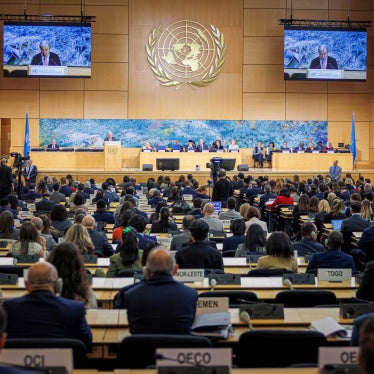
In October 2022, the Human Rights Council established the mandate of the Special Rapporteur on Russia, citing grave concern over “systematic crackdowns on civil society organizations”, “reported mass arbitrary arrests… , the deterioration of the rule of law,” and “mass forced shutdowns of civil society organizations and independent media outlets.” Since then, the authorities’ campaign of repression has only accelerated.
Human Rights Situation in Russia – Latest on an Ever-Worsening Crisis
Continued decimation of civil society
- “Undesirable” organizations. Russian authorities continued using legislation on “undesirable” organizations to target dissent.
- Since August 2024, authorities designated 67 organizations as “undesirable,” bringing the total number on the registry to 245.
- Among the organizations added in the past year are independent media outlets such as Echo, which authorities had liquidated earlier, the Ukrainian human rights group ZMINA, Amnesty International, the Polish human rights group Helsinki Foundation for Human Rights, the British Council, the U.S. Helsinki Commission, the Council of Europe-established Register of Damage Caused by the Aggression of the Russian Federation against Ukraine, and other anti-war and human rights initiatives.
- Prosecutions based on these arbitrary decisions continued. Since August 2024, courts imposed at least 185 penalties for “participating” in the activities of “undesirable” organizations. In at least 125 of these cases, authorities targeted people in connection with prominent media outlets such as Meduza, TV Rain, the Insider and Radio Free Europe.
- In May, a court in Moscow sentenced Grigory Melkonyants to five years in prison on bogus charges of heading a prominent Russian election monitoring group, Golos, which authorities equate with the European Network of Election Monitoring Organizations, which they previously designated “undesirable.”
- “Foreign agents.” The state can designate any individual or entity a “foreign agent” if authorities deemed them to be “under foreign influence.” Authorities yet again expanded this legislation to further stigmatize and marginalize independent voices.
- New laws banned “foreign agents” from conducting any education-related activities, expanded grounds to designate people and organizations as “foreign agents,” imposed additional prohibitions on state support to these groups, and added new and increased existing fines for violations. A December 2024 law banned “foreign agents” from disposing of intellectual property income, and income from renting or selling property. Such funds are frozen in a special account until the person or entity loses the status.
- Since August 2024, the authorities added 200 people, organizations, and groups to the registry, bringing its current total to 1,043. The new designations included Sova Research Center, “Transparency International Russia in exile,” and prominent members of Memorial Human Rights Center which is operating in exile (and which authorities designated in 2024). Nasiliu.Net, a project that combats domestic violence and supports survivors, designated a “foreign agent” in 2020, had to significantly scale down its programs because multiple commercial services, for example an SMS subscription service that facilitated SOS call buttons, refused to continue working with them. They cited the “risks” associated with Nasiliu.net’s “foreign agent status.”
- By June 2024, criminal cases were brought against 25 people for “foreign agent” violations. Between January and July 2025, new criminal cases were brought against another 72 people for “foreign agent” violations, according to a commission under the upper house of parliament.
Crushing of any political opposition
- Russian authorities have long since eliminated any semblance of genuine political competition and used a range of measures to harass and persecute political opposition.
- They continued using vague and ambiguous anti-extremism laws to prosecute people for symbols associated with Russian opposition leader Alexei Navalny, for whose death in prison in February 2024 the Kremlin is responsible, involvement with or donations to Navalny’s Anti-Corruption Foundation and other organizations. At least 76 people faced criminal charges for donations, and 49 have already been convicted and imprisoned, for up to 4 years. The number of penalties courts handed down for displaying these organizations’ symbols, Navalny’s portrait or using his name surpassed 200.
- Following Russian authorities’ June 2024 designation of the nonexistent “Anti-Russian Separatist Movement” as an “extremist” organization, along with 55 groups they falsely identified as its structural units, the Supreme Court also designated the online discussion forum Free Nations of Postrussia Forum a “terrorist” organization in November 2024, together with 172 groups it wrongfully alleged are the forum’s “units.” The decisions cover numerous political and rights groups, media outlets, Indigenous People’s organizations, research and other organizations. These decisions allow authorities to arbitrarily prosecute people on terrorism and extremism charges for a broad range of peaceful activism.
Repression of anti-war expression
- Courts have sentenced many people to long prison terms for anti-war speech and peaceful protest, sometimes in combination with other charges.
- 641 people have been criminally prosecuted on bogus charges of “false information” or “discreditation” of Russian armed forces since the start of the full-scall invasion of Ukraine. In total, 1,181 have faced criminal prosecution for opposition to Russia’s war, and 336 people remain imprisoned on these charges.
- In May, a military court sentenced Sergei Veselov to 13 years in prison for writing the number of Russian casualties in Ukraine on a bus stop. The prosecution considered this to be vandalism motivated by political hatred, “fake news” about the Russian army and evidence of alleged participation in the Freedom of Russia legion, which Russian authorities designated a terrorist organization. In July, in closed proceedings, a court in Ufa sentenced RusNews journalist Olga Komleva to 12 years in prison on charges of participating in the Anti-Corruption Foundation and disseminating false information about the Russian army. No details are available because the trial was closed.
- Authorities also continued censoring online information and opinions about Russia’s war on Ukraine that are not aligned with the official narrative. In August, the digital rights group Roskomsvoboda found that authorities blocked more than 25,000 websites on such grounds. However, the total number of materials censored since 2022 is in the hundreds of thousands.
Freedom of expression and access to information online
- Authorities continued expanding their control over Russia’s physical and technical internet infrastructure, including by investing significantly in controlling the companies providing internet services and expanding the technology that allows the state to independently reroute, block and filter internet traffic, which are mandatory for all internet service providers to install.
- Russian authorities adopted a law penalizing people for “intentionally searching” for extremist materials online, and made using VPNs an aggravating circumstance for committing certain crimes.
- By October 2024, Roskomnadzor, Russia’s communications agency, said it blocked 197 VPN services.
- The authorities regularly, increasingly carried out internet shutdowns which severely undermined access to information and services online in the country. They blocked and throttled access to social media platforms and other popular websites such as YouTube, WhatsApp, and Telegram.
Persecution of lesbian, gay, bisexual, and transgender (LGBT) people
- Based on Russia’s Supreme Court ruling outlawing “the International LGBT Movement” as an “extremist organization” in November 2023, courts imposed at least 101 penalties for supposed participation in the LGBT movement or displaying symbols associated with it, such as the rainbow flag.
- At least two people received prison sentences, of six and three years respectively, for allegedly “involving” people in the “LGBT Movement.” One person died by suicide in pre-trial detention where he was held on charges of running an “extremist organization.” The alleged organization was a travel agency that sought to market tourist travel to gay men.
- At least 17 more criminal cases are pending, including against individuals accused of running bars popular among LGBT people, posting items on social media for same-sex dating people, or advocating for LGBT rights.
- Since the November 2023 designation, police have conducted at least 51 raids on establishments popular among LGBT people, recorded guests’ personal data, and examined the contents of their devices.
Renewing the mandate of the UN Special Rapporteur on Russia
Renewing the Special Rapporteur on Russia’s mandate is essential to ensure an independent monitor of the situation and that the United Nations is in a position to respond robustly and consistently to the Russian government’s escalating human rights violations against people voicing peaceful criticism.
The Special Rapporteur mandate is needed also because it provides a vital lifeline of engagement and support within the UN system for Russian human rights defenders, activists, and civil society organizations, who are increasingly isolated from international support.