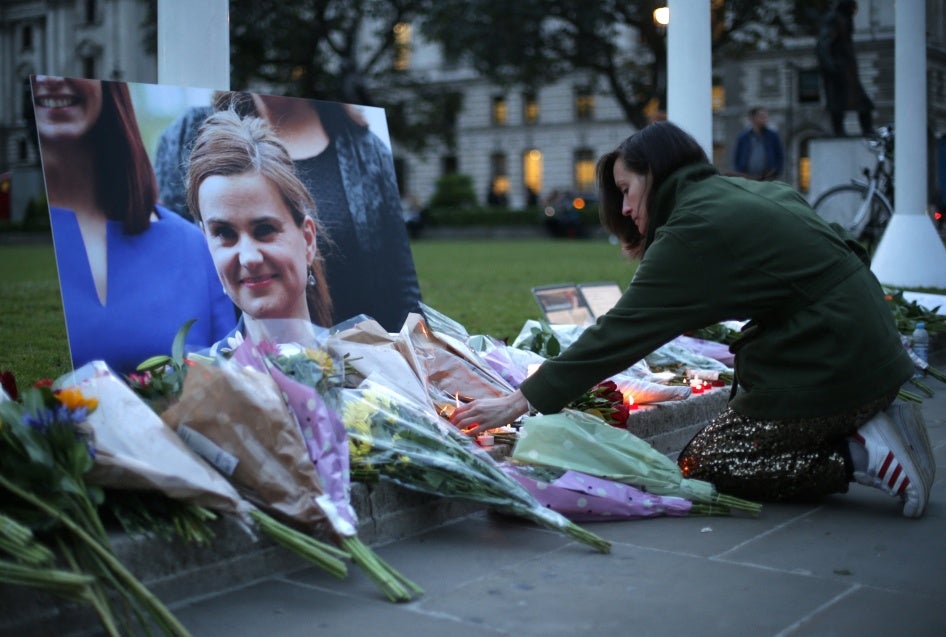
In June 2016, British member of Parliament Jo Cox, a close friend who worked with me at the humanitarian group Oxfam International, was murdered on the steps of her office in West Yorkshire, England. Jo was more than a rising star in British politics—she was a humanitarian, mother, friend, and a fighting force of hope in dark times. A man ended her life with a homemade gun, a knife, and a far-right ideology rooted in hatred. I still remember the phone call I got that day—the disbelief that Jo could be gone and that someone was so consumed by political disagreement that he could take her life.
I mourn the loss of Jo every year in June. But this year, that sadness became shock as political violence claimed yet another lawmaker's life. The killing of Melissa Hortman, a Democratic member of the Minnesota House of Representatives, and her husband Mark, and the wounding of Democratic State Senator John Hoffman, and his wife Yvette were equally senseless.
I hope they bring a reckoning with the violence that risks becoming a defining feature of U.S. politics and that has yet to be properly addressed.
Public servants should not have to weigh the risk to their families before casting a vote or answering constituents' questions. Political violence doesn't just harm individuals—it poisons the system, scares away good people, and chips away at public trust.
Some of the responsibility for building a national consensus against political violence—or at the very least not fueling the violence—sits with the president and his staff. So far this administration's instinct has been to pour fuel on the flames by demonizing its critics, its political opponents, even judges and civil servants who emerge as obstacles to its agenda.
By the time rioters assaulted the U.S. Capitol on Jan. 6, 2021, we were well past warning signs that political violence was becoming firmly rooted in modern politics. We'd already seen an assassination attempt on Arizona Representative Gabby Giffords, and a mass shooting that nearly claimed the life of then House Majority Whip Steve Scalise at a congressional baseball game.
Later, the husband of Nancy Pelosi, then the House speaker, was attacked in their home and Donald Trump was shot and very nearly assassinated while at a rally before the 2024 election. According to the Capitol Police, threats against members of Congress have more than doubled, from fewer than 4,000 in 2017 to nearly 10,000 in 2021.
After Jo's murder, the U.K. government took immediate steps to better protect members of Parliament. Security increased at constituency offices. Parliament members were given funds to install home protection systems. Likewise, members of the U.S. Congress can now be reimbursed for home security systems, and a $2.1 billion emergency spending package after Jan. 6 helped plug gaps in Capitol security.
Ramped up security is a reasonable response, but it doesn't get at the root causes of the extremism that makes protecting lawmakers from physical violence necessary in the first place. To do that, we need to build a real national consensus against political violence, and refocus the federal government on stopping violence before it happens.
Beyond legislation, members of Congress and lawmakers all the way down to the local level should take care with their words that may make a policy disagreement personal. All legislators have a responsibility not to incite or advocate political violence and should condemn it whenever and wherever it happens. They should also actively speak out to dissuade others from fomenting violence and publicly counter narratives that feed into dangerous speech and promotion of violence, including in their use of social and broadcast media.
Jo said in her maiden speech to the U.K. Parliament, "We are far more united and have far more in common with each other than things that divides us." It was a courageous call to all of us. She believed in her and our own ability to work for better politics and protect the freedoms of speech and association, and that her democracy was worth protecting and fighting for. I believe our American democracy is also worth saving and that any alternative is unacceptable.