Without Water, We are Nothing.
Read a text description of this video
SOUNDBITES
María Osorio Osorio
We are suffering a lot because of water.
Patricia Mejía Pérez
Honestly, knowing that there is much water in Guatemala but that here we have no freshwater is so sad.
María Canalari Pucarrín
We ask the government for help, that they help us with water. Because we can’t live without water.
TITLE
WITHOUT WATER, WE ARE NOTHING.
TEXT ON SCREEN
Guatemala has more freshwater per capita than the world average.
SOUNDBITE
María Osorio Osorio
In our village we are in need. We don’t have piped water.
TEXT ON SCREEN
In a country of about 18 million people, over 7 million live in a home without any indoor
connection to a water distribution network.
Many people are forced to rely on wells, rivers, lakes, springs or rainwater.
Governance failures, including poor resource management and inadequate infrastructure, have led to drinking water scarcity and widespread contamination.
SOUNDBITES
Patricia Mejía Pérez
If we had clean water, my life would be better, we would feel better.
María Osorio Osorio
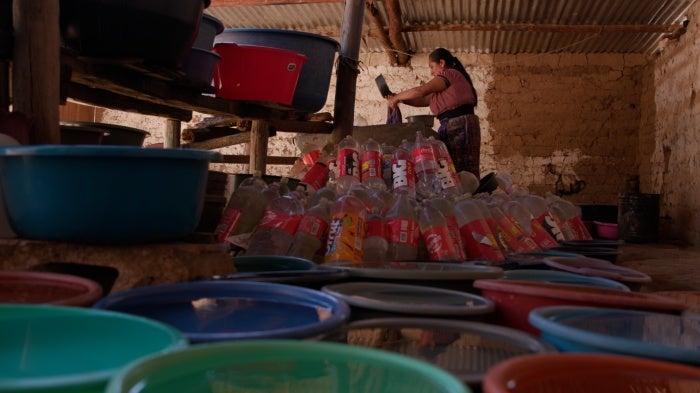
Together with my children we walk [to the well], I bring my jerrycan and they bring their ‘jumbos’ to collect water. The path to the well is really bad, it’s full of rocks, there is grass, among other stuff.
TEXT ON SCREEN
Indigenous people, especially women, are disproportionately affected due to structural discrimination, poverty, and inequality with deep historical roots.
Patricia Mejía Pérez
It takes us a long time to arrive at the well. We carry water but not too much because we can’t make it, the well is very far away. The way back is harder, harder indeed. It’s really tough because the path is uphill, it’s so difficult. Sometimes we find snakes on the way. It’s really hard to carry the water all the way here to take it home. Children cry because they can’t make it. “It’s too heavy,” they say. They cry because of the weight. They say “we are already thirsty” and they drink the water they carry because they are just so thirsty. And we do six trips in one same day. And the water we bring lasts for three days only.
TEXT ON SCREEN
Lack of safe water and sanitation fuels diseases like diarrhea, a leading cause of malnutrition.
SOUNDBITES
María Magdalena Cacó
We need to buy medicine because there is no medicine at the medical center. It’s so sad that the water is polluted, there are dead animals, and we drink that water. And after drinking it, we get sick. We get stomach ache, diarrhea actually.
Clara Susana Pubaca
I do have a toilet, but just a pit latrine because we have no money for a luxury toilet.
TEXT ON SCREEN
Guatemala has one of the highest malnutrition rates in the world. Nearly 50% of children under five are chronically malnourished.
SOUNDBITE
María Magdalena Cacó
If I had piped water at home, my children would take a shower every day. I wouldn’t need to bring water from the well so I would spend more time with my children. I would feel happy.
TEXT ON SCREEN
Guatemala should urgently enact a national water law that guarantees the human rights to water and sanitation.
SOUNDBITE
María Magdalena Cacó
To me, water is life. If we have no water, we can’t live. If we have no water, we die.
María Osorio Osorio, a 41-year-old Indigenous Maya woman from the municipality of Santa María Chiquimula, in Guatemala’s Totonicapán department, lives without access to running water. Three times a week she makes a two-hour round trip to collect water from a well or ravine, sometimes accompanied by her children, aged 5, 12, and 17. “Sometimes we each only drink one glass of water [a day],” María said. “There is no more water than that.”
This lack of water affects nearly every aspect of María’s life. With so little available, she is only able to bathe once a week. Her home has no toilet; instead, she relies on a blind pit (a hole in the ground) shared by seven people. María said her children are frequently sick, suffering from diarrhea or flu-like symptoms on a weekly basis.
