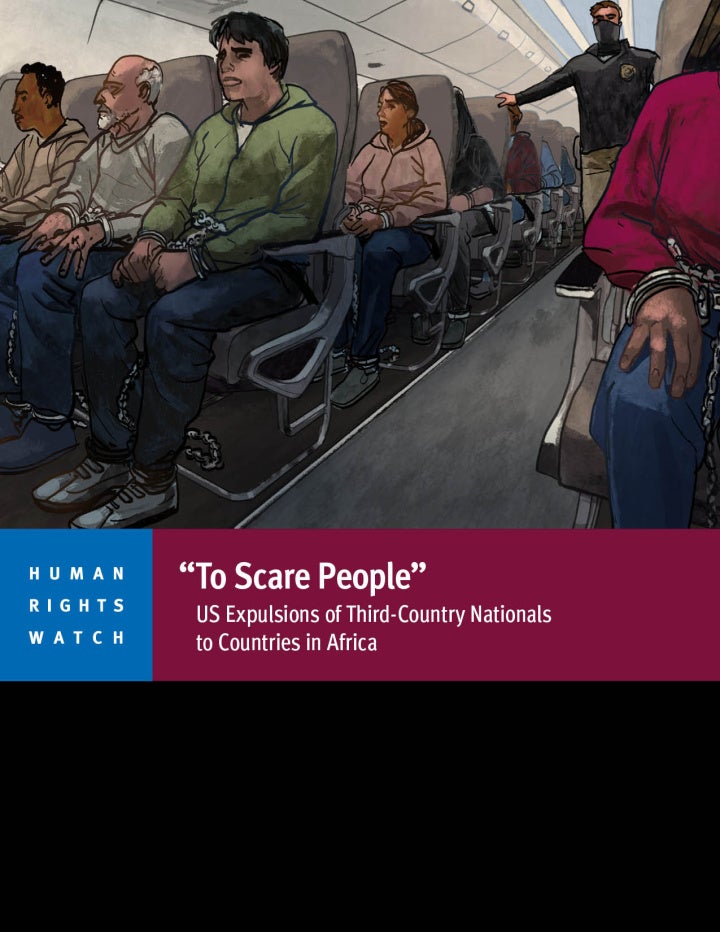
US Expulsions of Third-Country Nationals to Countries in Africa
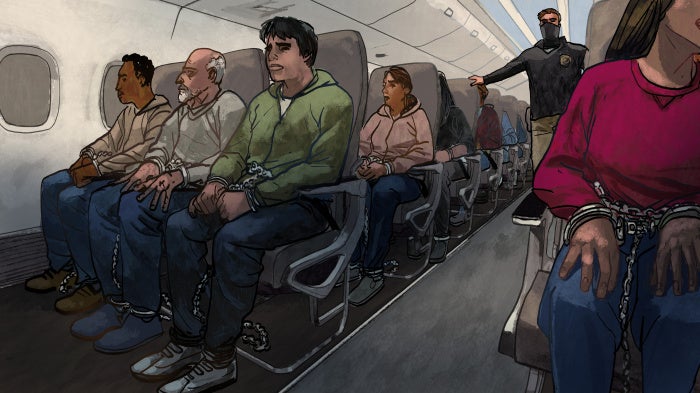
The 125-page report, “‘To Scare People’: US Expulsions of Third-Country Nationals to Countries in Africa,” documents that US authorities denied the more than 500 people transferred to third countries a meaningful chance to contest their removals or to articulate their fears of being removed to these countries. Some countries arbitrarily detained people they had accepted, and some have sent people onward to the risk of persecution or torture in their home countries, violating the international law principle of nonrefoulement.
For over a year, Human Rights Watch investigated and monitored French asylum policies, conducting numerous interviews with lawyers, human rights advocates, refugee assistance organizations, asylum seekers, and government officials. In the course of this work, we have identified several aspects of French asylum policy that contravene governing international standards.
Between 1993 and 1995, the United Nations Development Program (UNDP) administered a program to return an estimated 300,000 persons who were driven off their land by state-sponsored “ethnic” violence.
Unaccompanied Children Detained by the U.S. Immigration and Naturalization Service
The U.S. Immigration and Naturalization Service (INS) violates the rights of hundreds of unaccompanied children each year, some as young as eight, contrary to international law as well as INS regulations. Children are arrested, imprisoned, and deported, all by the same agency charged with protecting their rights.
In this document, Human Rights Watch seeks to raise concerns about some disturbing trends in the protection of refugees it has observed in the course of researching human rights abuses.
China is increasingly exercising its authority over the territory of Hong Kong on a number of issues and has directed, for instance, that all the Vietnamese be cleared from Hong Kong before July 1. Such pressure has spurred the Hong Kong government to redouble its efforts to resolve the Vietnamese situation, which has embroiled the territory in controversy for over twenty years.
and Other Human Rights Obligations on the First Anniversary of its Accession to the Council of Europe
On February 28, 1996, the Russian Federation became a full member of the Council of Europe, an intergovernmental organization based in Strasbourg, France, which, among other goals, aims to protect human rights. Accession to the Council of Europe heightened expectations that the Russian Federation would take concrete steps to improve its poor human rights record in the year that has followed.
Some 2,685 villages and hamlets in Turkey’s southeastern provinces have been completely or partially depopulated since fighting broke out in the region in August 1984 between government forces and the Kurdistan Workers Party (PKK), an armed group which until recently had the avowed goal of an independent Kurdish state. Although there has been some migration for economic reasons, most of the depopulation has been the result of a government counterinsurgency campaign intended to deprive the PKK of logistical support. The PKK has also targeted state-sponsored village civil militia settlements, forcing some inhabitants to flee. Estimates of the number of individuals displaced range from 275,000 to two million.
In 1992, a devastating civil war in Tajikistan led to the deaths of more than 20,000 (with some estimates as high as 50,000) and created more than 800,000 displaced persons and refugees.
In March and May 1995, the Human Rights Watch Children=s Rights Project conducted an investigation in Louisiana into the conditions in which children are confined in that state, examining the human rights aspects of their incarceration.We found that substantial numbers of children in the state training institutions are regularly physically abused by guards, are kept in isolation for long periods o
The children of Sudan, north and south, have been denied their basic rights by all parties to the conflict, and by the government of Sudan even in areas such as Khartoum where there is no war. Many who are considered street children, mostly southerners and Nuba, are removed from their families without notice.
Kuwait practices a system of institutionalized discrimination against its residents known as Bedoons, longtime inhabitants who have been denied Kuwaiti citizenship and are now being rendered stateless.
Rights Abuses Follow Renewed Foreign Aid Commitments
Since December 1994, there has been a notable deterioration in the human rights situation in Kenya, evidenced by Pres. Moi's crackdown against human rights activists, opposition politicians and internally displaced persons.
Two years after a bloody and devastating civil war, the human rights situation in Tajikistan remains precarious. Since the spring of 1993, refugees and internally displaced persons have returned to their villages in the southern province of Khatlon, from which the largest number of people were displaced following the war.
Germany has been confronted with a disturbing escalation in violent crimes against those who are different, and especially those who are perceived as not ethnic German during the period since unification. Racism that is endemic in many societies has exploded in a public way in Germany.
Like their enslaved ancestors more than two centuries ago, tens, if not hundreds, of thousands of Haitians are on the run, fleeing the murderous military regime that sent their elected president into exile after the September 30, 1991 coup d'etat.