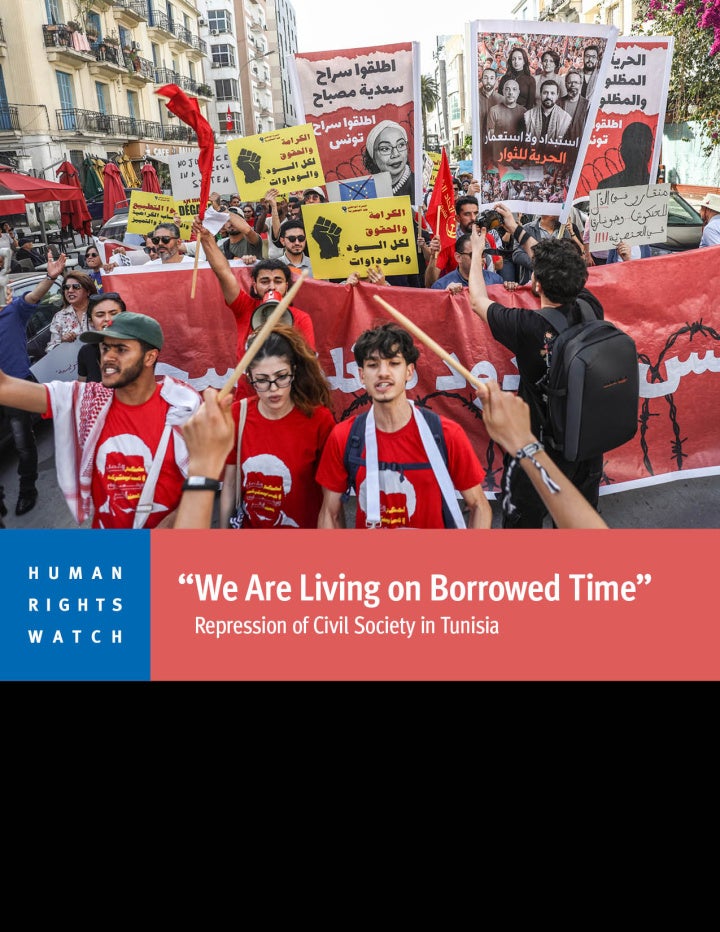
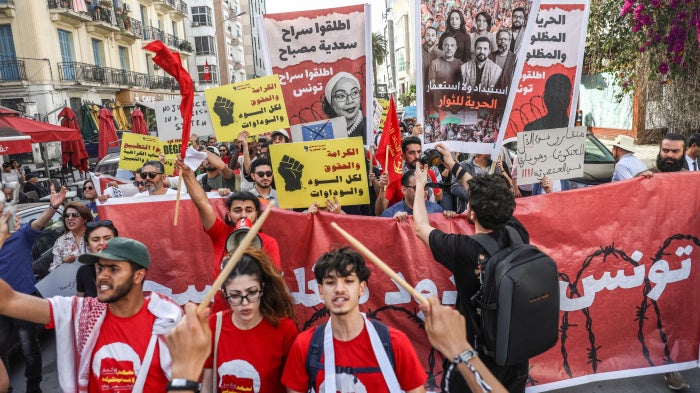
The 49-page report, “‘We Are Living on Borrowed Time’: Repression of Civil Society in Tunisia” documents the Tunisian authorities’ escalating repression of local and international civil society groups, workers, members, and affiliates through the weaponization of abusive prosecutions, arbitrary arrests, detention, financial and criminal investigations, mass suspensions, and threats of dissolution.
A nationwide student protest movement played an instrumental role in forcing the resignation of President Soeharto on May 21, 1998 and in opening the door to democratic reform in Indonesia.
The present political environment in Cambodia, in which opposition parties are not able to operate freely and safely, is in no way conducive to the holding of free, fair, and credible elections. The primary obstacle is neither logistical nor technical, but rather the determination of the ruling Cambodian People's Party (CPP) to control the electoral process and restrict basic freedoms.
Five years of civil war in Tajikistan were formally brought to a close on June 27, 1997, when a peace accord was signed between the government and the United Tajik Opposition (UTO). A major force, however, was left out of the peace negotiations: the political opposition based in Tajikistan's northern region, Leninabad.
This report examines barriers to academic freedom and the exercise ofbasic rights erected during the thirty-two year authoritarian rule of PresidentSoeharto in Indonesia. As this report was being prepared, Indonesia was undergoing what appeared to be a momentous transition, spurred on by students and faculty, toward a more democratic society.
A month after Second Prime Minister Hun Sen's coup, Cambodia bears little resemblance to the society envisioned in the Paris accords of 1991 that laid the framework for an end to conflict and a United Nations peacebuilding effort on an unprecedented scale.
The New Amendments to the Press and Publications Law
Since Jordan signed a peace treaty with Israel in 1994, there has been growing tension between the Jordanian government and the independent press, particularly the kingdom's small-circulation weekly newspapers. Journalists and editors have been arrested, detained and prosecuted for violations of both the penal code and provisions of the press and publications law of 1993.
On May 23, 1997, Iranians went to the polls for the seventh time to elect a president of the Islamic Republic. The incumbent, Hashemi Rafsanjani, served the two consecutive four-year terms permitted by law. The transfer of power by way of elections was a notable event in a region in which most leaders do not voluntarily leave power or subject themselves to any type of open electoral process.
Lebanon's airwaves had long been unregulated, with scores of unlicensed private broadcasters that ranged in political diversity from the radio station of the Lebanese Communist Party to the television station of Hizballah. The broadcasting community included 52 television stations and over 120 radio stations for a population of three million.
On November 18, 1996, Zambians voted in parliamentary and presidential elections—the second multiparty elections since the end in 1991 of twenty-seven years of authoritarian and mostly single-party rule, under former president Kenneth Kaunda.
With its decision to bring Chinese dissident Wang Dan to trial on October 30 on the charge of “conspiracy to subvert the government,” the most serious charge in the Chinese criminal code, the Chinese government has signaled its determination to deny freedom of speech and association to any citizen daring publicly to raise fundamental criticisms of government policy.
In the aftermath of rioting on July 27, 1996, in Jakarta, a massive crackdown was conducted by the Indonesian internal security apparatus, targeting young student activists suspected of involvement in organizations collectively branded by the army as the "new PKI" [Indonesian Communist Party].
On May 7, 1992, an Egyptian administrative court decided to uphold last year's decree dissolving the Egyptian branch of the Arab Women's Solidarity Association (AWSA), a prominent women's rights organization. The court refused to grant an injunction that would have allowed AWSA to continue operating while it awaits the outcome an appeal on the merits of the government decree.
As the 1997 parliamentary elections in Indonesia approach, the political atmosphere has begun to heat up and civil liberties are deteriorating. Since the first such election under the “New Order” government of President Soeharto in 1971, they have never been the “democratic festival” that the government would have both outsiders and its own citizens believe.
Despite the government of Uzbekistan's professed commitment to freedom of the press—made both explicitly and publicly over the past two years—state censorship of the media remains pervasive and intimidation of journalists is rampant. The tone and subject matter of articles published in Uzbekistan is strictly controlled by the government.