This statement was delivered at a consultation of the Global Initiative to Galvanize Political Commitment to International Humanitarian Law (IHL). The initiative was launched by the International Committee of the Red Cross, Brazil, China, France, Jordan, Kazakhstan, and South Africa and has brought together more than 100 states to develop concrete recommendations to promote compliance with IHL.
Human Rights Watch welcomes the opportunity to contribute to this consultation on Protecting Civilian Infrastructure.
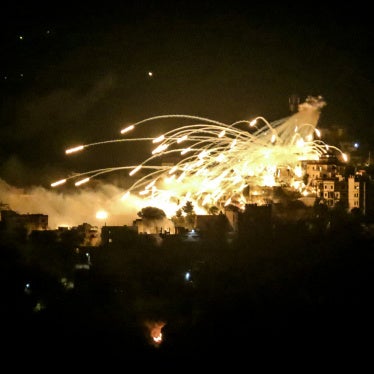
For decades, Human Rights Watch has documented widespread destruction in conflict zones of private and public civilian infrastructure and other civilian objects, including those indispensable to the survival of the civilian population. In numerous cases, including in particular the use of explosive weapons in populated areas, we have found that there were no apparent military targets at or near infrastructure that was destroyed, including at trading and transportation hubs, electricity and water installations, factories, hospitals, schools, and residential housing.
Unlawful infrastructure damage or destruction leads not only to laws of war and human rights violations but also to severe immediate and long-term civilian suffering. Put simply, collapsed food, water, and healthcare systems kill in the short and long term and trigger mass displacement and other humanitarian calamities.
In light of the catastrophic consequences flowing from unlawful attacks on infrastructure, Human Rights Watch encourages states:
- Not to adopt an overly expansive interpretation of the concept of “military objective”;
- To codify as clearly as possible in target selection and verification procedures when they consider infrastructure on which civilians depend to have become a military objective;
- To rigorously adhere to the principle that the expected civilian harm resulting from a planned attack on infrastructure, including the immediate, long-term, and reverberating effects, should never outweigh the concrete and direct anticipated military advantage;
- To use new technology and technical experts familiar with civilian infrastructure to ensure commanders take sufficient precautions to avoid or minimize civilian harm before attacking infrastructure on which civilians depend, bearing in mind that damage to just a small part of interconnected infrastructure can have serious effects on civilians;
- When assessing the foreseeable harm to civilians caused by destroying infrastructure on which civilians depend, to take into account which other infrastructure has already been destroyed and the ability of civilians to access humanitarian aid and services;
- To take constant care during military operations to spare civilian objects;
- To carry out rigorous post-strike impact assessments to determine whether the impact of the infrastructure damage or destruction goes beyond the originally anticipated harm to civilians and publish the results of these assessments;
- To ensure rigorous training for commanders on their obligations relating to civilian infrastructure;
- To investigate and prosecute those responsible for criminal attacks on civilian infrastructure, including commanders under the principle of command responsibility;
- To refrain from the use of explosive weapons with wide area effects in populated areas and restrict the use of all other explosive weapons in populated areas; and
- To endorse and implement the 2022 Political Declaration on Strengthening the Protection of Civilians from the Humanitarian Consequences Arising from the Use of Explosive Weapons in Populated Areas.
Thank you.