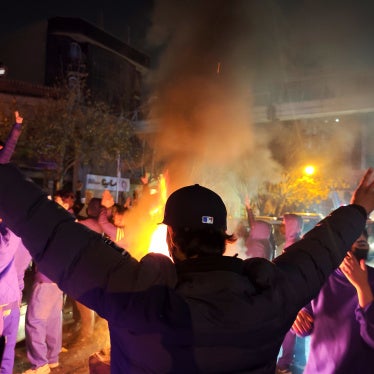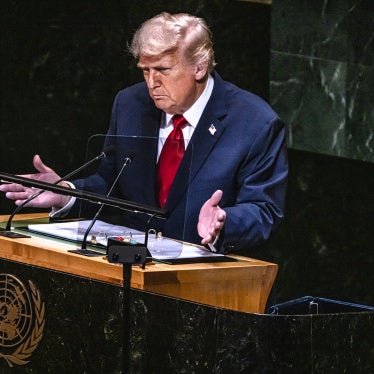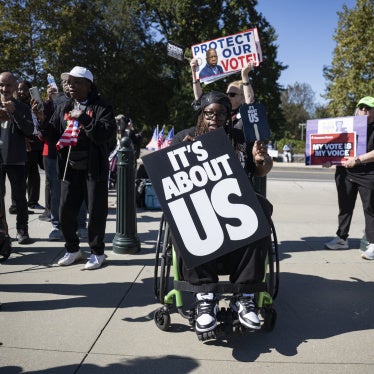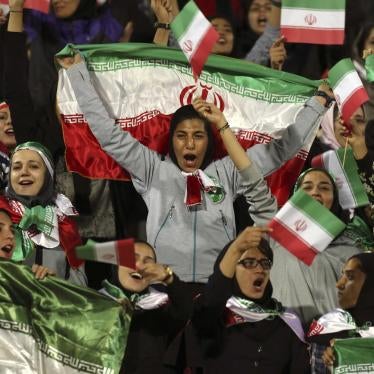
President Donald Trump has threatened to attack Iran to defend protesters there, casting himself as a defender of freedom and exhorting demonstrators to keep it up, posting “Iranian Patriots, KEEP PROTESTING — TAKE OVER YOUR INSTITUTIONS! … HELP IS ON ITS WAY.” Yet at home, Trump has treated protests not as protected democratic activity, a right to freedom of expression, but as a threat to be suppressed with violence and retribution.
This stance is of course wildly hypocritical, but it also reflects a deeper vision of rights as conditional. The administration responds to protesters as though rights should be extended selectively to those whose cause aligns with its own objectives and denied to those who challenge the president’s power.
Trump has consistently framed protest in the United States as a threat to be crushed. During the 2020 racial justice demonstrations following the murder of George Floyd, he described protesters as violent and publicly urged law enforcement officers to “dominate” demonstrators. In June 2020, following law enforcement’s use of tear gas to forcibly clear peaceful protesters from Lafayette Square, a park across the street from the White House, Trump stood in front of a nearby church for a photo opportunity, declaring himself a “law and order” president.
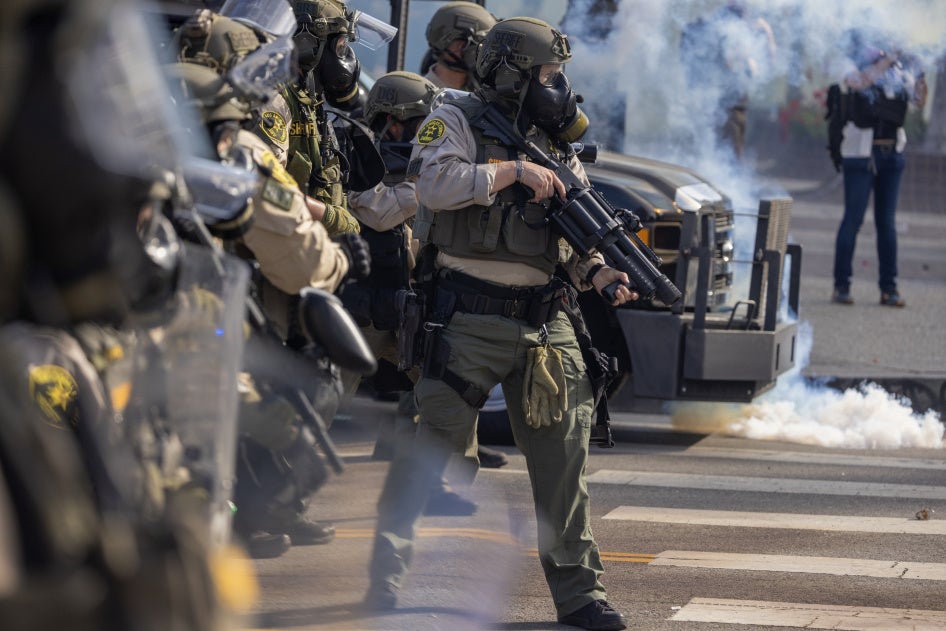
More recently, Human Rights Watch documented that federal law enforcement agencies responded to protests in Los Angeles and Chicago with excessive force, deploying tear gas and firing projectiles, including against journalists and legal observers. These tactics have contributed to a climate of fear and confusion that threatens to chill peaceful assembly. Senior officials and prosecutors have also issued official directives against domestic activist groups that risk conflating dissent and protected expression with criminal conduct, raising serious due-process and free-speech concerns.
Beyond using brute force to suppress protests directly, Trump has gone after the infrastructure of civil society that has been defending human rights. Groups working to protect immigrants’ rights, racial justice, reproductive rights, and civil liberties have been subjected to public vilification, threated with the revocation of their tax status, and, in the case of Palestinian rights groups, hit with sanctions. The administration also began an investigation of the Open Society Foundations, non-partisan funder of human rights defenders.
This domestic record makes Trump’s posture toward Iran especially exasperating. When he threatens military action in the name of protecting protesters abroad, he is cynically invoking the universal right to protest while making clear that he believes it is only legitimate when it serves his purposes.
The Trump administration’s abusive response to protests at home poses an even wider danger. Other governments are watching, and authoritarian leaders often point to the US double standard to justify their own crackdowns.
That dynamic did not begin with Donald Trump. Despite the United States’ rhetorical legacy of free speech in a free country, authoritarian governments have long found fodder in America to reframe their own repression. Turkey’s prime minister, now the president, Recep Tayyip Erdoğan, claimed that police violence during the 2013 Gezi Park protests in Istanbul were not very different from those used in the United States.
During the 2020 protests in the United States, Chinese state media broadcast videos of the militarized US response. A number of editorials compared the “barbarism” of US police with the “patience” shown by the Chinese government toward Hong Kong protesters responding to Beijing’s imposition of the Hong Kong National Security Law, which criminalized protest with up to life in prison.
What distinguishes the current moment is that the second Trump administration has elevated US hypocrisy into a governing logic that actively licenses repression at home while brandishing rights rhetoric as a pretext for coercion abroad.
The message Trump’s approach sends to people who risk their lives to protest is especially damaging. When support for protest is conditional and transactional, it becomes unreliable. Protesters become symbols to be either claimed or discarded, depending on the political winds and politicians’ whims. If Trump truly believed in freedom of expression, the evidence would be visible at home. Instead, the record points in the opposite direction. Defending protest abroad while suppressing it here is yet another example of Trump’s abandonment of universal human rights.