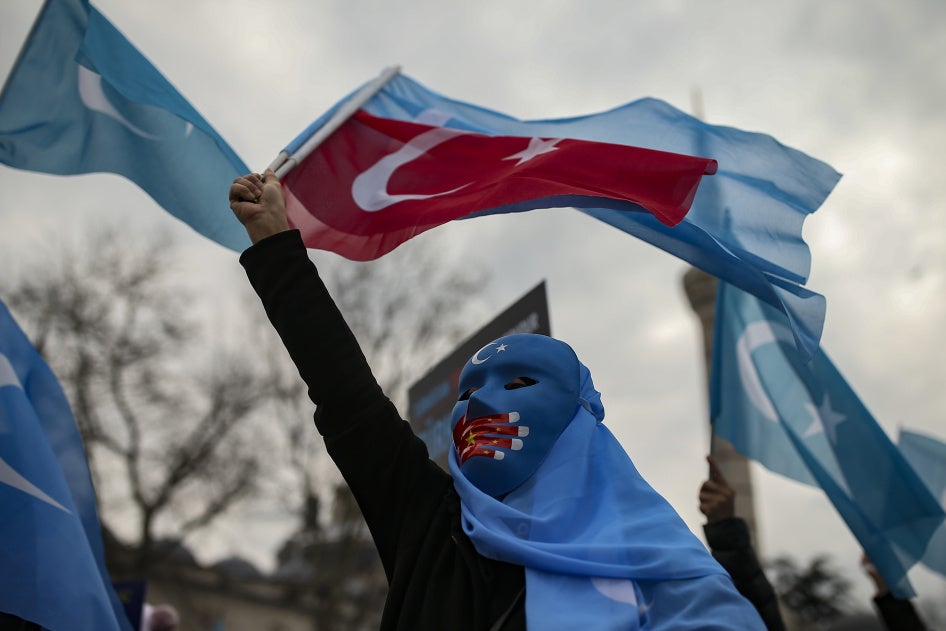
Since late 2016, Uyghurs and other Turkic Muslims in northwestern China have been victims of crimes against humanity perpetrated by the Chinese government. As an international student living in Istanbul at that time, I decided not to return home and instead started publicly advocating on behalf of hundreds of thousands of arbitrarily detained Uyghurs in China. They include my father, Memet Yaqup, who disappeared in 2018 and is now serving a 16-year prison sentence, having committed no crime.
Until recently, the Turkish government had provided protection with preferential treatment for Uyghurs like me due to our Turkic origin. This made many of us eligible for long-term residence permits and subsequently Turkish citizenship. However, over the last couple of years, as Turkey has adopted increasingly anti-immigrant policies and China-Turkey relations warm, various administrative malpractices have not only nullified that preferential treatment – they have put members of my community at risk of forcible return to China.
Based on my recent research, Turkish authorities have arbitrarily assigned “restriction codes” to some Uyghurs, among other refugees and migrants, considering them public-security threats, often without evidence or any reasonable justification. The Turkish government has cited laws pertaining to foreigners and international protection in doing so, but the criteria and rationale for how these codes are currently assigned is unclear.
A simple complaint from a neighbour, even if deemed unfounded later, can result in the application of restriction codes in Turkey. The Chinese government has submitted lists to the Turkish authorities of people Beijing considers terrorists, in some cases for peaceful activism or expression of Uyghur identity. Some people on these lists have also ended up being tagged with restriction codes.
Such codes can lead to a cascade of negative and often devastating consequences, including denial of international protection, or denial of other statuses that entitle a person to residency or would provide a path to citizenship. This has had the effect of categorizing Uyghurs restricted by these laws as irregular migrants subject to deportation. If they are picked up by police or immigration officers for any reason, they can be sent to a deportation centre.
Turkish immigration authorities have pressed, and at times forced, Uyghur detainees (along with others from Syria or Afghanistan) to sign voluntary return forms.
Although the Turkish government has a policy against deporting Uyghurs directly to China, they have deported them to other countries where they are at risk of return.
I interviewed a person whom Turkish immigration authorities deported in 2019 to the United Arab Emirates, which has an extradition treaty with China. This person left the UAE and traveled through several other countries before reaching a safe destination. During that time, Chinese government agents harassed him and pressed host governments to send him back to China. Local immigration authorities in two of his transit countries detained him.
Under Turkish law, individuals can appeal these deportation decisions. However, according to a lawyer I spoke to who has made such appeals many times, judges often make a negative decision when they see restriction codes attached to a file, just to be safe.
I reviewed a number of cases in which Turkish courts ruled that the international prohibition on sending people back to a place where they would face danger does not apply for the Uyghurs. There is ample evidence, though, that Uyghurs returned to China face detention, interrogation, torture and other cruel, inhumane and degrading types of treatments, especially if they come from countries Beijing arbitrarily deems “sensitive,” including Turkey.
As my community went through the pain of family members being forcibly disappeared back home, Turkey provided me the lifeline I needed. I graduated with a PhD in international relations from Turkey’s Koç University and feel privileged and grateful to have obtained Turkish citizenship. But that privilege is not the case for many other Uyghurs.
Many Uyghurs I speak with, from all over the world, including those in London, where I currently live, love Turkey and feel like home when they walk through Uyghur neighbourhoods in Istanbul. It is probably one of the few places where Uyghurs thrive and embrace their identity, culture and religion, while simultaneously existing as vibrant members of a cosmopolitan city. It is also the city where one can find the most delicious Uyghur cuisine, traditional clothing and Uyghur language books.
Turkish authorities should protect those Uyghurs who consider Turkey a second homeland, and not put them in harm’s way.