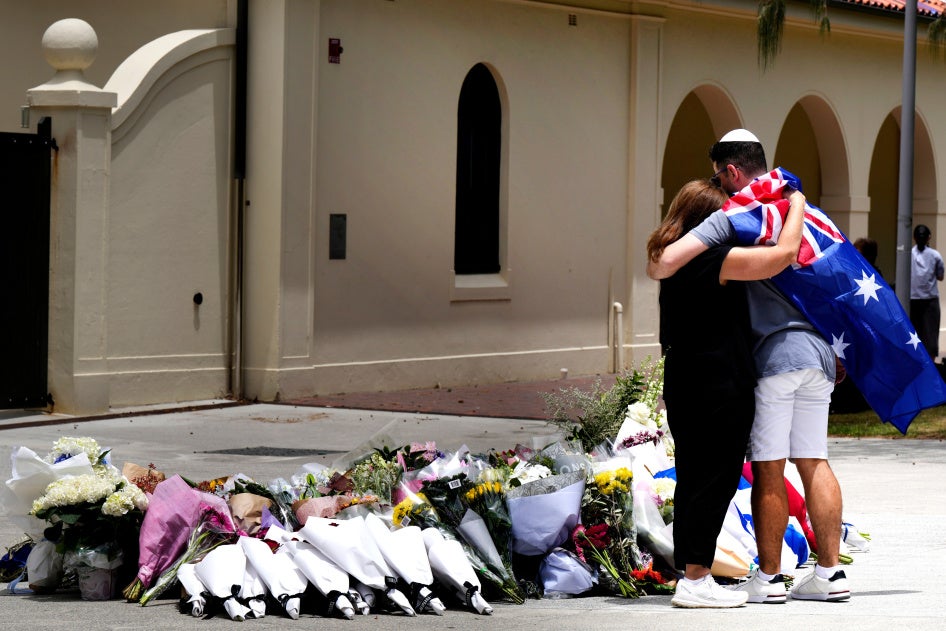
(Sydney) – A summer Sunday evening at Sydney, Australia’s Bondi beach turned into a terrifying nightmare as two gunmen opened fire on people celebrating the first night of the Jewish festival of Hanukkah. Sixteen people have been confirmed dead, including one of the shooters, with at least 42 injured. A second assailant was taken into custody.
“An attack on Jewish Australians is an attack on every Australian,” said Australia’s Prime Minister Anthony Albanese last night at a press conference. “Australia will never submit to division, violence or hatred.”
Strong political leadership is vital in ensuring everyone can live in safety and practice their religious beliefs. The actions needed to address intolerance and counter violent extremism will be a key debate in Australia for days and weeks to come.
The Bondi attack is the deadliest mass shooting in Australia in three decades, after the 1996 Port Arthur Massacre, which led to significant changes in Australia’s gun laws. The National Firearms Agreement is broadly regarded as one of the major achievements of then-Prime Minister John Howard’s term. The legislation banned semi-automatic rifles and shotguns and imposed strict national licensing requirements.
The attack comes after an increase in antisemitic hate crimes in Sydney. In the span of two weeks this past January, there was an arson attack and antisemitic graffiti on a childcare center in the suburb of Maroubra near a Jewish school and synagogue, two synagogues were defaced with swastikas, and the former home of a prominent Jewish community leader was set ablaze and four cars were destroyed.
Rights-respecting intelligence gathering and police work are key to protecting people in the most direct, physical sense. But tackling the motivations underlying hate crimes requires much more. They underscore the need for the Australian government to strengthen anti-racism community initiatives, as well as investing in education and community dialogue to combat prejudice. Politicians should not exploit this tragedy to sow further hate or division.
Authorities at the community, state, and national level should invest substantially in efforts to counter threats or acts of incitement, the spreading of hateful content online and harmful misinformation, and to promote inclusiveness and respect for all communities in Australia.