Database of UN Human Rights Treaty Bodies' Statements on Taxation
*Last updated July 8, 2025
Tax policy is inextricably bound up with governments’ human rights obligations. Under the International Covenant on Economic, Social and Cultural Rights, governments have an obligation to use the maximum available resources, including through international assistance and cooperation, to realize rights. This implicates governments’ domestic policies on tax as well as the extraterritorial impacts of these policies and the positions governments take within relevant international institutions. Taxation also affects the enjoyment of many other human rights, not just because of its impact on available resources but because tax policy creates legal obligations and behavioral incentives that can have wide-ranging human rights impacts.
International human rights norms offer useful guidance to international policy debates around taxation, in particular as states are beginning negotiations around a new United Nations tax convention, which are expected to conclude by the end of 2027. The convention’s terms of reference note that efforts to achieve its objective should “be aligned, in the pursuit of international tax cooperation, with States’ obligations under international human rights law.”
This database compiles each Concluding Observation made by UN human rights treaty bodies regarding taxation. There are 10 human rights treaty bodies; committees of independent experts charged with providing authoritative interpretation of their respective instruments and monitoring states’ implementation of their obligations under these treaties. For an analysis of how the treaty bodies have engaged with the complex interplay between human rights law and tax policy in these concluding observations, see Human Rights Watch's background brief.
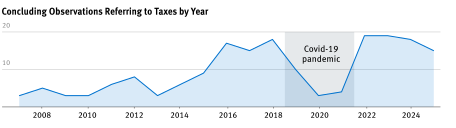
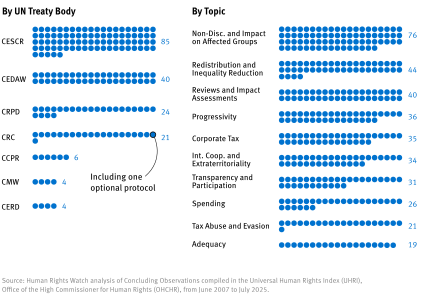
Click here to see the methodology for compiling this database.
Methodology
Concluding Observations were compiled using the Universal Human Rights Index (UHRI), maintained by the UN Office of the High Commissioner for Human Rights (OHCHR). The UHRI includes the concerns, observations, and recommendations made by each treaty body, as well as the Special Procedures mandate holders and the Universal Periodic Review.
Search results using the key word “*Tax*” were downloaded into a Microsoft Excel file and each result was manually reviewed to filter out irrelevant entries included in the search results (for example, references to taxis).
Along with the recommendations/observations text and the fields included in the search parameters, the exported search results also included categorizations according to relevant Sustainable Development Goals (SDG); Document Publication Date; Type (i.e., recommendation vs. observation); Regions Concerned; Date of Publication on UHRI; and the Document Symbol. Any missing data was added based on a review of the available information and in an attempt to remain consistent with the UHRI’s categorization methods and formatting.
Human Rights Watch then manually included additional categories for each concluding observation based on a subjective and relative review of each Concluding Observation as a whole.
The manual categorization was done conservatively: concluding observations were only included in the database, and then tagged to relevant issues, when the relationship was clear.
This database is periodically updated to incorporate newly published Concluding Observations following the same process outlined above.