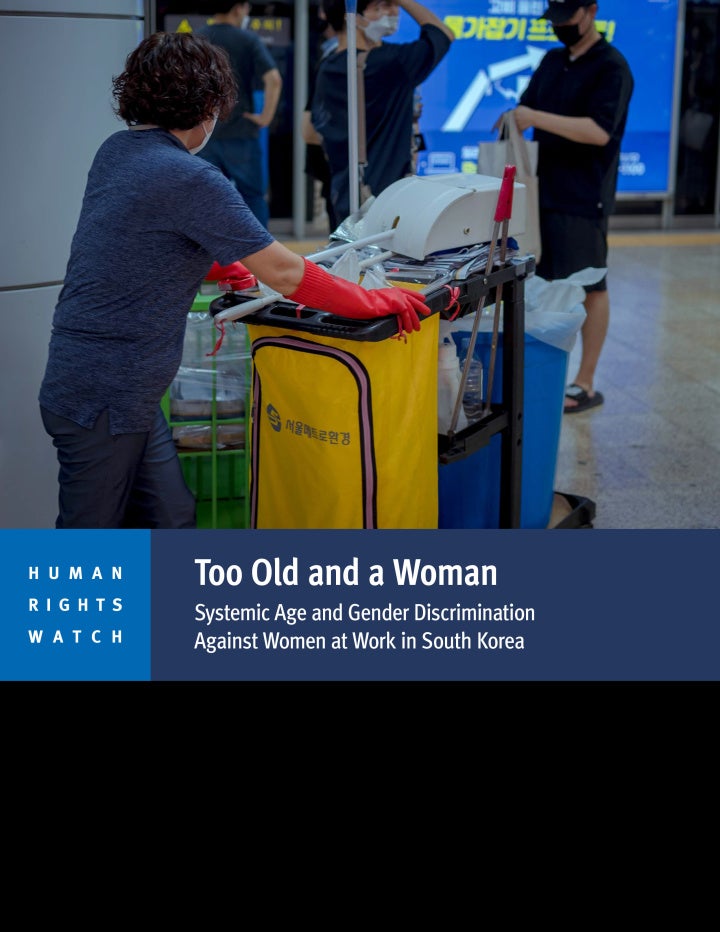
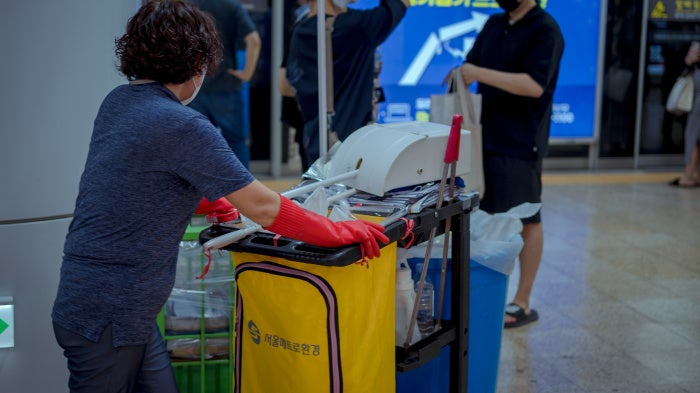
Systemic Age and Gender Discrimination Against Women at Work in South Korea
The 92-page report, “Too Old and a Woman: Systemic Age and Gender Discrimination Against Women at Work in South Korea,” documents that social attitudes toward education, unfair treatment in hiring, disrupted careers due to family responsibilities, limited promotion opportunities, glass ceilings, and sexual harassment create a disadvantage for South Korean women throughout their working lives. As women get older, their work opportunities narrow to a handful of low-paid, insecure jobs, and the gender pay gap increases. By the time they are eligible for pensions, women face a significant gender pension gap.
Backgrounder for the World Conference against Racism, Racial Discrimination, Xenophobia and Related Intolerance
Throughout the world, refugees, asylum seekers, migrants and internally displaced persons are the victims of racial discrimination, racist attacks, xenophobia and ethnic intolerance. Racism is both a cause and a product of forced displacement, and an obstacle to its solution.
Caste-based discrimination blights the lives of hundreds of millions of people around the world, and the World Conference Against Racism should have the issue squarely on its agenda, Human Rights Watch urges in a new report.
The State Response to Violent Crime on South African Farms
The South African government is failing to adequately protect residents of commercial farming areas from violent crime, Human Rights Watch charged in a report released today. Black farm residents are most severely affected by this failure, and black women are most vulnerable of all, Human Rights Watch said.
Millions of people in Asia, Africa, Europe, and the Middle East have been denied or stripped of citizenship in their own countries solely because of their race, national descent, and gender. In many countries, children born in their mother's country are denied her nationality because women can not transmit nationality.
Uzbekistan's post-Soviet development, like that in most of the former Soviet Union, has entailed enormous and disproportionate obstacles to women's realization of their human rights. During the past ten years, Uzbekistan's government has attempted to institute some safeguards for women's rights, mainly in the area of social welfare support.
In this paper, we call on the World Health Organization (WHO) to establish minimum standards for the collection of evidence in cases of sexual and domestic violence. We also call on WHO to draft a policy paper to support the effective implementation of the minimum standards.
Abuse of Domestic Workers with Special Visas in the United States
The special visas granted to foreigners who work as household domestics in the U.S. leave them vulnerable to serious abuse, Human Rights Watch charged in a report released today. Thousands of these workers, typically women, enter the United States every year to work for diplomats, officials of international organizations, foreign businesspeople, and U.S. citizens temporarily back in the U.S.
Denial of Rights of Bidun, Women, and Freedom of Expression in Kuwait
Human Rights Watch today called on Kuwait to revoke laws that discriminate against women and long-term non-citizens of Kuwait. In a report issued before the opening of the Kuwaiti National Assembly on October 28, Human Rights Watch also called on Kuwait to amend its Penal Code and Printing and Publications Law to protect freedom of expression.
Thousands of Thai women are "trafficked" every year into Japan, where many of them endure slavery-like conditions in the Japanese sex industry, Human Rights Watch said in a this new report.
Human Rights Watch began investigating the use of rape and other forms of sexual violence by all sides in the conflict in 1998 and continued to document rape accounts throughout the refugee crisis in 1999.
In the wake of the military takeover in Pakistan, Human Rights Watch released this major report on the state of women's rights in the country. The 100-page report, Crime or Custom?
Acts such as rape, sexual assault, sexual slavery, forced prostitution, forced sterilization, forced abortion, and forced pregnancy may all qualify as crimes under national and international laws.
Continued Sex Discrimination in Mexico’s Maquiladora Sector
In this report Human Rights Watch documents the Mexican government's failure to enforce its own labor laws in the export processing (maquiladora) sector. In violation of Mexican labor law, maquiladora operators oblige women to undergo pregnancy testing as a condition of work. Women thought to be pregnant are not hired.
On August 8, 1998, Taliban militia forces captured the city of Mazar-i Sharif in northwest Afghanistan, the only major city controlled by the United Front, the coalition of forces opposed to the Taliban. The fall of Mazar was part of a successful offensive that gave the Taliban control of almost every major city and important significant territory in northern and central Afghanistan.