Update: On February 27, the Israeli High Court issued a temporary injunction that freezes the cease operations order after more than 15 groups lodged an appeal on February 22.
(New York) – Israeli authorities plan to bar 37 international nongovernmental organizations from operating in Gaza and the West Bank on March 1, 2026 for refusing to provide the government with lists of their staff and their biodata as part of new registration requirements, Human Rights Watch said today. The organizations say that these requirements violate the humanitarian principles of neutrality and independence.
International aid groups have long provided lifesaving humanitarian aid to Palestinians in Gaza and the West Bank including East Jerusalem, amid considerable duress and Israeli attacks. On February 22, more than 15 groups appealed to the Israeli High Court, saying the new registration requirements undermine international humanitarian law and threaten to cut off lifesaving assistance to Palestinians in Gaza and the West Bank.
“Israel’s politicization of registration requirements for aid groups hamstrings their lifesaving activities while Israeli authorities continue to impose a crippling, unlawful blockade on Gaza,” said Michelle Randhawa, senior refugee and migrant rights officer at Human Rights Watch. “Israel should rescind the registration requirements and stop interfering with organizations trying to respond to the devastating humanitarian crises it has created in Gaza and the West Bank.”
The Israeli government has not committed to filling the aid gap, and only 27 organizations have approved registration.
According to the United Nations Office for the Coordination of Humanitarian Affairs (OCHA), if these groups cease operations in Gaza, one in three health facilities would immediately close, 20,000 patients requiring monthly specialized care would lose access to care, waterborne diseases and sanitation conditions would worsen, and there would be immediate and severe gaps in detecting and treating malnutrition.
“We will not transfer sensitive personal data to a party to the conflict since this would breach humanitarian principles, duty of care, and data protection obligations,” an Oxfam spokesperson told Al Jazeera in January. Humanitarian principles emphasize that humanitarian organizations should operate without political interference and maintain autonomy from governments. In a May 2025 press release, 55 organizations operating in the region said that the new rules make INGO registration “conditional on political and ideological alignment, undermining the neutrality, impartiality and independence of humanitarian actors.”
The law, Government Resolution No. 2542, approved in December 2024, mandated all international organizations providing “Palestinian residents” humanitarian aid to register with the Ministry of Diaspora Affairs and Combating Antisemitism by December 31, 2025, or lose their registration and be forced to cease operations by March 1, 2026. The law gives the Israeli government broad power to deny or cancel the registration of any organization or individual staff member deemed to be a “public safety or state security” risk. The law does not apply to organizations providing services to “Israeli citizens or residents, including residents of East Jerusalem.”
As of mid-October 2025, the UN Satellite Center reported that approximately 81 percent of all structures in Gaza had been damaged. All 36 hospitals and the majority of primary health care centers in the strip have been damaged or destroyed, and as of November, more than 97 percent of schools have been damaged or destroyed.
The Integrated Food Security Phase Classification, a global tracker of malnutrition and food insecurity, determined that between mid-October and the end of November, about 1.6 million people in Gaza—roughly 77 percent of the population—faced crisis-level hunger or worse.
Oxfam, the Norwegian Refugee Council (NRC), Save the Children, and Médecins Sans Frontières (Doctors Without Borders or MSF) are among the 37 affected organizations that, together with Palestinian civil society groups and the UN, have provided lifesaving goods and services to millions of Palestinians in Gaza and the West Bank. According to OCHA, international organizations in Gaza run or support 60 percent of field hospitals and all the stabilization centers for children with severe malnutrition, and they deliver 42 percent of all water, sanitation, and hygiene services.
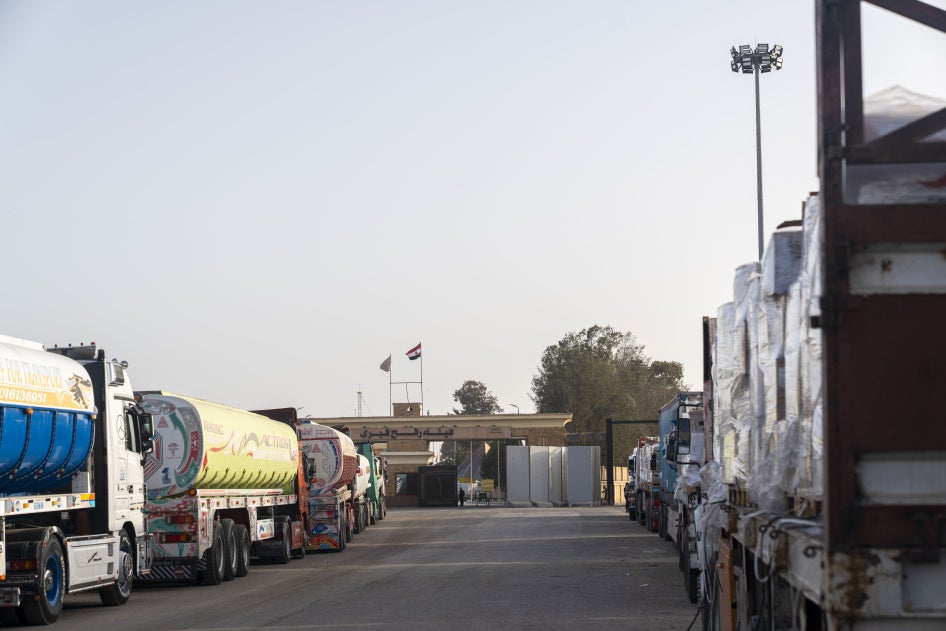
Despite the ceasefire agreement in October, Israel’s continued restriction of aid entry into Gaza causes shortages of medicines, reconstruction equipment, food, and water. Israel’s deliberate restrictions to aid in pursuit of its political or military objectives violate its obligations as an occupying party under international humanitarian law and constitute a war crime when they amount to using starvation as a weapon of war
In November, the deputy UN spokesperson, Farhan Haq, said: “The Israeli authorities have rejected 107 requests for the entry of relief materials,” saying the materials were outside the scope of humanitarian aid or “dual-use” items. The Guardian reported in January 2026 that Israel has allowed commercial shippers to import “dual-use” items for sale on the market.
As of the end of October 2025, “almost $50 million worth of essential goods from operational INGOs, including food, medical supplies, and shelter materials, remain stockpiled at crossings and warehouses.”
Aid workers in Gaza have for the last two years operated amid Israel’s indiscriminate and disproportionate attacks, use of starvation as a weapon of war, extermination and acts of genocide, and massive, deliberate forced displacement of Palestinian civilians, amounting to crimes against humanity. As of September, 543 aid workers were confirmed killed in Israeli attacks in Gaza. Human Rights Watch found in May 2024 that Israeli forces had attacked eight known aid-worker locations, where the organizations had provided their exact coordinates. Humanitarian workers are protected under international law, and targeting humanitarian workers is a war crime.
Since October 2023, at least 255 journalists, 1,700 medical workers, and 967 educational staff have been killed in Israeli attacks in Gaza.
The ban of the 37 groups follows Israel’s ban on the UN Relief and Works Agency for Palestine Refugees in the Near East (UNRWA), which severely limited the agency’s humanitarian assistance capabilities, including blocking aid distribution into Gaza and issuing closure orders for UNRWA-operated schools in East Jerusalem. In October 2025, the International Court of Justice issued an advisory opinion that Israel’s allegations that UNRWA lacks impartiality are unfounded and that its obstruction of the agency’s work is at odds with international law.
In the West Bank, settler violence is on the rise, illegal settlements are expanding, and campaigns of forced displacement and housing demolitions are ongoing. In January and February 2025, Israeli authorities forcibly displaced 32,000 people from three West Bank refugee camps, amounting to war crimes and crimes against humanity. As of February 2026, the UN reports that Israeli authorities have not permitted any of them to return.
“Beyond providing immediate relief, humanitarian workers advocate for civilian protection under international law and work to preserve human dignity,” Randhawa said. “Making the distribution of humanitarian aid to Palestinians a national security concern is yet another Israeli ‘assault on dignity’ of Palestinians and part of a larger pattern of debilitating Palestinian civil society and the international presence in the Occupied Palestinian Territory.”