To: General Mamadi Doumbouya, President of the Republic of Guinea
Sent via email
Re: Moussa Dadis Camara’s Pardon, Release, and Departure from Guinea
Dear President Doumbouya,
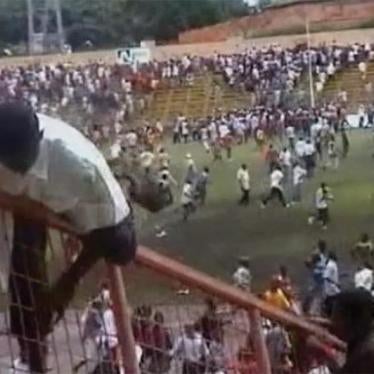
We are writing to express our strong concern that your decision to release former President Moussa Dadis Camara from serving his sentence for crimes against humanity committed during the September 28, 2009 stadium massacre is incompatible with Guinea’s obligations under international law and could amount to a violation of the right of victims to an effective remedy, and to ask you to urgently rescind the pardon.[1]
We recall your pledge to rebuild the state, respect human rights, and deliver justice, including for the September 28, 2009 stadium massacre, stating: “justice will be the compass that will guide every Guinean citizen.”[2] Your government provided invaluable support—following representatives of victims’ associations, as well as local and international rights organizations consistently calling for greater government support for holding the perpetrators to account—by facilitating the landmark trial before the Dixinn criminal tribunal, which began on the 13th anniversary of the massacre.[3] Almost two years and more than a hundred victim and witness testimonies later, on July 31, 2024, the Guinean court convicted Dadis Camara, and seven others, of crimes against humanity, and issued sentences ranging from 10 to 20 years in prison, and one life in prison sentence.[4] The verdict—including the conviction of Dadis Camara as the commander-in-chief who oversaw the 2009 crimes and his sentence of 20 years in prison—was hailed by many Guineans and international partners of at least some measure of justice.[5]
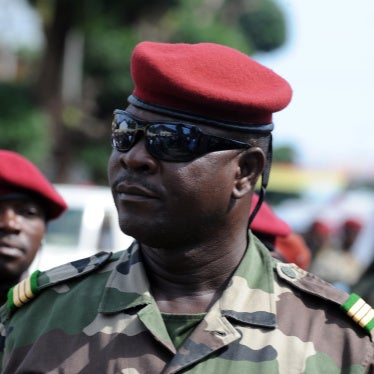
Despite these stated commitments to justice, you pardoned Moussa Dadis Camara on March 28, 2025, citing “health reasons.”[6] It appears the pardon may also have been intended to foster national reconciliation. He was released from prison on the same day. According to media reports, on the night of April 13 to 14, Moussa Dadis Camara left Guinea to seek medical care and treatment in Morocco.[7] To date, there have been no further public updates regarding Moussa Dadis Camara’s location and state of health.
The pardon announcement came as a surprise in Guinea.[8] As far as we are aware, the public, as well as victims and survivors, learned through a decree over national television, without any prior notification, that the most senior official convicted in the trial would be pardoned, after spending two and a half years in detention, and while appeals in the case remain pending.[9] More than five months after the pardon announcement, the decree has not been published in the Official Journal for Guinean Legislation; one of the undersigned organizations to the present letter has unsuccessfully requested access to the decree.
The pardon was swiftly criticized by the UN Human Rights Office, human rights groups, including the undersigned organizations, as well as victims participating in the case and their lawyers.[10] A Guinean media outlet reported on the safety concerns expressed by some victims, given that they have had safety concerns throughout the justice process regarding retaliation against those who had publicly taken the stand in the trial.[11]
The Lawfulness of the Pardon under Guinean Law
The 2021 Charter of Guinean Transition grants the president the power to pardon.[12] Under the Guinean law on criminal procedure, a pardon is “an exemption from serving a sentence […] for a convicted person serving a final and enforceable sentence.”[13] However, Dadis Camara’s sentence is not yet final. All parties, except for one, have lodged appeals, including Dadis Camara himself.[14] Even if Moussa Dadis Camara’s defense lawyers renounce his own appeal, our concerns remain regarding the lawfulness of the pardon in the absence of final proceedings or a final decision in the case. In other words, as Guinean law does not give power to the president to grant pardons before a final judgment is issued, the pardon you granted to Moussa Dadis Camara contradicts Guinean law.
More than one year after the verdict, no date has been scheduled for the start of the appeal hearings. With the lack of official communication following the pardon with the parties to the trial, and the ambiguity as to the status of the historic domestic trial, victims and other defendants who are still in prison awaiting the appeal hearings, are left in the dark around the repercussions of Moussa Dadis Camara’s pardon on the remainder of the judicial process. We understand that the effect of a lawful pardon is to exempt the convicted person from serving their sentence, and given that the pardon was granted to Moussa Dadis Camara before the completion of the proceedings against him, it puts into question the lawfulness of such a pardon, and whether the remainder of the appeal proceedings concerning him and others in the case will be jeopardized. This pardon does not absolve Moussa Dadis Camara of criminal responsibility under Guinean law, including his responsibility with regards to reparations;[15] clarity remains needed for the continuation of the proceedings for the other parties.
Guinea’s Obligations under International Law
The 2021 Charter of Guinean Transition also states that international treaties ratified by Guinea have authority superior to that of domestic laws, meaning that the powers recognized in the charter should be interpreted in accordance with such international treaties.[16]
Guinea has an international obligation to investigate, prosecute, and punish those responsible for crimes against humanity and other serious violations of international human rights law. This obligation derives from a number of sources including the International Covenant on Civil and Political Rights and the African Charter on Human and Peoples’ Rights, to both of which Guinea is a state party.[17] The obligation to investigate, prosecute and punish those responsible for crimes against humanity is also reflected in Guinea’s obligations as a state party to the Rome Statute of the International Criminal Court (ICC). This duty cannot be undermined by any pardon, amnesty, or other domestic legal provisions that effectively bestow impunity on those responsible for such crimes under international law.[18]
The African Commission on Human and Peoples’ Rights (ACHPR), one of the bodies charged with the promotion and protection of the human rights protected by the African Charter on Human and Peoples’ Rights, highlighted that “a commutation of sentences,” while it is “a more limited form of clemency,” it is “prohibited” under the charter where it results in impunity for serious human rights violations, which includes crimes against humanity.[19] According to the ACHPR, clemency may encourage a form of “de jure impunity,” which arises where legislation provides “exemption from legal responsibility in respect of acts that have in the past been committed,” including, for example, by commuting or quashing the sentence of the defendant.[20] A pardon may also encourage “de facto impunity.” As understood by the ACHPR, de facto impunity occurs where those responsible for serious human rights abuses are “in practice insulated from the normal operation of the legal system.”[21]
Under the present circumstances, your pardon of Moussa Dadis Camara appears to contradict both Guinean law and Guinea’s obligations under international and regional human rights law, as established by the jurisprudence of the ACHPR. The pardon in this case amounts to both de jure and de facto impunity as understood by the ACHPR, in that it results in a punishment that is not proportionate to the gravity of crimes against humanity and appears to insulate Moussa Dadis Camara from the normal operation of the legal system.
To the extent the pardon of Moussa Dadis Camara is motivated by “health reasons,” one of the undersigned organizations has repeatedly argued that granting a humanitarian pardon may be consistent with international human rights law, so long as the defendant is not granted special treatment and the release is the result of an independent, thorough, and conclusive medical determination establishing the gravity of his health status and the seriousness of the risk that continued detention might pose to his deteriorating condition.[22]
The Inter-American Court of Human Rights (IACtHR), in a case similar to that of Moussa Dadis Camara, ordered Peru to review the pardon of former president Alberto Fujimori, emphasizing that pardons for individuals convicted of crimes against humanity must be granted only in extreme circumstances and should not lead to impunity.[23] The court stressed that health concerns alone are insufficient grounds for such measures, which must also consider factors like sentence completion, payment of reparations, acknowledgment of crimes, rehabilitation, and the social impact of early release, including on victims and their families.[24] Furthermore, the IACtHR asserted that any discretionary pardon by the executive must be subject to judicial review to ensure victims’ rights, including access to justice and effective remedies, are respected.[25]
To date, however, the Guinean authorities have not provided any information that would allow for a determination as to whether these criteria have been met. This casts serious doubts on the fairness, credibility and transparency of the process that preceded Moussa Dadis Camara’s pardon.
The undersigned organizations, therefore, call for an independent examination of Dadis Camara’s health and an exploration as to whether measures can be put in place to provide medical care for Moussa Dadis Camara, including temporary release from detention to allow him to get medical treatment when and where needed, without the granting of pardon.
To the extent the pardon of Moussa Dadis Camara is motivated by fostering national reconciliation, instead of or in addition to health grounds, such reasoning does not absolve Guinea from its obligations under international and regional human rights law. Under the current circumstances, the pardon not only undermines victims’ right to an effective remedy but risks reinforcing perceptions of selective justice in Guinea. The ACHPR supported the same reasoning as the IACtHR, in a case involving Zimbabwe granting clemency to absolve perpetrators “in a bid to reconcile the population,” confirming that “even when intended to establish conditions conducive to a peace agreement or to foster national reconciliation, amnesty and other measures of clemency shall be kept within certain bounds,” including that the state should first meet its obligations under international law to ensure the perpetrators are “prosecuted, tried and duly punished.”[26]
The undersigned organizations have serious concerns that national reconciliation as motivation for granting pardons could be used as a prelude to provide further impunity for crimes against humanity committed on and around the events of September 28, 2009, not only for Moussa Dadis Camara, but for others, either those convicted in the present case, and potentially those undergoing trial in connection with the same facts.
We note that on March 26, 2025, the Minister and Secretary-General of the Presidency of the Republic, General Amara Camara read, on national television, a new decree declaring that the Guinean National Development Budget will cover the entire cost of compensating victims of the September 28, 2009, massacre.[27] According to the contents of this decree, this act is motivated by “the concern for social justice, national reconciliation and reparation for moral and physical harm.” The decree was welcomed by many who have long called for the government to compensate victims, albeit limited to 334 victims under the terms of the court order, excluding hundreds of other victims from benefiting from their right to redress.[28] However, it cannot substitute for effective investigation, prosecution, and punishment. Under international human rights law, Guinea has an obligation to respect, protect, and fulfil the right of victims to truth, justice and reparations.
We urge you to take all necessary steps to rescind the pardon, refrain from granting further clemency, including pardons, and express your clear commitment to enable Guinean judicial authorities to move forward independently and expeditiously with the appeals process, as well as trials in all other pending cases related to the stadium massacre.
The ICC has a mandate to step in where national authorities do not conduct genuine proceedings of crimes falling within its jurisdiction. Under Guinea’s memorandum of understanding with the ICC Office of the Prosecutor, signed in September 2022, the office may reconsider its decision and open an investigation “in light of any significant change in circumstances, including the imposition of any measures that might significantly hamper the progress or genuineness of the judicial proceedings related to the 28 September 2009 events.” ICC judges have stated that “granting amnesties and pardons for […] crimes against humanity is incompatible with internationally recognized human rights.”[29]
The following organizations ask you to affirm your commitment to justice, not only for the victims and survivors of the September 28, 2009, crimes, but to all Guineans who following the July 2024 verdict regained a glimmer of hope for a more promising Guinea that honors a credible and fair justice and allows no room for impunity, especially for serious crimes.
Sincerely,
Amnesty International
Association of Victims, Relatives and Friends of September 28, 2009 (AVIPA)
Guinean Organization for the Defense of Human Rights (OGDH)
Human Rights Watch
International Federation for Human Rights
--
[1] African Charter on Human and Peoples' Rights, adopted June 27, 1981, OAU Doc. CAB/LEG/67/3 rev. 5, 21 I.L.M. 58 (1982), entered into force October 21, 1986, art. 7; International Covenant on Civil and Political Rights (ICCPR), adopted December 16, 1966, G.A. Res. 2200A (XXI), 21 U.N. GAOR Supp. (No. 16) at 52, U.N. Doc. A/6316 (1966), 999 U.N.T.S. 171, entered into force March 23, 1976, art. 2.
[2] “Guinea: Rights at Risk as Promised Transition Derails,” Human Rights Watch news release, December 2, 2024, https://www.hrw.org/news/2024/12/02/guinea-rights-risk-promised-transition-derails; “Guinea: the leader of the putschists Mamady Doumbouya promises a new government,” RFI, September 6, 2021, https://www.rfi.fr/fr/afrique/20210906-guin%C3%A9e-le-chef-des-putschistes-mamady-doumbouya-promet-un-nouveau-gouvernement (accessed August 13, 2025).
[3] “Guinea’s 2009 Stadium Massacre Trial” (tag page), Human Rights Watch, (specific date not found), https://www.hrw.org/tag/guineas-2009-stadium-massacre-trial (accessed August 13, 2025).
[4] “Guinea: Landmark Verdict in Stadium Mass Killings Trial,” Human Rights Watch news release, July 31, 2024, https://www.hrw.org/news/2024/07/31/guinea-landmark-verdict-stadium-mass-killings-trial.
[5] “Historic Trial in Guinea: Reactions from Civil Society,” Coalition for the ICC, (date not specified), https://www.coalitionfortheicc.org/news/historic-trial-guinea-reactions-civil-society (accessed August 13, 2025).
[6] “Guinea – Report on Moussa Dadis Camara’s Presidential Pardon” (video), YouTube, date not specified, https://www.youtube.com/watch?v=OgTLFhMPoVA (accessed August 13, 2025).
[7] “Guinea: Recently Pardoned, Former Dictator Moussa Dadis Camara Flies to Morocco,” LeMonde.fr, April 16, 2025, https://www.lemonde.fr/afrique/article/2025/04/16/guinee-recemment-gracie-l-ancien-dictateur-moussa-dadis-camara-s-est-envole-pour-le-maroc_6596625_3212.html; Jeune Afrique, “Moussa Dadis Camara Has Left Guinea for Morocco, His Family Announces,” JeuneAfrique.com, March 2025, https://www.jeuneafrique.com/1679651/politique/moussa-dadis-camara-a-quitte-la-guinee-pour-le-maroc-annonce-sa-famille/(accessed August 13, 2025).
[8] “Guinea: General Mamadi Doumbouya Grants Presidential Pardon to Moussa Dadis Camara,” RFI, March 28, 2025, https://www.rfi.fr/fr/afrique/20250328-guin%C3%A9e-le-g%C3%A9n%C3%A9ral-mamadi-doumbouya-accorde-une-gr%C3%A2ce-pr%C3%A9sidentielle-%C3%A0-moussa-dadis-camara (accessed August 13, 2025).
[9] Dadis Camara was in detention (including pre-trial detention) from September 27, 2022, to March 28, 2025.
[10] “Guinea: Pardon of Ex-President Raises Serious Concerns,” OHCHR press release, April 2025, https://www.ohchr.org/en/press-releases/2025/04/guinea-pardon-ex-president-raises-serious-concerns; “The 28 September 2009 Stadium Killings Trial: The Pardoning of Moussa Dadis Camara,” International Federation for Human Rights (FIDH) press release, 2025, https://www.fidh.org/en/region/Africa/guinea-conakry/the-28-september-2009-stadium-killings-trial-the-pardoning-of-moussa; “Release of Dadis Camara: ‘A Shock,’ Reacts Human Rights Watch,” Africaguinee.com, March 30, 2025, https://www.africaguinee.com/liberation-de-dadis-camara-un-choc-reagit-human-rights-watch/.
[11] “Pardon Granted to Dadis: We Should Take Security Measures for All Victims Before Thinking About It – Fatoumata Barry,” Mosaiqueguinee.com, March 2025, https://mosaiqueguinee.com/2025/03/grace-accordee-a-dadis-on-devrait-prendre-des-mesures-de-securite-pour-toutes-les-victimes-avant-dy-penser-fatoumata-barry/ (accessed August 13, 2025); “Guinea’s 2009 Stadium Massacre Trial,” Human Rights Watch question-and-answer document, July 26, 2024, https://www.hrw.org/news/2024/07/26/guineas-2009-stadium-massacre-trial#whathavebeen (accessed August 13, 2025).
[12] See, Charte de la Transition (Charter of Guinean Transition), Republic of Guinea, September 2021, https://www.sgg.gov.gn/uploads/CharteDeLaTransition270921_cnrd.pdf (accessed August 13, 2025), art. 43. Following the suspension of the 2020 Guinean Constitution in 2021, the Charter of Guinean Transition is currently in place until September 2025, when a constitutional referendum is expected.
[13] Guinean Code of Criminal Procedure, February 2016, art. 1192, “A pardon is an exemption from serving a sentence, granted by the President of the Republic to a convicted person serving a final and enforceable sentence. The right to pardon is exercised by the Head of State and is not subject to appeal,” https://www.vertic.org/media/National%20Legislation/Guinea/GUINEA_GN_Nouveau_Code_Procedure_Penale.pdf.
[14] “The 28 September 2009 Stadium Killings Trial: The Pardoning of Moussa Dadis Camara,” FIDHpress release, Guinea-Conakry, April 1, 2025, https://www.fidh.org/en/region/Africa/guinea-conakry/the-28-september-2009-stadium-killings-trial-the-pardoning-of-moussa (accessed August 13, 2025).
[15] Guinean Code of Criminal Procedure, February 2016, art. 810 “A pardon, whether full or partial, does not remove the conviction from the individual's criminal record […]”https://www.vertic.org/media/National%20Legislation/Guinea/GUINEA_GN_Nouveau_Code_Procedure_Penale.pdf. A Guinean magistrate recalled that “if Moussa Dadis Camara was pardoned, he was not granted amnesty, and that his conviction is therefore still relevant.” The law gives the president the right to issue a pardon to exempt a person convicted of a serious crime from serving their sentence. However, it remains on his criminal record, with all the legal consequences that this implies. See, “Guinée : la grâce de Moussa Dadis Camara, une décision qui suscite réactions et interrogations,” RFI, March 29, 2025, https://www.rfi.fr/fr/afrique/20250329-guin%C3%A9e-moussa-dadis-camara-graci%C3%A9-une-d%C3%A9cision-qui-suscite-de-nombreuses-interrogations (accessed August 11, 2025).
[16] Guinean Charter of Transition, Republic of Guinea, art.73, “Treaties, conventions or agreements duly ratified or approved shall, upon publication in the Official Journal of the Republic, prevail over Acts of Parliament, subject, with respect to each treaty, convention or agreement, to its application by the other party.” https://www.sgg.gov.gn/uploads/CharteDeLaTransition270921_cnrd.pdf (accessed August 13, 2025).
[17] ICCPR, art. 2(3); UN Human Rights Committee (HRC), General Comment No. 31, The Nature of the General Legal Obligation Imposed on States Parties to the Covenant, CCPR/C/21/Rev.1/Add (2004), paras. 15, 19; HRC, General Comment No. 29, States of Emergency (Article 4), CCPR/C/21/Rev.1/Add.11 (2001), para. 14; African Charter on Human and People’s Rights, art. 7. See also, UN General Assembly, “Basic Principles and Guidelines on the Right to a Remedy and Reparation for Victims of Gross Violations of International Human Rights Law and Serious Violations of International Humanitarian Law,” Resolution 60/147 (2005), A/RES/60/147, https://www.ohchr.org/en/instruments-mechanisms/instruments/basic-principles-and-guidelines-right-remedy-and-reparation (accessed August 11, 2025), para. 4.
[18] International human rights jurisprudence repeals amnesties, pardons, or similar benefits to serious human rights violators for different reasons: it leads to impunity, it is contrary to states obligation to investigate and punish violations (and crimes), it denies victims effective remedy. See, Zimbabwe Human Rights NGO Forum v. Zimbabwe, African Commission on Human and Peoples’ Rights (AfCHPR), Communication No. 245/2002, Decision, May 25, 2006, paras. 200, 211; Inter-American Court of Human Rights (Inter-American Court), Barrios Altos and La Cantuta case, Monitoring Compliance with Judgment, May 30, 2018, para. 31; Inter-American Court, Massacres of El Mozote and Nearby Places case, Judgment of October 25, 2012, Inter-Am.Ct.H.R., (Ser. C) No. 252 (2012), para. 283, “[…] ruled on the incompatibility of amnesty laws in relation to grave human rights violations with international law and the international obligations of States. This is because amnesties or similar mechanisms have been one of the obstacles cited by States in order not to comply with their obligation to investigate, prosecute and punish, as appropriate, those responsible for grave human rights violations.” ICC judges have also stated that “granting amnesties and pardons for […] crimes against humanity is incompatible with internationally recognized human rights,” see,The Prosecutor v. Saif Al-Islam Gaddafi, ICC, “Decision on the ‘Admissibility Challenge by Dr. Saif Al-Islam Gadafi pursuant to Articles 17(1)(c), 19 and 20(3) of the Rome Statute’”, ICC-01/11-01/11-662, April 15, 2019, para. 77.
[19] Zimbabwe Human Rights NGO Forum v. Zimbabwe, AfCHPR, Decision, paras. 196, 200, 201.
[20] Ibid., para. 200.
[21] Ibid.
[22] “Peru: Don’t Give Fujimori Special Treatment,” Human Rights Watch news release, July 6, 2017, https://www.hrw.org/news/2017/07/06/peru-dont-give-fujimori-special-treatment; “Peru: No Special Treatment for Fujimori,” Human Rights Watch news release, June 16, 2011, https://www.hrw.org/news/2011/06/16/peru-no-special-treatment-fujimori; “Amicus curiae on Fujimori’s release,” Human Rights Watch amicus briefing, February 1, 2018, https://www.hrw.org/news/2018/02/01/human-rights-watch-amicus-curiae-fujimoris-release#_ftn8.
[23] “Peru: Inter-American Court rules that the Peruvian courts should review the pardon granted to Fujimori,” Amnesty International news release, June 18, 2018, https://www.amnesty.org/en/latest/news/2018/06/peru-corte-interamericana-resuelve-que-tribunales-peruanos-deben-revisar-el-indulto-concedido-a-fujimori/ (accessed August 11, 2025); See, Inter-American Court, Barrios Altos and La Cantuta case, Monitoring Compliance with Judgment, paras. 49 and 53.
[24] Inter-American Court, Barrios Altos and La Cantuta case, Monitoring Compliance with Judgment, para. 57.
[25] Ibid.
[26] See, Zimbabwe Human Rights NGO Forum v. Zimbabwe, AfCHPR, Decision, paras. 194, 202 (fn. 74), 204.
[27]“Decret du 26 mars 2025 lu par Général Amara Camara” (YouTube video), SIRANKA TV, March 26, 2025, https://www.youtube.com/watch?v=0SlU-zgJC34 (accessed August 11, 2025).
[28] “Massacre du 28 septembre: plusieurs victimes omises sur la liste sollicitent l’implication urgente du général Doumbouya pour leur indemnisation,” Mosaiqueguinee.com, June 2025, https://mosaiqueguinee.com/2025/06/massacre-du-28-septembre-plusieurs-victimes-omises-sur-la-liste-sollicitent-limplication-urgente-du-general-doumbouya-pour-leur-indemnisation/ (accessed August 11, 2025); “En Guinée, début de l’indemnisation des victimes du massacre du 28 septembre 2009,” JeuneAfrique.com, https://www.jeuneafrique.com/1687933/politique/en-guinee-debut-de-l-indemnisation-des-victimes-du-massacre-du-28-septembre-2009/ (accessed August 11, 2025).
[29] The Prosecutor v. Saif Al-Islam Gaddafi, ICC, “Decision on the ‘Admissibility Challenge by Dr. Saif Al-Islam Gadafi pursuant to Articles 17(1)(c), 19 and 20(3) of the Rome Statute’”, ICC-01/11-01/11-662, April 15, 2019, para. 77.