(New York) – The Trump administration’s brazen military assault risks causing a new human rights disaster for Venezuelans, Human Rights Watch said today.
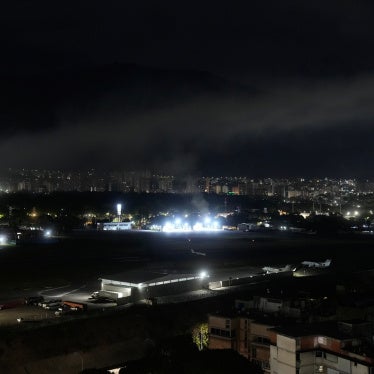
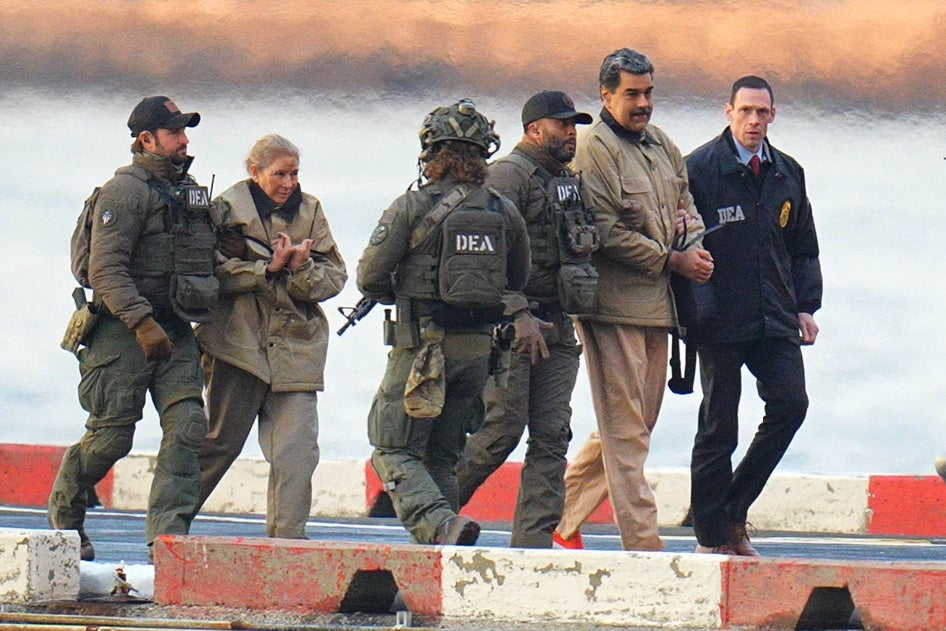
In the early morning hours of January 3, 2026 the US military conducted strikes on Venezuela and took into custody the country’s president, Nicolás Maduro, and his wife, Cilia Flores. They have since been arraigned before a US federal court on drug trafficking and other criminal charges.
“Venezuelans are entitled to freely choose their own leaders and decide their nation’s future,” said Juanita Goebertus, Americas director at Human Rights Watch. “However, the US appears poised to actively encourage Venezuela to maintain Maduro’s repressive apparatus as long as it furthers US political and business interests.”
President Donald Trump said on January 3 that the United States would “run” Venezuela for the time being, without specifying what this means. US officials have indicated that they intend to work with Delcy Rodríguez, who had been serving as Maduro’s vice president and was sworn in as interim president on January 5.
US authorities said that they will use their ability to tighten or loosen an oil blockade in the Caribbean, along with the threat of further strikes, to compel the Venezuelan government to comply with US demands and expectations. These include paving the way for US oil company investments in the country and addressing gang violence, among other goals.
The US strikes on January 3 are reported to have targeted military facilities and reportedly killed dozens of military officers and at least two civilians. The Cuban government, which has long supported Venezuela’s government, said that 32 Cuban officers were killed. In the buildup to these strikes, the United States extrajudicially executed at least 115 people in vessels that the Trump administration claims were trafficking illegal narcotics in the Caribbean Sea and Pacific Ocean.
Following the January 3 strikes, US Secretary of State Marco Rubio said that the United States will press the Venezuelan government to facilitate oil investments by US companies, respond to criminal groups, and sever ties with Iran and Hezbollah. President Trump told reporters on January 5 that if Venezuela does not “behave,” the United States “will do a second strike.”
Trump has also said the United States would “run” Venezuela until there is a “judicious transition.” The US government has not specified when or how any transition might take place or whether that process would include free and fair elections, the release of political prisoners, and other key human rights changes.
In July 2024, Venezuelans took to the polls in large numbers despite repression by the Maduro government. Independent observers presented data showing that Venezuelans overwhelmingly supported Edmundo González, who is backed by the opposition leader María Corina Machado, to become president. However, electoral authorities announced that Maduro had been re-elected.
Following the elections, the Maduro government carried out a wave of widespread human rights violations, including killings of protesters and arbitrary detention and enforced disappearance of opposition leaders, critics, human rights defenders, and foreign nationals.
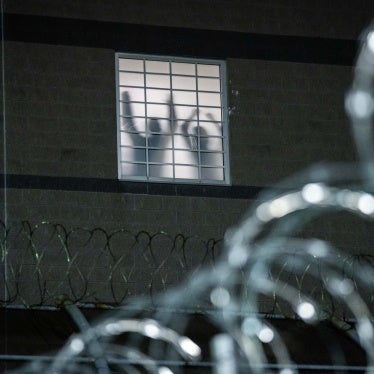
Over 860 political prisoners remain behind bars in Venezuela, according to the pro-bono legal group Foro Penal. The Office of the Prosecutor of the International Criminal Court has an open investigation into alleged crimes against humanity committed in Venezuela since 2014.
For over a decade, Venezuelans have suffered a humanitarian crisis, with severe shortages of food and medicine. Seven million Venezuelans have fled the country and 14.2 million others have severe humanitarian needs.
Latin American, European, Canadian, and other world leaders should push for a transition to democracy, call for the release of political prisoners, and promote accountability for serious human rights violations committed by the Venezuelan government, Human Rights Watch said. For its part, the US government should uphold its obligations under international human rights law and international humanitarian law.
“Foreign governments should focus on protecting the rights of Venezuelans who have suffered for a decade at the hands of the Maduro government,” Goebertus said. “Trump’s decapitation of the Venezuelan government has done nothing to protect them from further abuse.”