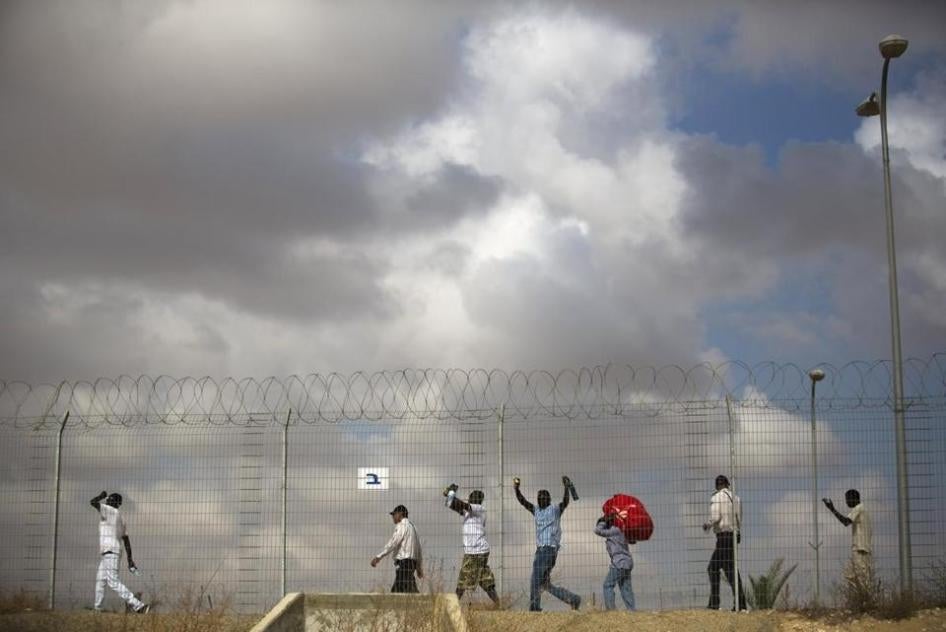
(Tel Aviv) – The Israeli authorities’ declared ban on recently released Eritrean and Sudanese nationals living and working in Tel Aviv and Eilat violates their right to freedom of movement, Human Rights Watch said today. About 41,000 Eritrean and Sudanese nationals live in Israel, most of them in Tel Aviv, Arad, Ashdod, Ashkelon, Eilat, and Jerusalem, although there are no known statistics showing how many live in each city.
Israel’s Interior Ministry announced the ban on August 23, 2015, three days before the Israeli High Court’s deadline for the release of anyone held at the Holot “Residency Center” for more than one year. The authorities released 1,178 Eritreans and Sudanese from Holot on August 25 and 26. Interior Minister Silvan Shalom announced on his Facebook page on August 23 that “infiltrators released from Holot will not be allowed to reach Tel Aviv and Eilat,” giving no reason and citing no legal basis. In a radio interview earlier that day, he vowed to “do everything in my power to prevent them [the released Sudanese and Eritreans] from coming to Tel Aviv.”
“The Israeli authorities have made no secret about their wanting to make Eritrean and Sudanese nationals’ lives so miserable that they leave the country,” said Gerry Simpson, senior refugee researcher at Human Rights Watch. “Banning the released Eritreans and Sudanese from living in their communities in major Israeli cities simply replaces illegal detention in Holot with illegal movement restrictions.”
Under international law, the Israeli government can restrict the right to freedom of movement – whether of Israelis or foreign nationals – only when necessary to protect national security, public order, or public health. Absent a lawful justification under international law, which it has not cited, the Israeli government should immediately rescind the ban, Human Rights Watch said.
Measures taken by Israel to coerce Eritreans and Sudanese into leaving Israel have included laws authorizing their prolonged or indefinite detention in prisons or at Holot, a remote desert facility where residents are required to check in daily. Israel’s High Court has twice ruled that the laws restricting “infiltrators” to Holot violate their right to liberty under the country’s Basic Law.
In response, in December 2014 the authorities limited detention in Holot to a maximum of 20 months. On August 11, 2015, the High Court ruled that Holot could remain open, but that the Israeli Parliament had six months to reduce the length of detention. In the meantime, it ordered the authorities to release all detainees held for more than 12 months by August 26.
|
News Release
Israel: Drop City Ban on Released Eritreans, Sudanese
1,200 Face Prison for Living or Working in Tel Aviv, Eilat
Every piece on our website is resource intensive. If you donate whatever you can today, we will use it to continue investigating abuses and advocate for change in 100+ countries.
Region / Country
More Reading


Reports
-
November 20, 2025
“All My Dreams Have Been Erased”
Israel’s Forced Displacement of Palestinians in the West Bank

-
December 4, 2024
“Die First, and I'll Pay You Later”
Saudi Arabia’s ‘Giga-Projects’ Built on Widespread Labor Abuses

Most Viewed
-
June 14, 2018
Africa: Pregnant Girls, Young Mothers Barred from School

-
September 8, 2016
Nepal: Child Marriage Threatens Girls’ Futures

-
May 17, 2021
“Years Don’t Wait for Them”

-
October 18, 2023
Israel/Palestine: Videos of Hamas-Led Attacks Verified

-
November 12, 2018
“Shall I Feed My Daughter, or Educate Her?”