Everyone said that it was my fault, because I should have stopped him. I could have said no or not invited him to my house.
He [teacher] said that he was going to send his friends to kill our families.
In my school, everyone would send intimate photos to everybody, like they were selfies.
Sexual and gender-based violence is a long-standing problem in Ecuador’s education institutions.
Government data shows that over 4,220 students suffered sexual violence by teachers, school staff and other students between 2014 and May 2020.
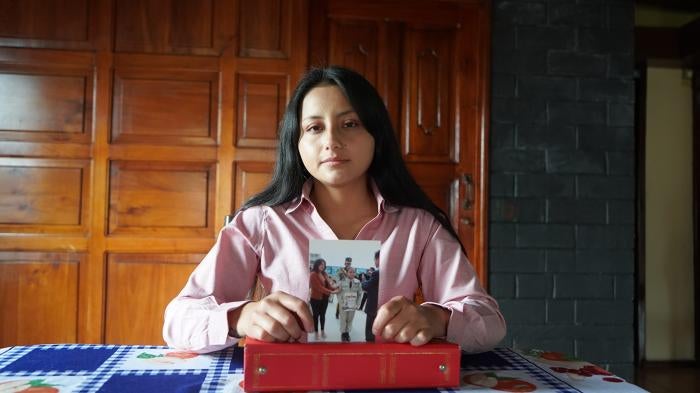
Jennifer Real, 19 years old:
By sixth grade, I was 10 years old. The first thing he did was tell us stories about being part of a gang. He sowed fear in us.
Once he hit me on my legs with a metallic broom stick. Another time he didn’t like something I said, and he had my classmates kick me while I was laying on the floor. Then the sexual abuse began with natural science classes. He made several of us girls stand in a line, and we were, of course, developing. We unbuttoned our shirts and then he began teaching and drawing on our bodies. I remember him making us watch pornography on TV.
Every day I thought, what will happen today?
My family found out. My mom told the authorities. They obviously didn't believe her at first. The school did nothing at first, until some classmates decided to talk to their parents one night.
In 2010, a teacher sexually abused and assaulted 41 children, aged 10 and 11 at AAMPETRA, a private school in Quito.
In the beginning, we all went to the prosecutor's office to give our versions. Recounting everything that had happened to us. We had to do that several times when I was still a child, and nothing ever happened. After that, I only stepped into the prosecutor’s office again when I was 17 years old, when he had been arrested.
Evelyn Yucailla, 23 years old:
My teacher at school pretended to want to be my friend, to be supportive. He was an adult, 10 years older than me. He manipulated me psychologically. He told me he wasn’t going to be with me to just hold hands or hug and that he wanted something more.
I didn't want to have sex with him. I wanted to end it but he took it the wrong way. He began harassing me as a teacher, giving me lower grades, reporting me for indiscipline. That year, I even considered suicide because his harassment towards me at school was too much.
Indecent assault. Who was the judge. Who was later dismissed for wrongdoing.
The prosecutor who took my case was a male prosecutor. He said, “But you invited him to your house that day, so you are the one to blame.”
In many cases, perpetrators go unpunished.
Many prosecutors and judges lack the skills and training to work on sexual and gender-based violence cases. Children are often re-traumatized during judicial proceedings.
I believe that I suffered in two ways: one by my teacher and the other by the justice system, because it completely fails in Ecuador.
Sexual abuse, including online sexual harassment and the sending of unsolicited sexually explicit pictures, is also perpetrated by fellow students.
Carla Vázquez, 18 years old:
I was in the first year of high school and he was in the tenth grade. I got messages from him saying “hello, hello, hello.” He keeps writing to me until one day he sends a photo of his penis. I told him "Hey what's wrong with you, don't do that."
A year later I see a message on Messenger from the same boy. He says, “I am going to send you a photo to see if you like it” and he sends me a second photo of his penis. I decide to go directly to the school to tell them what’s happening. I found out that day that he is the nephew of my course supervisor.
Some school officials don’t believe children when they report their abuse, or try to solve it at the school level, leaving them unprotected and leading to underreporting of cases.
We eventually went to the principal’s office and he says that he has some pictures that I had shared with an ex-boyfriend a long time ago, some intimate photos of me. The boy shows these photos and says, “but she sends this type of photos too.” Then he shows another photo from my Facebook, saying “but she dresses like this, and wears tight clothes, short dresses, puts on skirts, puts on tank tops.” The school psychologist then said, “I’ve seen how she behaves at school, she has many male friends, in a way it is also her fault.”
Some schools fail to do adequate background checks on staff.
School staff also lack training and skills on how to handle cases of sexual violence, including emerging forms of online abuse and exploitation.
Many children and families seeking justice for the abuses they have suffered face many obstacles in Ecuador’s justice system.
Now I understand that it wasn’t my fault.
The second thing is analyzing what we have done and what we need to do as a collective...
I’m the president of a collective that I created to support victims of sexual violence.
What is the use of getting psychological help with the collective if the education institutions don’t help...
What the government should do for those of us who have already suffered, is to have a [law] on comprehensive reparations, where they enable us to continue with our lives and at the same time, have psychological support.
Regarding the government, they never supported us in the individual or collective process, we were always alone. No one takes responsibility for this. [The government] has not made an organization [office] that specializes or focuses on reparations in cases of child sexual abuse in Ecuador.
I kept on going to dance [classes] because it was a way to unburden myself of my problems.
In my school nothing ever changed after [my] incident. There were never talks about cyber harassment. The Ministry of Education should get much more involved in dealing with cyberbullying and sexual harassment in [education] institutions because it is real.
Ecuador should commit to end and prevent sexual violence in schools and to ensure young survivors have access to an effective restorative justice process.