INTRODUCTION
One year ago, for the second consecutive year, the United Nations Commission on Human Rights adopted a resolution expressing concern about the situation in Chechnya. The resolution called on Russia to curb abuses by its forces, establish a meaningful domestic accountability process, and invite several of the Commission's key special mechanisms to visit the region. The Russian government rejected the resolution out of hand, as it had done a year before, and refused to implement most of its key requirements.
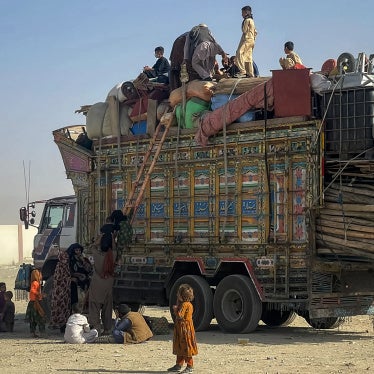
Today, as the Commission opens its 58th session, Chechnya remains the only place in Europe where civilians are killed on a daily basis in armed conflict. Russian and Chechen rebel forces subject civilians to a vicious cycle of abuse. Since the 57th UNCHR session, abuses by Russian troops-particularly "disappearances" and extrajudicial executions-did not relent. In fact, Human Rights Watch found that at least one "disappearance" occurred each week between September and December 2001. In the absence of meaningful government investigations into abuses, Russian forces continue to operate with an undiminished sense of impunity. Chechen rebels and their supporters have stepped up their intimidation campaign against those who cooperate with the Russian government, assassinating dozens of local Chechen civil servants, and making death threats to many more. This volatile security situation continues to prevent more than 200,000 internally displaced persons (IDPs) from returning to their homes in Chechnya. The majority remain in Ingushetia, although Russian authorities there continually pressure them to return to Chechnya.
In 2001 and 2002, Human Rights Watch conducted four field missions to the Northern Caucasus region. We published our findings in a February 2002 report documenting abuses in military sweep operations of June and July 2001, and a March 2001 report on forced disappearances.1 This memorandum provides an updated overview of these issues, based on more than fifty interviews conducted in December 2001 and February 2002. It summarizes violations committed by Russian forces in six military sweep operations between August and December 2001, and documents nine forced disappearances as well as five cases of indiscriminate shootings and use of force. It also describes assassinations and threats against civilians by Chechen forces. Additionally, it analyzes the Russian authorities' meager efforts in investigating abuses, which have stunted any domestic accountability process.
After the September 11 attacks in the United States, the Russian government has labored to link its campaign in Chechnya with the global campaign against terrorism, claiming it was fighting the same enemy.2 International criticism of Russia's methods in Chechnya, summarized in this memorandum, has waned, as Russia has become a key partner in the international coalition against terrorism. But Russia's role in the coalition should not shield it from scrutiny or criticism by any fora, especially the highest international body solely concerned with human rights.
Human Rights Watch urges the Commission to adopt a resolution on the Chechnya conflict, calling on Russia to issue invitations to the relevant thematic mechanisms and to invigorate the domestic accountability process. A Commission resolution should deplore continued abuses, and should note in particular the failure by Russia to establish a national commission of inquiry, and the utter lack of an official public record of violations of international human rights and humanitarian law committed in the conflict.
RECENT ABUSES BY RUSSIAN FORCES
In 2001, abuses by Russian forces continued to be an integral part of the daily life of civilians in Chechnya. In villages and towns throughout Chechnya federal forces conducted dozens of sweep operations. Ostensibly designed to seek out rebel fighters and their supporters and ammunition depots, sweeps are usually reactive, following Chechen military actions such as ambushes on Russian military columns or attacks on Russian checkpoints. They are routinely the occasion for abuse, particularly arbitrary detention and subsequent torture, ill-treatment, and "disappearances." Soldiers also killed numerous civilians, both during and beyond the context of sweep operations, in indiscriminate shootings. Masked soldiers conducted numerous nightly raids, detaining men who subsequently "disappeared."
Sweep Operations
A series of exceptionally harsh sweep operations in June and July 2001, during which Russian troops rounded up several thousand Chechen men, caused a storm of criticism in Russia and the international community.3 In response, military officials promised improvement, and the Procuracy General issued a decree ordering procuracy officials to be present during all sweep operations to monitor the conduct of federal forces.4 However, information gathered by Human Rights Watch about several dozen sweep operations conducted since July 2001 clearly illustrates that the promises were unfulfilled and that the decree was largely ignored or rendered irrelevant.5
Beginning in mid-August 2001, sweeps occurred with increasing frequency. Several villages and towns, including Argun, Novye Atagi, Starye Atagi, and Tsotsin-Yurt, were the sites of repeated sweep operations. In some cases, Russian forces conducted the operations in response to ambushes or enemy fire on Russian convoys; in others, on the basis of intelligence information on fighters' whereabouts; and occasionally without any apparent cause. Human Rights Watch collected information on several of these sweeps.
· Alleroi (August 16-26, 2001). According to the Russian human rights group Memorial, Russian troops committed serious abuses during this ten-day-long sweep in eastern Chechnya, killing at least one person with indiscriminate gunfire; unlawfully detaining dozens of men and several women, many of whom faced electric shock and beatings; willfully destroying civilian property; and torching several houses.6 Human Rights Watch documented two disappearances during the sweep. On August 17, Russian troops detained twenty-two-year-old Magomed-Emi Alsultanov and several of his neighbors on Kavkazskaia Street. According to the neighbors, who were later released, the soldiers initially held the men in a pit at a local military base but later took Alsultanov away. He has not been seen since.7 On August 20, soldiers detained thirty-two-year-old Khasmagomed Esuev during an internal passport check and took him away. He also has not been seen since.8 The relatives of the two men tried to find them, but to no avail; officials denied having detained Alsultanov and provided no information of the whereabouts of Esuev.9
· Tsotsin-Yurt. The village of Tsotsin-Yurt saw repeated sweeps between June 2001 and February 2002, with soldiers each time blocking off the entire village, detaining large numbers of local men and looting civilian property. On September 15, Russian troops, supported by numerous armored personnel carriers (APCs) and military trucks, conducted a sweep operation in the village. Zulai Khamzatova, whose three sons were detained during the sweep, told Human Rights Watch that servicemen took dozens of men to a makeshift detention facility and kept them there for more than twenty-four hours while the soldiers checked their identity papers.10 Most detainees-including two of Khamzatova's sons-were released the next day, but at least two, Khamzatova's twenty-nine-year-old son Mukhadi, and twenty-one-year-old "Aslanbek A." (not his real name), "disappeared."11 The mothers of the two men approached the Kurchaloi commandant's office and police, and the Argun procuracy, but officials said the men's names were not in their files. They did not provide any other information to family members.
During another sweep operation in Tsotsin-Yurt, which lasted from October 10-15, Russian servicemen looted many homes and killed and took away hundreds of cattle. 12 They also detained thirty-seven men and kept them in a makeshift facility at the outskirts of the village; reportedly, many were beaten and tortured.13 Two local women sustained serious injuries when villagers tried to prevent the detention of Aiub Ortsuev. A group of villagers followed the soldiers, appealing for Ortsuev's release; when the women refused to desist, the soldiers fired into the crowd from an underbarrel grenade launcher, seriously wounding Ortsuev's neighbor, thirty-five-year-old Birlant Jemalieva, and his nineteen-year-old relative, "Malika Musaeva" (not her real name).14
· Avtury (November 30, 2001).15 During the November 30 sweep in Avtury, Russian troops extrajudicially executed two men and detained and ill-treated at least seven others. "Ruslan R." told Human Rights Watch that a group of fifteen soldiers ordered him and his wife to the yard of their home at 4:30 a.m. As he was being held, he witnessed as several of the soldiers, without prior warning, shot seventeen-year-old Ramzan Suleimanov, who was sitting unarmed outside his home across the stream from that of "Ruslan R." A bullet struck Suleimanov in the neck, killing him. The soldiers also shot Suleimanov's twenty-two-year-old neighbor, Adam Urzuev, who came running over when he heard screams. Ruslan R. also said he met seven men who were detained that day after their release; he said the men had severe bruises on their faces, several maintained their ribs and jaws were broken, and two had burns they said were the result of electric shock.16
· Argun (December 11-16, 2001). Following a rebel attack on a Russian military convoy, Russian troops entered Argun on December 11. Five eyewitnesses, interviewed separately, told Human Rights Watch the soldiers detained large numbers of men-some estimated as many as 150-and looted house after house.17 According to eyewitnesses, the soldiers took away food and sweets many residents had prepared in advance of the end of Uraza-Bairam, a major three-day Muslim holiday that began that year on December 15. On December 15 at around midday, Russian troops stopped forty-one-year-old Vakhid Daudov's car in the center of the town, forced his wife out of the car, got in themselves and then drove off. Daudov has not been seen since.18 Human Rights Watch also has documentation on the forced disappearance of twenty-one-year-old Zaur Khizriev, eighteen-year-old Suliman Nushaev, and Sharpuddin Madaev, whom federal forces detained in their respective homes on December 15.19
Forced Disappearances
Human Rights Watch has researched almost seventy cases in which people "disappeared"20 after being taken into the custody of Russian authorities in 2001. Their relatives' inquiries to Russian authorities as to their whereabouts were met either with denials that the apprehended persons were ever in custody, or by a lack of clarity and forthrightness about the person's fate. 21 Almost half, or thirty-four, had been taken into custody during sweep operations; five of these cases are described above. More than one-third, or twenty-four, "disappeared" after being taken away in raids, during which armed and masked soldiers-often traveling in military vehicles-burst into private homes in the middle of the night. In some of these cases, Russian government officials cast blame for these "disappearances" on Chechen rebel fighters. However, in most cases, considerable evidence-such as the presence of APCs during the raid and the fact that the masked men spoke unaccented Russian-undermines these claims. Among the cases documented by Human Rights Watch were:
· "Disappearance" of Saidmagomed Mutsukaev. At 1:30 a.m. on September 9, 2001, about thirty masked servicemen speaking unaccented Russian burst into the Mutsukaev family house in Shali. After checking the family's internal passports, they ordered twenty-five-year-old Saidmagomed Mutsukaev into a car and drove him away. A fellow villager later told Mutsukaev's parents he had been held in a cell adjacent to their son's at a local police station on September 10. The police in Shali told Zura Mutsukaeva, his mother, that Saidmagomed had been released without being charged at 11:00 p.m. on September 11. Relatives have searched for him extensively, petitioning, among others, the head of the local administration and the Shali military commandant's office, and the office of the Special Envoy of the President of the Russian Federation on Human Rights in the Chechen Republic. According to Mutsukaeva, criminal proceedings have since been opened against the head of the criminal investigation division and his deputy at the Shali police station, but both individuals have already been transferred back to their home regions. As of December 2001, she has received no further information.22
· "Disappearance" of "Tamerlan T." At about 7:30 a.m. on October 12, 2001, armed men in camouflage uniforms arrived in two APCs at the home of "Khava Kh." in Argun, looking for her son, twenty-four-year-old "Tamerlan T." They pulled the man from his bed, handcuffed him, and took him away. Following his detention, Tamerlan T.'s family began to search for him. They petitioned the local administration and the commandant's office in Argun, which advised them to search in Khankala.23 Authorities in Khankala also denied having her son. The Argun procuracy opened a criminal investigation and took the family's testimony, but as of December has not informed the relatives of any results. Khava Kh. told Human Rights Watch two other residents of Argun "disappeared" in mid-October as well after Russian soldiers detained them.24
· "Disappearance" of Anzor Ismailov. At about 5:30 a.m. on November 4, 2001, five masked and armed men entered the Ismailov family home in Goity. The men, who spoke unaccented Russian, ordered Anzor Ismailov to get dressed and get his internal passport, and forced the rest of the family to lie on the floor with their hands behind their heads. The men took Ismailov away in a police car, and he has not been seen since.25 After his detention, Ismailov's family began to search for him, visiting Urus Martan, the military base at Khankala, the Chernokozovo prison and procuracy offices, and writing to the procurator-general, Ministry of Internal Affairs, and to the Temporary Department of Internal Affairs in Urus Martan.26 A criminal investigation was opened by procuracy officials, but Ismailov's family still has no information as to his whereabouts.
Extrajudicial Executions
Following the assassination of Gen. Geidar Gajiev, the federal forces' commandant of Urus-Martan district, on November 29, 2001, Russian forces went on a rampage in Urus-Martan and several surrounding villages. They pillaged civilian property, torched several homes, and detained dozens of people. According to information gathered by Human Rights Watch and also by Memorial, at least nineteen of these detainees "disappeared." The bodies of seven of them were later found in a forest outside Grozny, some bearing the marks of an extrajudicial execution. Among the corpses found were those of fifty-three-year-old Musa Yunusov and nineteen-year-old Lom-Ali Yunusov.27
Two witnesses, including a relative of the victim, told Human Rights Watch that on the night of December 9 a group of masked and armed men burst into the home of Lom-Ali Yunusov and took him away.28 While detaining Lom-Ali Yunusov the soldiers ordered family members, including a four year-old-girl and seventy-two-year-old woman, to lie on the floor, covered them with mattresses, and taped the mouths of some of them.29 The same night the relative learned that the soldiers had taken away Lom-Ali's brother, Musa, who lived across the river in the same village.30 Musa Yunusov's wife told the witnesses that soldiers torched the homes of Lom-Ali and Musa Yunusov, as well as the home of Lom-Ali's neighbor, Uvais Khazuev.31
Relatives searching for the two men approached the Federal Security Service (FSB) and military procuracy in Urus-Martan, but the officials denied having any information about the detainees and advised the relatives "not to worry."32 Five days later, the relatives identified the mutilated bodies of Musa and Lom-Ali Yunusov among seven corpses that had been dumped in a forest near a Grozny suburb.33 The other five bodies belonged to: Shamil Jamaldaev (born 1982) and Aslan Taramov, both detained in Alkhan-Yurt on November 30, 2001; Vakha Tukaev (born 1977), detained at his home in Gekhi-Chu in the early hours of December 5, 2001; Muslim Khomiev (born 1974), detained at his home in Gekhi on November 30, 2001; and a man named Ruslan from Gekhi (last name and year of birth as yet unknown), apparently detained at the market in Urus-Martan in early December 2001.34
According to one of the relatives who saw six of the corpses, the body of Musa Yunusov had been mutilated and his head and several of his limbs had been blown off. The corpses of both Lom-Ali Yunusov and Shamil Jamaldaev had multiple knife wounds and were also mutilated.35
Indiscriminate Use of Force
Human Rights Watch documented several dozen incidents of indiscriminate attacks, including shootings and shelling, by Russian troops in 2001, and has information on the killings of twenty-five civilians.
Five of these deaths occurred over the course of two days, when Russian troops opened fire on civilians in three different villages. These were:
· Madina Mezhieva and Amkhad Gekhaev. At 3:00 p.m. on October 27, 2001, sixteen-year-old Amkhad Gekhaev was driving his twenty-three-year-old aunt Madina Mezhieva to her home from a turnip field near Komsomolskoe. Three helicopters had begun to hover above the field; one of the helicopters pursued the car, and then opened up with machine-gun fire, wounding both passengers. According to eyewitnesses, the helicopter then landed and soldiers collected the passengers, who apparently were still alive.36 Several days later, the military commander's office in Gudermes released the bodies of Mezhieva and Gekhaev, both missing limbs, to family members. The Gudermes procuracy opened a criminal investigation, and the bodies were taken to Makhachkala for a forensic examination. However, no witnesses were questioned and after a few days investigative activity ceased. Two months later the relatives had no information of any progress in the investigation.37
· Malika Lalaeva and Raisa Taramova. At around 8:00 p.m., also on October 27, Russian forces shelled the village of Goity. Nine shells were lobbed into the village, and three of them hit Akhmed Lalaev's house, killing his fourteen-year-old daughter Malika Lalaeva and her thirteen-year-old friend Raisa Taramova, and seriously injuring Lalaev's wife. Akhmed Lalaev sustained minor injuries. A shell also wounded two young men who were sitting in the street near the house.38 Apparently, no criminal investigation was initiated, though the investigators in Urus-Martan promised Lalaev to find those responsible for the shelling. The authorities also promised to help him restore the destroyed house, but as of December no assistance has been provided, and Lalaev's family continued to live in the damaged home.39
· Salambek Atiev. On October 28 at around 1:30 p.m., two brothers, Khasambek and Salambek Atiev were driving a tractor from Samashki to their home village of Assinovskaia. When a military convoy overtook the tractor, soldiers on the first APC of the convoy opened fire. Fifty-four-year-old Salambek Atiev was hit in the heart and died instantly. According to his brother, the soldiers had given no physical or verbal warning before opening fire.40 The procuracy in the Achkoi-Martan district has opened a criminal investigation into the incident, but as of December no results were known to the Atiev family.41
ABUSES BY CHECHEN FORCES
Throughout 2001, Chechens fighters and their sympathizers assassinated, attacked, or threatened Chechen civil servants, seeking to intimidate Chechens who might cooperate with the Russian government. From September 2000 to September 2001, there were at least forty-one apparent assassinations, including eleven village mayors, four deputy village mayors, four deputy district chiefs, three religious officials (and two of their relatives), eight policemen, and two educators. There were also at least thirteen attempted assassinations including of four village mayors, three district chiefs, three deputy district chiefs, one judge, and the head of the Chechen administration, Akhmad Kadyrov.
Chechens are reluctant to speak about abuses perpetrated by Chechen forces, exhibiting extraordinary fear of retaliation. Human Rights Watch was able to interview several who were willing to discuss incidents of which they had personal knowledge. "Vahid V." told Human Rights Watch about the murder of his elderly father, "Musa M.," in the summer of 2001; the day before Musa M.'s murder, the village mayor had been murdered.42 Prior to his murder, Musa M. had received special citation by a local Russian commander. Other family members worked as policemen, and had received warning that they should leave Chechnya because they were on a "blacklist."
At around 11:40 p.m. that summer night, there was a knock at the door, and when Musa M. and his wife opened it, about a dozen men in camouflage uniforms and plain clothes were waiting outside.43 They told Musa M.'s wife to bring her husband's documents; after she went into the house, Vahid V. said, she heard machine-gun fire.
Several witnesses described direct and indirect warnings they had received, presumably from Chechen forces or their sympathizers. A judge told Human Rights Watch that around October 2001 he had received a letter addressed to him, warning him to "resign or face the consequences." Several of his colleagues, also judges, told him they had received similar letters.44 Aziza A., a thirty-six-year-old woman from a mid-sized village, told Human Rights Watch in February that her family received repeated threats because husband and son worked for the Ministry of Emergency Situations.45 Some threats, with specific reference to the fact that her husband worked "for the Russians," came through third parties. On one occasion, she told Human Rights Watch, the family received a note that read, "We'll kill you, you work for the Russians."46
A teacher from a large village, whose son works for the local Russian command center, told Human Rights Watch that letters were dropped almost weekly on the streets near the homes of civil servants, including hers, as well as at the local school, hospital, and mosque. A letter she found on her street had said, "We're going to knife teachers who work for the federals." She said that in general the leaflets had Arabic script at the top, followed by a threatening message in Cyrillic.47
In a letter to Human Rights Watch, Aslan Maskhadov, the leader of the Chechen rebels and president of the self-proclaimed Chechen Republic of Ichkeria, denied claims that his forces had issued an order to assassinate Chechens who voluntarily cooperate with the Russian government. He stated, however, that he considered such Chechens to be guilty of treason and did not rule out that some of his fighters may have committed some "isolated abuses" against them, "perhaps in the heat of the battle or from the desire to seek vengeance that stems from rage and loss."48 Despite these denials of involvement in the killings of civilian administrators, it is widely believed that rebel forces have been behind many of the killings.
LACK OF ACCOUNTABILITY
Under pressure from the international community, Russia's civilian and military procuracies began opening criminal investigations into many reported abuses of human rights.49 On March 5, 2002, the military procuracy announced that it had opened 118 criminal investigations into crimes by military servicemen against civilians since the beginning of the current anti-terrorist operation in Chechnya;50 as of April 2001, the civilian procuracy had opened 294 investigations.51 The numbers of investigations opened, however, cannot obscure their inadequacies. Human Rights Watch's analysis of a list of 359 cases, and research on specific individual cases, found that the vast majority of cases had either been suspended or lacked vigor. Human Rights Watch is not aware of a single investigation into evidence of torture or ill-treatment.
In April 2001, the Joint Working Group of the State Duma and Parliamentary Assembly of the Council of Europe prepared a list of all criminal investigations into alleged abuses by Russian troops against civilians in Chechnya. According to the list, the civilian and military procuracies had begun 294 and 65 criminal investigations respectively. However, of the 359 investigations, only seventy were under active investigation-forty-nine by the civilian and twenty-one by the military procuracy-and no fewer than 191 investigations had been suspended. Out of 110 investigations into "disappearances," seventy-nine (seventy-two percent) were suspended. Procuracies had transferred case materials to the courts in only nineteen cases. By March 5, 2002, military courts had convicted twenty-three military servicemen for abuses against civilians, although as of this writing, the government has not provided details regarding the nature of the crimes and the sentences.52
Throughout 2001, Human Rights Watch monitored investigations into several particularly serious incidents, and found severe shortcomings with respect to each.
· Sernovodsk Sweep "Disappearances." Although the Russian government has regularly championed the investigation into the July 2001 Sernovodsk sweep operation as evidence of its commitment to a meaningful accountability process, very little is known about the progress of the investigation.53 In one illustrative case, Human Rights Watch found that investigators have to date failed to take basic steps to secure information on the identity of servicemen responsible for two forced disappearances that took place during the sweep. Russian forces detained Apti Isigov and Zelimkhan Umkhanov on July 2; in February 2002, their relatives told Human Rights Watch that although several eyewitnesses to the detention say they would be able to identify the detaining soldiers, investigators had refused to start any kind of identification procedures. Investigators also failed to subpoena a copy of the sweep's military plan, which could significantly narrow down the group of potential suspects.54
· Mass Grave Investigation. In February 2001, the corpses of fifty-one Chechens-most with execution-style wounds-were discovered in Dachny village, less than a kilometer from the main military base of Russian troops in Chechnya. A May 2001 Human Rights Watch report found the official investigation into the grave to be wholly inadequate, as investigators failed to gather or preserve crucial evidence.55 The investigation appears to remain stalled. In February 2002, the relatives of three people whose bodies were found in the mass grave told Human Rights Watch that there had been no progress in the investigation and complained that investigators did not provide them with any explanation for the delays.56
· Alkhan-Yurt, Staropromyslovskii, and Aldi Massacres. To date, no one has been held criminally accountable for the 130 execution-style murders of civilians in these three massacres, which took place in December 1999, January 2000, and February 2001, respectively. While criminal investigations into these massacres were opened, officials are investigating only a small fraction of the killings. According to the list submitted to the Council of Europe, investigators are looking into only about half the killings that occurred in Alkhan-Yurt; a January 2001 letter from the procuracy of Chechnya to the Parliamentary Assembly of the Council of Europe revealed that officials are investigating only about ten of more than sixty alleged extrajudicial executions in the Staropromyslovskii district of Grozny. With regard to the Aldi massacre, no units responsible for the massacre have been identified by government sources, nor has anyone been arrested.
PLIGHT OF INTERNALLY DISPLACED PERSONS
More than 200,000 people remain displaced as a result of the conflict in Chechnya, at least 150,000 of whom reside in Ingushetia.57 They often face a grim choice: to remain in Ingushetia-in conditions of squalor, poverty, and uncertainty, or return to Chechnya, where they face the ongoing cycle of violence and abuse. Throughout 2001 and early 2002, the Russian government employed both legitimate and unacceptable methods to encourage internally displaced persons (hereinafter, IDPs) to return to Chechnya. Not only did the overwhelming majority remain in Ingushetia, but sweep operations of the kind described above produced a steady stream of new arrivals there.
In 2001, Russian authorities repeatedly asserted that displaced people should return home before the end of the year. The government first tried to gently encourage return, preparing temporary resettlement centers inside Chechnya, providing transportation into Chechnya, and actively recruiting returnees. When this policy failed to produce significant results, the authorities took a more aggressive line, tinkering with food and shelter allocations, and ending registration of new IDPs.
In April 2001, Ingush migration authorities discontinued the registration of any new IDPs from Chechnya.58 In the absence of official registration, there is no way accurately to track the IDP population. Moreover, unregistered IDPs cannot receive aid provided by the Russian government or by humanitarian agencies, and can access the health care system and place their children in local schools only through paying prohibitive informal "fees." Throughout 2001, government-provided hot meal and bread deliveries were highly unpredictable, due purportedly to failure by the federal government to transfer funds to the Ingush government. The federal government periodically threatened to close tent camps, where about 30,000 displaced people live.59 Since 2000, the federal government has refused to build a new tent camp in Ingushetia, as proposed by the UNHCR, thus leaving many newly arriving families with no realistic or affordable alternative other than return to Chechnya or to remain illegally, i.e. without an obligatory residence permit, in another region of the country.60
Despite attempts by the Russian government to make the IDPs less comfortable and secure in Ingushetia and to return them to Chechnya, 146,278 registered IDPs from Chechnya remained in Ingushetia as of October 2001, and the numbers continued to rise, especially after the series of harsh sweep operations at the end of 2001 and in early 2002.61 A Human Rights Watch survey conducted in July 2001 among 232 IDPs in Ingushetia revealed that the overwhelming majority, despite difficult living conditions, did not want to return to Chechnya at the time due to security considerations.
Some of the people who did return to Chechnya in April 2001 went back to Ingushetia shortly thereafter and sought, unsuccessfully, to register again as IDPs, citing dangerous conditions at home.
While officially declaring that return was voluntary, Russian authorities renewed their efforts at the beginning of 2002 to induce IDPs to return to Chechnya. In a number of public statements officials emphasized the importance of bringing civilian life back to Chechnya, and stressed their intention to create appropriate conditions for returning IDPs. They tried to convince the Russian and international community that the security conditions in Chechnya had improved significantly, and that IDPs could and should return home.62 At the same time, the authorities continued to manipulate food rations. On March 1, 2002, Ingush authorities have suspended free distribution of bread to the IDPs because of the federal authorities' debt to Ingush companies. The supply of electricity and natural gas to all refugee camps now risks being cut for the same reason.63
1 Human Rights Watch, "Swept Under: Torture, Forced Disappearances, and Extrajudicial Killings During Sweep Operations in Chechnya," A Human Rights Watch Report, vol. 14 no. 2 (D), February 2002. Hereinafter, "Swept Under." Human Rights Watch also published a report on the Russian authorities' botched investigation into a mass grave in Chechnya. See also Human Rights Watch, "Burying the Evidence: The Botched Investigation into a Mass Grave in Chechnya," A Human Rights Watch Report, vol. 13, no. 3 (D), May 2001, and Human Rights Watch, "The `Dirty War' in Chechnya: Forced Disappearances, Torture, and Summary Executions," A Human Rights Watch Report, Vol. 13, No. 1 (D), March 2001.
2 On September 12, President Vladimir Putin said, "We have reason to believe that bin Laden's people are connected with the events currently taking place in our . . . Chechnya. We know his people are present there. Our American partners cannot but be concerned about this circumstance. So we have a common foe, the common foe being international terrorism." Susan B. Glasser and Peter Baker, "Putin, Bush Weigh New Unity Against A `Common Foe'," Washington Post, September 13, 2001.
3 For a detailed account of the violations of international human rights and humanitarian law committed by federal forces during these operations, see "Swept Under."
4 See Decree 46 of the Procuracy General of the Russian Federation "On intensifying oversight of observance of citizens' rights during identity checks at permanent or temporary residence in the Chechen Republic," July 25, 2001, http://www.memo.ru/hr/hotpoints/northkavkaz.htm (accessed March 8, 2002). The decree also required officials conducting identification checks to compile a list of all detainees that would indicate the grounds for detention, information about who took individual into custody and where the latter were taken. It further required officials to inform relatives of the detainees of their whereabouts.
5 The Memorial Human Right Center also found that in most cases the procuracy officials were not present during the sweep operations, and that even when they were, e.g., during the December operations in Argun and Tsotsin-Yurt, they could not function effectively because they were either threatened or otherwise encumbered by military commanders. See RFE/RL interview with Tatyana Kasatkina of Memorial, January 8, 2002, http://www.svoboda.org/programs/RTL/2002/RTL.010802.asp (accessed March 11, 2002).
6 See: http://www.memo.ru/hr/hotpoints/northkavkaz.htm (accessed March 6, 2002), report of September 2, 2001.
7 Human Rights Watch interview with Kilsa Yunusova, Alsultanov's mother, Nazran, Ingushetia, December 18, 2001.
8 Human Rights Watch interview with Petimat Taramova, Esuev's sister, Nazran, Ingushetia, December 18, 2001.
9 In a letter to Human Rights Watch dated December 17, 2001, Elizaveta Baimutgireeva, Esuev's wife, wrote that she has appealed to numerous officials, including the military commander of the Kurchaloi district, the procurator in Kurchaloi, and an unspecified military procurator, but was unable to obtain any information about his whereabouts.
10 Human Rights Watch interview with Zulai Khamzatova, Nazran, Ingushetia, December 9, 2001.
11 Ibid; Human Rights Watch interview with the mother of "Aslanbek A." (not his real name), who requested to remain anonymous, Nazran, Ingushetia, December 9, 2001.
12 See: http://www.memo.ru/hr/hotpoints/northkavkaz.htm (accessed March 6, 2002), report of January 8, 2001.
13 See Memorial, "Clean-up" operations in the village of Tsotsin-Yurt, October to November 2001," January 8, 2001, http://www.memo.ru/eng/memhrc/texts/tsotsin.shtml, (accessed March 15, 2001).
14 Aiub Ortsuev returned home several days later. He had reportedly suffered broken arms and ribs following a beating by soldiers who had taken him to a field between the villages of Kurchaloi and Mairtup. See: Amnesty International, "Failure to protect or punish: human rights violations and impunity in Chechnya," Memorandum by Amnesty International to the Parliamentary Assembly of the Council of Europe on the conflict in Chechnya, January 21, 2001, http://www.web.amnesty.org/ai.nsf/recent/eur460042002 (accessed March 11, 2002).
15 Memorial Human Rights Center cites November 23 as the date for this sweep operation.
16 Human Rights Watch interview with "Ruslan R." (not his real name), Nazran, Ingushetia, December 13, 2001.
17 Human Rights Watch interview with Zarina Naibarkhanova, Tsatsita refugee camp, Sleptsovsk, December 18, 2001; Human Rights Watch interview with "Malika M." and "Aina A.", (not their real names), Nazran, Ingushetia, December 17, 2001; Human Rights Watch interview with Markha Jabrailova, Nazran, Ingushetia, December 21, 2001; Human Rights Watch interview with "Fatima F." (not her real name), Nazran, Ingushetia, December 20, 2001.
18 Human Rights Watch interview with Zura Mashtigova, Nazran, Ingushetia, December 21, 2001. Daudov's wife related the incident to Mashtigova.
19 Documentation on these cases will be made available in Human Rights Watch's forthcoming report on forced disappearances.
20 A forced disappearance is any situation in which "...persons are arrested, detained or abducted against their will or otherwise deprived of their liberty by officials of different branches or levels of Government, or by organized groups or private individuals acting on behalf of, or with the support, direct or indirect, consent or acquiescence of the Government, followed by a refusal to disclose the fate or whereabouts of the persons concerned or a refusal to acknowledge the deprivation of their liberty, which places such persons outside the protection of the law." United Nations Declaration on the Protection of all Persons from Enforced Disappearances (A/RES/47/133), December 18, 1992.
21 A Human Rights Watch report documenting recent "disappearances" is forthcoming.
22 Human Rights Watch interview with Zura Mutsukaeva, Nazran, Ingushetia, December 12, 2001. Many police units in Chechnya are from other regions of Russia and serve for short terms in Chechnya.
23 Human Rights Watch interview with "Khava Kh." (not her real name), Nazran, Ingushetia, December 20, 2001.
24 Human Rights Watch has not interviewed relatives of these men or witnesses to their detention and therefore cannot verify the circumstances of their disappearance. Their names are on file with Human Rights Watch.
25 Human Rights Watch interview with Sultan Ismailov, Nazran, Ingushetia, December 20, 2001.
26 Ibid.
27 Human Rights Watch interview with "Abubakar A." and "Mokhadyr M." (not their real names), Nazran, Ingushetia, December 20, 2001
28 Ibid.
29 Human Rights Watch interview with "Abubakar A.," Nazran, December 20, 2001.
30 Ibid. Lom-Ali Yunusov's father, Umar Yunusov, had been the head of Alkhan-Yurt since 1997. In the fall of 2000, he was arrested by Russian authorities who claimed that he had been involved in numerous cases of kidnapping, including the kidnapping of the President's plenipotentiary Valentin Vlasov, "Glavr administratsii: byvshii "khozyain" Alkhan-Yurta zadezhjan po podozrenyu v pokhischenii lyudei" (Chief of Administration: Former boss of Akkhan-Yurt detained on suspicion of kidnapping") Segodnya, November 21, 2000 http://www.segodnya.ru/w3s.nsf/Archive/2000_260_news_text_viktorov1.html (accessed March 11, 2002). Abubakar A. mentioned to Human Rights Watch that Umar Yunusov had been killed last year.
31 The houses of Lom-Ali Yunusov and Uvais Khazuev were completely destroyed and the interior of the home of Musa Yunusov was burned.
32 Human Rights Watch interview with Abubakar A. and Mokhdyr M., Nazran, December 20, 2001.
33 Ibid.
34 Human Rights Watch interview with Valid Azdamirov, Nazran, Ingushetia, December 18, 2001; and http://www.memo.ru/hr/hotpoints/northkavkaz.htm (accessed March 6, 2002), report of December 20, 2001.
35 Human Rights Watch interview with Abubakhar A., Nazran, December 20, 2001.
36 Human Rights Watch interview with Azman Beriskhanova, Nazran, Ingushetia, December 10, 2001; Human Rights Watch interview with Asset Beriskhanova, Nazran, Ingushetia, December 11, 2001; Human Rights Watch interview with Abzat Amkhadov, Nazran, Ingushetia, December 13, 2001.
37 Human Rights Watch interview with Abzat Amkhadov, Nazran, Ingushetia, December 13, 2001.
38 Human Rights Watch interview with Akhmed Lalaev, Nazran, Ingushetia, December 20, 2001.
39 Ibid.
40 Human Rights Watch interview with Khasambek Atiev, Nazran, Ingushetia, December 12, 2001.
41 Ibid.
42 Human Rights Watch interview with "Vahid V." (not his real name), date suppressed, Ingushetia. To protect the witness and his family, we do not name the village and have suppressed other details relating to the case. All information on this case derives from this interview.
43 Apparently the group had at first tried unsuccessfully to climb over the wall that outside the home.
44 Human Rights Watch interview, date and place suppressed.
45 Human Rights Watch interview, Ingushetia. February 7, 2002. To protect the family's security, the family's name, the name of the village, and the exact location of the interview have been omitted.
46 Ibid.
47 Human Rights Watch interview, Ingushetia, February 7, 2002.
48 Letter from Aslan Maskhadov to Holly Cartner, then executive director of the Europe and Central Asia Division of Human Rights Watch, dated May 28, 2001. Human Rights Watch also met with Ilias Akhmadov, the foreign minister of the Chechen Republic of Ichkeria, on April 3, 2001. He also denied any involvement by Chechen forces under Maskhadov's command in the killings of Chechens who cooperate with the Russian government.
49 The military procuracy is responsible for investigating crimes committed by those serving in the armed forces, including the army, as well as by those serving in the Ministry of Internal Affairs' armed forces. Crimes committed by other Ministry of Internal Affairs personnel (including Otriady Militsii Osobogo Naznachenia (OMON) and Spetsnaz) are under the jurisdiction of the civilian procuracy.
50 "V Chechne za prestuplenia protiv mirnogo naselenia privlecheno k ugolovnoi otvetstvennosti 55 voennykh (Fifty-five military servicemen are being prosecuted for crimes against the civilian population in Chechnya), Interfax news agency, March 5, 2002.
51 Updated figures on investigations by the civilian procuracy were not made available as of this writing.
52 "V Chechne za prestuplenia protiv mirnogo naselenia privlecheno k ugolovnoi otvetstvennosti 55 voennykh (Fifty-five military servicemen are being prosecuted for crimes against the civilian population in Chechnya), Interfax news agency, March 3, 2002. In September Rossiskaia Gazeta, the State Duma newspaper, published Russian government information regarding eleven out of fifteen convictions, which at that point was a comprehensive accounting. Of the eleven, six had either been amnestied or paroled, and five were serving active sentences-one for looting, two for murder, one for attempted murder, and one for mishandling a weapon. See www.rg.annons/anons/arc 2001/0920/3.shtm, (accessed September 20, 2001).
53 In July, the procuracy ordered the arrest of six servicemen in relation to the sweep operations in Sernovodsk and Assinovskaia, for offenses ranging from kidnapping and robbery to abuse of authority. See Human Rights Watch. "Swept Under," page 44.
54 Human Rights Watch interview with Shamil Umkhanov, Taisa Musaeva (Isigov's wife) and Khalisat Umkhanova, Karabulak, Ingushetia, February 9, 2002.
55 Human Rights Watch, "Burying the Evidence."
56 Human Rights Watch interview with Magomed Magomadov, Magomed Musaev, and Zargan Mitaeva, Nazran, Ingushetia, February 7, 2002.
57 While the vast majority of internally displaced persons from Chechnya are living in Ingushetia, about 5,000 are believed to be in Dagestan, and between 5,000 and 7,000 are believed to be refugees in Georgia. Because refugees in Georgia have not been registered, it is difficult to confirm the accuracy of this estimate.
58 It is estimated that there are currently 10,000 to 15,000 unregistered IDPs. See UNHCR, "Paper on Asylum Seekers from Russian Federation in the Context of the Situation in Chechnya" (January, 2002).
59 More than 40,000 IDPs squat in spontaneous settlements in abandoned farms, vacant schools, cellars and the like. Conditions in such settlements are particularly appalling. Thousands of other IDPs rent rooms or other accommodations from local Ingush families. See Médecins Sans Frontières, "Chechnya/Ingushetia: Vulnerable Persons Denied Assistance": A report by Médecins Sans Frontières, January 2002.
60 Ibid.
61 The figure was provided by the Danish Refugee Council.
62 See, for example, Echo of Moscow interview with Vladimir Kalamanov, January 17, 2002 at http://www.echo.msk.ru/interview/interview/7350.html, accessed March 7, 2002.
63 Agence France Presse, March 1, 2002.