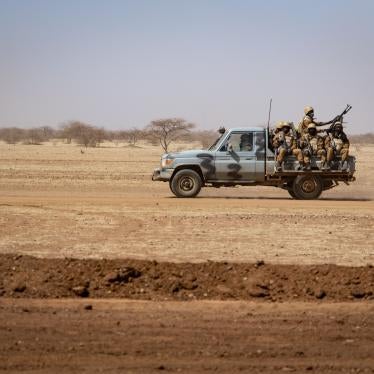
Robbed of their childhood, child combatants are subjected to a cycle of violence that they are often too young to understand, or resist.

Some have been forced to commit atrocities against family members or relatives. Inexperienced and immature, these children suffer far higher casualty rates than their adult counterparts. Those who survive are often physically or psychologically scarred. Typically lacking an education or civilian job skills, their futures are often bleak.


Letter to Clinton on Child Soldiers

December 15, 1998

President William J. Clinton
The White House
1600 Pennsylvania Avenue
Washington DC 20500

Dear Mr. President,

As leaders of professional, religious, human rights, peace, humanitarian, veterans, child welfare and other organizations, we are writing to express our deep concern over the global use of children as soldiers, and current U.S. policy towards efforts to end this reprehensible practice.

In today's armed conflicts, children are increasingly not only victims, but participants. The latest research estimates that more than 300,000 children under eighteen years of age are participating in armed conflicts around the world. Hundreds of thousands more are members of armed forces who could be sent into combat at any moment. Although most child recruits are over fifteen years of age, significant recruitment starts at ten years, and the use of even younger children is not uncommon.

Robbed of their childhood, child combatants are subjected to a cycle of violence that they are often too young to understand, or resist. While many of these young recruits may start out as porters or messengers, too often they end up on the front lines of combat. Some are used for particularly hazardous duty, such as entering mine fields ahead of older troops, or undertaking suicide missions. Some have been forced to commit atrocities against family members or relatives. Inexperienced and immature, these children suffer far higher casualty rates than their adult counterparts. Those who survive are often physically or psychologically scarred. Typically lacking an education or civilian job skills, their futures are often bleak.

Earlier this year during your trip to Africa, Mrs. Clinton spoke out strongly against the use of child soldiers. In one of her speeches, she rightly stated that "Nothing so offends any definition of human rights than the use of children as pawns of war. . . Only cowards would hide behind children in battle."

The United States government has made welcome financial allocations for the rehabilitation of former child soldiers. However, we are deeply disappointed that the United States has opposed efforts through the United Nations to establish eighteen as the minimum age for military recruitment or participation in armed conflict. Such a standard represents a growing international consensus, and is in line with existing international norms that recognize the special care and protection to which children are entitled.

The United States opposition to the proposed standard is based on current U.S. practice which allows the voluntary recruitment of seventeen-year olds, with parental permission. However, Defense Department statistics show that this age group comprises a minuscule number of the total U.S. troop force. Raising the U.S. enlistment age to eighteen would not compromise national security, and would set an important example to other nations.

Mr. President, the United States is in a unique position to exert strong leadership towards ending the reprehensible use of child soldiers. We urge you to give your full support to an international prohibition on the military recruitment or participation in armed conflict of any child under the age of eighteen. In addition, we urge an increase in the age for U.S. military enlistment to eighteen, and an elimination of U.S. military aid that facilitates the use of child soldiers by other governments or organizations.

We believe that your leadership can help eliminate one of the most alarming and tragic trends in modern warfare. We hope we can count on you to take the necessary steps towards ensuring that children are never used to fight the wars of adults.

Sincerely,

Larry Goodwin, Executive Director
Africa Faith and Justice Network

David Pruitt, M.D., President
American Academy of Child and Adolescent Psychiatry

Kara Newell, Executive Director
American Friends Service Committee

Dr. William F. Schulz, Executive Director
Amnesty International USA

Miriam A. Young, Executive Director
Asia Pacific Center for Justice and Peace

Daniel T. Plesch, Director
British American Security Information Council

Harry G. Barnes, Jr.
Chair, Human Rights Committee
The Carter Center

Ron Daniels, Executive Director
Center for Constitutional Rights

Samuel A. Worthington, Executive Director
Childreach

Rev. Judy Mills Reimer, Executive Director
Church of the Brethren General Board

Rodney Page, Executive Director
Church World Service

Rev. John Dear, SJ, Executive Director
Fellowship of Reconciliation

Edward Stowe, Legislative Secretary
Friends Committee on National Legislation

Pauline Baker, President
Fund for Peace*

Patricia M. Mische, President
Global Education Associates

Kenneth Roth, Executive Director
Human Rights Watch

Pharis J. Harvey, Executive Director
International Labor Rights Fund

Martha Honey, Peace and Security Director
Institute for Policy Studies

Rev. Richard Ryscavage, SJ, Director
Jesuit Refugee Service/USA

Mary Sochet, Co-Chair
Kids Meeting Kids Can Make a Difference

Ralston Deffenbaugh, Jr., Exec. Director
Lutheran Immigration and Refugee Service

Rev. Dr. Joan Brown Campbell,
General Secretary, National Council of the Churches of Christ, USA

Bob Chase, President
National Education Association*

Patricia Ireland, President
National Organization for Women

Mubarak E. Awad, Director
National Youth Advocate Program

Kathy Thornton, RSM
NETWORK: A National Catholic Social Justice Lobby

Sharifa Alkateeb, Vice-President
North American Council for Muslim Women

Gordon Clark, Executive Director
Peace Action Educational Fund

Leonard S. Rubenstein, Executive Director
Physicians for Human Rights

Robert Musil, Executive Director
Physicians for Social Responsibility

Joanne Carter, Legislative Director
RESULTS

Randall Robinson, President
TransAfrica

Charles J. Lyons, President
US Committee for UNICEF

Robert O. Muller, President
Vietnam Veterans of America Foundation

Malkia M'Buzi Moore, YouthPeace Coordinator,
War Resisters League

Susan Shaer, Executive Director
Women's Action for New Directions

Marilyn Clement, Executive Director
Women's International League for Peace and Freedom

Jo Uehara, Assistant National Executive Director,
YWCA of the USA*

Nancy Nye, Director
Youth Advocate Program International

Eugene Carroll, Jr., Rear Admiral
US Navy (retired)

* organization listed for identification purposes only


Home Page | About HRW | Research and Advocacy | How You Can Help | HRW International Film Festival