HUMAN RIGHTS
WATCH Human Rights News FrenchSpanishRussianKoreanArabicHebrewspacer
RSSPortugueseGermanChinesePersianMore Languagesspacer
   
Human Rights in the U.S.: Military Commissions FREE    Join the HRW Mailing List 
U.S.: Right to Counsel in Military Commissions
Letter to the Department of Defense
October 20, 2003


Paul W. Cobb, Jr.
Deputy General Counsel
Department of Defense
1600 Defense Pentagon
Washington, D.C. 20301-1600


Dear Mr. Cobb:


Thank you for your letter of August 20 regarding military commission rules for defense counsel. We appreciate your efforts to clarify the Department of Defense's views. Nevertheless, we remain concerned that certain rules impose unjustifiable limitations on the right to counsel and effective representation, and as such are inconsistent with principles firmly embedded in U.S. constitutional law, the rules for courts-martial, and international human rights law. Your letter's explanations either fail to address our core objections or offer justifications that do not withstand scrutiny.

As a preliminary matter, we want to acknowledge and welcome the change you made to Military Commission Instruction No. 5, Annex B, II (E). We had objected to the original language because it severely restricted the ability of defense counsel to prepare a defense. As rewritten, the rule now permits counsel to travel, undertake research and conduct interviews wherever necessary to build a case prior to the initiation of commission proceedings without having to seek approval from the Appointing Authority or the Presiding officer.

There remains one ambiguity in the new language, however. The revised rule permits counsel to communicate about the case with potential witnesses, members of the defense team, commission personnel, and "other individuals with particularized knowledge." It is not clear whether such individuals must have particularized knowledge of specific facts related to the case. Because criminal cases involve both factual and legal issues, we urge the Department of Defense to clarify that "other individuals" may include persons with legal or other expertise that might be useful to defense counsel. Indeed, in its discussions with the British government over its nationals detained at Guantanamo, the Defense Department already clarified that defense counsel consultation with British lawyers was permitted under the rules.

Despite this welcome clarification, we have several outstanding concerns regarding restrictions on defense counsel.

Right to Counsel of Choice

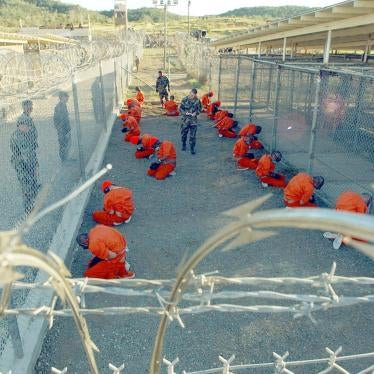
In your letter, you stated that the rule that all accused be represented by military defense counsel, even if he also has civilian defense counsel, was required "in the event classified material is presented for which civilian defense counsel does not have the necessary clearance, as Detailed Defense Counsel may not be excluded from any closed session." This is not a justification for rules that violate the right to counsel of choice - a fundamental component of a fair trial - by requiring the accused to accept representation by a military lawyer and by denying the defendant the right to either represent himself or to be represented solely by private counsel. As we noted in our letter to you of June 10, 2003, we do not question whether detailed military defense counsel would mount vigorous and competent defense of their clients. Nevertheless, because of culture, political belief, and their imprisonment, many of the detainees subject to trial by military commission may never fully trust or cooperate with U.S. military counsel assigned to them. Such trust and cooperation are, of course, vital for an effective defense.

Forcing military defense counsel on the accused is not the only way to balance the right to counsel with protection of classified information. For example, the Department of Defense could permit civilian counsel to have access to classified documents subject to serious penalties if they in fact divulge protected information. Both civilian courts and military courts martial can impose penalties for violating court orders to keep information confidential. Sensitive information can be protected by providing for such penalties in the commission rules. Moreover, existing rules of professional conduct preclude violation of confidentiality orders. The Department of Defense could also choose to use the procedures specified in the Classified Information Procedures Act that balance the need to protect classified information and the right to a full and fair defense.

Indeed, we question the very basis for restricting access to evidence and proceedings by civilian defense counsel who already have undergone a rigorous security clearance. All persons with access to classified information, whether civilians or members of the military, must protect that information. Yet, under the rules, civilian defense counsel may be excluded from critical portions of the trial and be denied access to protected information admitted against the client, even if they have a high-level security clearance. (MIC No. 5, Annex B, I (B)). These restrictions clearly impinge on the ability to provide effective representation. We strongly believe the Department of Defense should ensure that civilian counsel who have received a security clearance be given access to all commission proceedings, including closed sessions, and to all information necessary to their defense work.

Attorney-Client Communications

The rules require a civilian defense counsel to agree to monitoring of attorney-client conversations by U.S. officials for security or intelligence purposes. (MCI NO. 5, Annex B, II (I)). Such conversations are traditionally covered by the attorney-client privilege of confidentiality to encourage clients to confide openly with their attorneys. The ability to communicate candidly and fully with one's attorney is inherent in the right to counsel, which in turn, helps secure the overarching right of due process and a fair trial. The U.S. government's willingness to profoundly compromise these rights is deeply troubling. You offer as a defense of the rule that "nothing said between an Accused and his attorney, nor anything derived there from, may be used against that Accused in a military commission." Restricting the use of information obtained from monitoring attorney-client conversations does not fully mitigate the harm from such monitoring. The mere fact that conversation may be monitored will likely inhibit candid conversations between the accused (whether guilty or innocent) and his attorney. The right to counsel and right to a fair trial are clearly jeopardized when the officials who are the captors, jailers, prosecutors, and judges of the accused can listen in to all their conversations with their attorneys, regardless of the subsequent use to which information gleaned from those conversations is put.

Barriers to Representation by Civilian Counsel

The Department of Defense should encourage qualified attorneys to serve as civilian counsel. Instead, the Pentagon has erected barriers to representation by civilians. It requires prospective civilian counsel to pay the costs of obtaining the security clearance required to participate as counsel before the commissions. While the $224 fee for a secret security clearance may not be a disincentive to many attorneys, the fee of $2,801 for a top secret clearance is a significant amount of money. Indeed, contrary to what you suggest, the latter amount is certainly not "akin to other fees that lawyers must pay prior to admission to a bar." A top secret clearance is necessary if civilian defense counsel are to maximize their access to material presented during a commission proceedings. The significant cost of obtaining that clearance may well deter attorneys from deciding to join the defense pool for the accused.

Requiring private attorneys to bear the costs of obtaining security clearances is, as you point out, consistent with your instructions that representation by civilian defense counsel should be at no expense to the U.S. government. Our position is that those instructions must be changed. There are plenty of other difficulties faced by civilian lawyers who may want to represent the accused, including the location of the commission proceedings at Guantanamo, restrictions on their ability to travel to and from the site, and the requirement in the commission rules that counsel agree that they will not seek delays in the commission proceedings because of other cases or commitments. In this context, the fee for security clearances constitutes another hurdle that, intentionally or not, may limit civilian representation. Given the unique nature of these proceedings and the national and international importance of ensuring these trials are scrupulously fair and meet international due process standards, the U.S. government should be willing to assume certain civilian defense counsel costs.

Gag Rules on Civilian Defense Counsel

Your letter offers no justification for the remarkable commission rule that expressly prohibits civilian defense counsel from communicating directly with the media regarding military commission cases unless they receive prior approval from the military. You suggest this rule is not troubling because defense counsel may speak in court and because they may seek permission from the Appointing Authority or the Department of Defense General Counsel to speak to the media out of court. While the option of seeking permission may be appropriate for military prosecutors who remain within the military chain of command - and the commission rules subject them to a similar gag rule - there is no basis for giving the Defense Department complete control over what civilian counsel say outside of court. We know of no precedent in either civilian courts or the rules of military justice for such a gag order. Judges sometimes impose gag orders on attorneys in individual cases to protect the interests of justice, e.g., to ensure fair proceedings before an unprejudiced jury. Prohibiting attorneys from revealing protected or classified information to the public is also a familiar concept in the U.S. criminal justice system. As currently written, however, the commission rule is not limited to protecting sensitive information nor is it necessary to further the interests of justice.

The only apparent purpose of that gag rule is to control what the public may learn and understand about commission proceedings. Such a purpose is inconsistent with right of the public to have access to information about what its government is doing, a right that is particularly significant in the context of such nationally and internationally important proceedings. Limiting defense counsel's ability to speak to journalists can only impede the media's - and hence the public's - understanding of the significance of developments during the proceedings. Moreover, this rule will undermine public confidence in the commission proceedings in the eyes of a world that is already skeptical about the Department's handling of detentions at Guantanamo Bay.

For similar reasons, we continue to object to the additional requirement that civilian defense counsel agree to never say anything publicly or privately about any closed sessions of the proceedings. The breadth of this rule far exceeds any legitimate purpose. A prohibition on disclosing protected or classified information is unobjectionable, but this particular gag rule would prevent an attorney from providing important information to the public about the conduct of these trials that is neither classified nor protected. For example, the rule would prevent defense counsel from ever commenting on whether her exclusion from closed sessions affected her ability to mount an effective defense or whether the rulings during closed sessions were fair. The press and the public will not have access to closed sessions; their only ability to evaluate whether justice was served in those sessions will be through comments made by defense counsel or the prosecution. A perpetual gag order on defense counsel precluding any comments at all on closed sessions will invariably be seen as an unwarranted effort to shield from public view what may prove to be the most crucial parts of commission proceedings.

We urge you to take the steps necessary to revise the commission rules governing defense counsel so that they better reflect the dictates of basic rights and due process. Although this letter has only focused on defense counsel rules, we also continue to urge that the Defense Department review the structure and rules of the commissions to ensure consistency with fair trial and due process standards. Human Rights Watch remains extremely concerned that as presently conceived, the commissions cannot meet the standards of justice that the United States has traditionally sought to uphold. The lack of appeal to a truly independent body, the potential violation of the rights of persons entitled to prisoner-of-war status who should therefore only be tried by courts-martial, the possibility of a military trial of persons who are non-combatants - these remain among the serious defects in the commissions, in addition to the rules governing defense counsel. We have publicly stated before, and we reiterate here, that absent significant change, no one should be tried before the commissions.

The world will be watching how the United States tries suspected terrorists before the military commissions. The United States should ensure those prosecuted receive trials that are a credit to American justice and testimony to the country's long-standing commitment to human rights.

Sincerely,

Jamie Fellner, Esq.
Director, U.S. Program


HRW Logo Contribute to Human Rights Watch

Home | About Us | News Releases | Publications | Info by Country | Global Issues | Campaigns | Community | Bookstore | Film Festival | Search | Site Map | Contact Us | Press Contacts | Privacy Policy

© Copyright 2006, Human Rights Watch    350 Fifth Avenue, 34th Floor    New York, NY 10118-3299    USA