Mariano Fernández Bermejo
Minister of Justice
Ministry of Justice
San Bernardo, 45
28071 Madrid
Spain
Dear Minister Fernández Bermejo,
We are writing to express Human Rights Watch’s deep concern that the government of Spain is considering the extradition of Murat Ajmedovich Gasayev in reliance on diplomatic assurances against torture and ill-treatment proffered by the Russian authorities. Human Rights Watch sent a letter to the Audiencia Nacional in June 2007 expressing our concern for Gasayev’s safety upon return to Russia and urging the court to deny the extradition request.1
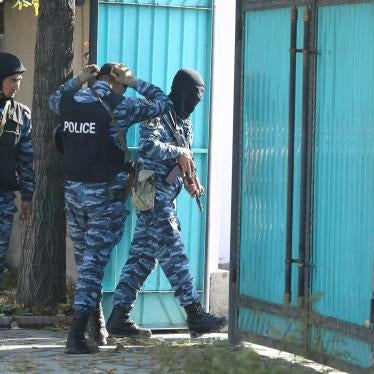
Murat Gasayev, an ethnic Chechen, is wanted in connection with an attack by an armed group on government buildings in the Republic of Ingushetia in June 2004. Gasayev was detained for three days in August 2004 by the Federal Security Service (FSB) in Ingushetia, and claims that during his interrogation, he was tortured and ill-treated. He was then released without charge. The extradition request appears to be based on subsequent statements by another detainee, Idris Matiev, who named Gasayev as a participant in the June 2004 actions while under interrogation by the FSB. Matiev later retracted this statement, alleging he was subjected to beatings, torture with electricity and threats against his family.2 In April 2008, several Ingushetia-based human rights organizations sent an open letter to the Spanish government emphasizing that the evidence against Gasayev had been obtained from Matiev under torture and calling on the government to deny any request to extradite Gasayev.3
Murat Gasayev argues he faces a real risk of torture and ill-treatment, as well as the denial of a fair trial due to the potential use of evidence extracted under torture, if extradited to Russia.4 The widespread torture and ill-treatment, and continuing enforced disappearances, in the Northern Caucasus in the context of counterterrorism or counterinsurgency operations by the Russian security apparatus are well-documented by Russian and international rights organizations. Numerous cases of torture of ethnic Chechens and Ingush suspected of involvement in the June 2004 raid on Nazran and other acts of insurgency are described in detail by the Moscow-based human rights organization Memorial in its September 2005 report A Conveyer of Violence: Human Rights Violations During Anti-Terrorist Operations in the Republic of Ingushetia.5
As there is no remand prison in Ingushetia, suspects are taken to Vladikavkaz, North Ossetia, where confessions are often extracted under physical coercion by security and law-enforcement officials. Based on those confessions, the suspects are then prosecuted in Ingushetia. Even in the rare cases of acquittal by a court of law, those individuals remain vulnerable to further persecution by security services.6 In a particularly disturbing case publicized by Anna Politkovskaya, unidentified armed personnel attempted to abduct the just acquitted Murat Margoshvili directly from the premises of the Ingushetia Supreme Court.7
Indeed, by requesting diplomatic assurances against torture and ill-treatment from the Russian government, the Spanish authorities acknowledge the risk faced by Murat Gasayev on return.
Alleged Post-Return Monitoring by the Committee Against Torture
We understand that the Audiencia Nacional refused Gasayev’s appeal against extradition in large measure as a result of diplomatic assurances from the Russian authorities contained in a set of letters transmitted to the Spanish government in 2007. These assurances included undertakings that Gasayev’s conditions of detention would comport with Article 3 of the European Convention on Human Rights, he would not be subjected to the death penalty, and he would be eligible for parole after 25 years in prison if convicted to a life sentence.
Moreover, the Russian authorities guaranteed that in conformity with Part II of the UN Convention Against Torture, members of the Committee Against Torture would be permitted to visit Gasayev in detention and to conduct private interviews with him.8 After a careful review of the court documents in the Audiencia Nacional proceedings, it is clear that the guarantee of monitoring visits by the CAT played a pivotal role in the court’s decision to approve Gasayev’s extradition.
Human Rights Watch opposes the use of diplomatic assurances against torture and ill-treatment in any case where there is an acknowledged risk of such abuse upon return.9 Diplomatic assurances are inherently unreliable from governments in states where torture and ill-treatment are practiced or where particular groups are routinely targeted for such abuse, as is the case with Chechens suspected of militant activities in Russia. Our opposition to the use of diplomatic assurances has been echoed by the UN high commissioner for human rights, the special rapporteurs on torture and on counter-terrorism and human rights, and the Council of Europe commissioner for human rights, among other international human rights experts.
With respect to the involvement of the Committee Against Torture, it is critical to point out several serious problems with the Russian authorities’ naming of the committee to conduct post-return monitoring of Gasayev’s detention conditions and treatment:
- To our knowledge, neither the Committee Against Torture, nor the UN Office of the High Commissioner for Human Rights, is seized of the Gasayev case. There apparently has been no consultation with the very organs of the UN named as monitors.
- There is no provision in Part II of the Convention Against Torture for the type of ad hoc post-return monitoring of a single individual guaranteed by the Russian government. Article 20 of the Convention Against Torture provides for representatives of the committee to make a visit to a state party, but only in the context of a more general inquiry resulting from information that torture is systematically practiced in that state. Article 20 cannot be read as creating a role for the committee to monitor a sole detainee as a function of a guarantee contained in a bilaterally negotiated set of diplomatic assurances. Such assurances are negotiated outside the formal UN treaty system, do not include any enforcement mechanism, and thus are not legally binding.
- The role of the Committee Against Torture in monitoring the implementation of the Convention Against Torture has never involved the practice of visiting detention centers. There is simply no precedent for this activity, and currently there is no monitoring capacity or funding available for such monitoring. The Russian government clearly did not intend to refer to the Optional Protocol of the Convention Against Torture, which does establish an international monitoring body, since Russia is a not a party to the OPCAT.
- The Committee Against Torture has issued recommendations and conclusions, and decisions in individual petition cases, raising serious concerns about the growing reliance on diplomatic assurances against torture and ill-treatment by states parties to the Convention Against Torture.10 The committee has also stated that governments should not rely on diplomatic assurances against torture from states that systematically violate the provisions of the Convention Against Torture.11
- Post-return monitoring on an ad hoc basis cannot, in and of itself, protect a detainee from abuse. Even if the committee had agreed to conduct visits to Gasayev to monitor his treatment upon return, that initiative could not be considered adequate to ensure his safety. UN High Commissioner for Human Rights Louise Arbour has written that “Based on the long experience of international bodies and experts, it is unlikely that a post-return monitoring mechanism set-up explicitly to prevent torture and ill-treatment in a specific case would have the desired effect. These practices often occur in secret, with the perpetrators skilled at keeping such abuses from detection. The victims, fearing reprisal, often are reluctant to speak about their suffering, or are not believed if they do.”12
Human Rights Watch fears that the Audiencia Nacional denied Murat Gasayev’s appeal based on a misunderstanding of the nature of the activities in which the Committee Against Torture engages. Moreover, we reiterate that even if such monitoring were undertaken, it could not protect Gasayev from the real risk of torture and ill-treatment he faces upon return to Russia.
The European Court of Human Rights
We understand that the European Court of Human Rights last month declined to communicate an order for interim measures in Murat Gasayev’s case. While the reasons for the court’s response to Gasayev’s petition for interim measures remain unclear, the recent jurisprudence of the court has reaffirmed the absolute ban on sending people to countries where they are at risk of torture and ill-treatment, despite assurances against such abuse from the receiving state.
In the February 2008 judgment in the case of Saadi v. Italy, a unanimous Grand Chamber reaffirmed the absolute nature of article 3 of the European Convention on Human Rights, prohibiting torture and other ill-treatment and transfers of persons to places where they are at risk of such abuse. The judgment also addressed the issue of diplomatic assurances and whether a state’s duty not to deport where there is a risk of torture or ill-treatment can be mitigated by promises of humane treatment from the state to which the individual is to be returned. The court held that such assurances do not automatically offset an existing risk, emphasizing “that the existence of domestic laws and accession to treaties guaranteeing respect for fundamental rights in principle are not in themselves sufficient to ensure adequate protection against the risk of ill-treatment where . . . reliable sources have reported practices resorted to or tolerated by the authorities which are manifestly contrary to the principles of the Convention.”13
The court also concluded that even if more specific assurances were secured, the court would still evaluate them on a case-by-case basis to determine whether the “assurances provided, in their practical application, a sufficient guarantee that the applicant would be protected against the risk of treatment prohibited by the Convention.” In practice, once such a risk has been established, the court has never found assurances capable of displacing it.14
On April 24, 2008, the European Court ruled in the case of Ismoilov v. Russia that the extradition of 12 Uzbeks from Russia to Uzbekistan would violate article 3 of the Convention despite the diplomatic assurances against torture provided by the Uzbek authorities. The court noted that diplomatic assurances were rejected in Saadi and in the 1996 case of Chahal v. UK for a deportation to the Punjab region of India, where torture abuses were endemic and persistent. It concluded: “Given that the practice of torture in Uzbekistan is described by reputable international experts as systematic . . . the Court is not persuaded that the assurances from the Uzbek authorities offered a reliable guarantee against the risk of ill-treatment.”15
The assurances against torture offered by Russia in the Gasayev case merely restate its key obligations under the European Convention on Human Rights. According to our and others’ research, however, Russia has routinely failed to honor its legally-binding treaty commitments and the practice of torture and ill-treatment of persons continues, in particular against Chechens, and also in the context of counter-terrorism or counter-insurgency cases in the Northern Caucasus. There is an unacceptable risk that a breach of these assurances would only be discovered after torture has already occurred.
This was the conclusion of a British court in 2003 when it rejected diplomatic assurances from Russia with respect to Akhmed Zakaev, a Chechen official in exile. In refusing to accept the Russian assurances, the court relied on the fact that torture is widespread in Russia, that Chechens in particular are targeted for such abuse, and that the Russian government could not have effective control over the vast prison system as to guarantee Zakaev would not be tortured. Despite the personal testimony of the deputy minister for prisons in Russia, who appeared in court to verify the assurances, Zakaev’s extradition was refused.16
Russia Has Breached Diplomatic Assurances in the Past
The government of Russia has failed to abide by diplomatic assurances it has offered in the past. The US government transferred seven Guantanamo Bay detainees to Russia in March 2004 in reliance on promises from Moscow to prosecute the detainees only on terrorism charges and to treat them humanely. Russia did neither. Some of the men were subsequently harassed and convicted on trumped up charges. Former detainee Rasul Kudaev, a resident of Kabardino-Balkaria in southern Russia, was detained after an armed uprising in the provincial capital in October 2005. According to photographs, medical records, court documents, and the testimony of lawyers and family members, Kudaev was repeatedly beaten in custody in an effort to compel him to confess to involvement in the uprising.17
In 2003, Russian authorities denied a delegation of the European Court of Human Rights access to five extradited Chechens. Georgia had extradited the men in October 2002 despite a request from the Court that it suspend any transfer until it had had an opportunity to review the cases.18 The Russian authorities had subsequently offered diplomatic assurances, including guarantees of unhindered access for the Chechens to appropriate medical treatment, to legal advice, and to the European Court itself. In its April 2005 ruling, the Court found that Russia had violated the European Convention (article 38) by “obstructing the Court’s fact-finding visit and denying it access to the applicants,” having thereby “unacceptably hindered the establishment of part of the facts in this case.”19 The Shamayev court also ruled that the extradition to Russia of one of the men remaining in Georgia would violate Art. 3, despite the assurances of humane treatment from Moscow.
We are aware that some governments argue that diplomatic assurances should automatically be accepted from Council of Europe member states because they are a party to the European Convention on Human Rights and any persons returned and subsequently subjected to torture or ill-treatment will have access to the European Court of Human Rights. The Russian authorities’ failure to comply with assurances it made to the European Court in the Shamayev case, however, is a striking illustration of the fact that mere accession to regional or international human rights instruments is no guarantee that a state will comply with the obligations enshrined in those instruments, or even with express assurances given to the European Court of Human Rights in the course of pending proceedings.
We also draw the Spanish government’s attention to the fact that the Russian government has an extremely poor record of implementing decisions of the European Court of Human Rights, particularly final decisions involving abuses against ethnic Chechens.20 If Murat Gasayev were tortured or ill-treated on return to Russia, it is unlikely that the perpetrators of his abuse—even in the event he were able to bring and win a case at Strasbourg—would ever be held accountable.
International Expert Opinion on Diplomatic Assurances
A growing number of international human rights experts oppose the use of diplomatic assurances against torture and ill-treatment. In March 2006, UN High Commissioner for Human Rights Louise Arbour stated, “I strongly share the view that diplomatic assurances do not work as they do not provide adequate protection against torture and ill-treatment.”21 As noted above, the high commissioner has also articulated why post-return monitoring of an isolated individual cannot be regarded as an added safeguard.22
Commenting on the UK government’s efforts to deport terrorism suspects based on diplomatic assurances, UN Special Rapporteur on Torture Manfred Nowak has noted that seeking such assurances “reflects a tendency in Europe to circumvent the international obligation not to deport anybody if there is a serious risk that he or she might be subjected to torture.”23
Thomas Hammarberg, the Council of Europe Commissioner for Human Rights, is unequivocal in his opposition to the practice of seeking assurances against torture:
“Diplomatic assurances”, whereby receiving states promise not to torture specific individuals if returned are definitely not the answer to the dilemma of extradition or deportation to a country where torture has been practiced. Such pledges are not credible and have also turned out to be ineffective in well-documented cases… In short, the principle of non-refoulement should not be undermined by convenient, non-binding promises of such kind.24
Such categorical opposition lends weight to the proposition that diplomatic assurances against torture do not work and undermine the non-refoulement obligation.
Spain’s Position on Diplomatic Assurances
The Spanish government in the past has taken a critical view of diplomatic assurances. The extradition of Murat Gasayev on the basis of diplomatic assurances would appear to be directly at odds with statements made in December 2005 and March 2006 by a Spanish representative during deliberations on the issue of diplomatic assurances against torture at two expert meetings of the Group of Specialists on Human Rights and the Fight against Terrorism (DH-S-TER) at the Council of Europe. In June 2005, the Council of Europe’s Steering Committee on Human Rights (CDDH) tasked the Group of Specialists with examining the wisdom of developing guidelines for the “appropriate use” of diplomatic assurances. In the end, the DH-S-TER recommended that no guidelines be developed for the use of assurances, with the Spanish government at that time firmly in the corner of those states opposing the use of assurances for transfers to risk of torture and ill-treatment.25
At the March 2006 meeting of the DH-S-TER, a Human Rights Watch representative attending in observer capacity noted the Spanish representative’s vocal and steadfast opposition to the use of diplomatic assurances against torture and ill-treatment. The Spanish representative joined a group of countries who argued, in concert with a coalition of nongovernmental organizations including Human Rights Watch, that diplomatic assurances against torture and ill-treatment do not mitigate the real risk of abuse. The April 2006 final report of the meeting stated:
Certain experts considered that diplomatic assurances concerning Article 3 ECHR treatment in the context of expulsion procedures were inherently unreliable and could not be regarded as having sufficient weight to amount to an effective mitigation of the risk. They should thus never be relied upon. Some expressed this view for all the cases; others limited their remarks to cases where there is a systematic pattern of torture in the receiving State.26
The Spanish government representative steadfastly espoused the position that diplomatic assurances against torture undermined the non-refoulement obligation and should not be used in cases where there was a real risk of torture and ill-treatment upon return. Human Rights Watch thus seeks clarification regarding what appears to be your government’s disassociation from the position taken by Spain at the DH-S-TER meeting and possible shift toward acceptance and reliance upon diplomatic assurances for deportations/extraditions to risk of torture.
Conclusion
To rely on diplomatic assurances to extradite Murat Gasayev would be a serious mistake, and would place him at grave risk of serious abuse. It would fly in the face of well-documented evidence that such guarantees of humane treatment do not provide an effective safeguard against torture and ill-treatment. We respectfully request that the Spanish government reject as unreliable and insufficient Russia’s diplomatic assurances in the Gasayev case, halt its efforts to extradite Gasayev, and refuse to seek such assurances in any future case where there is a real risk of torture or ill-treatment on return.
Sincerely,
|
Holly Cartner |
Joanne Mariner |
cc.
Louise Arbour, UN High Commissioner for Human Rights
Claudio Grossman, Chairperson, UN Committee Against Torture
Manfred Nowak, UN Special Rapporteur on Torture
Martin Scheinin, UN Special Rapporteur on Human Rights and Counter-terrorism
Terry Davis, Council of Europe Secretary General
Thomas Hammarberg, Council of Europe Commissioner for Human Rights
Miguel Ángel Moratinos Cuyaubé, Foreign Minister, Spain
1 Human Rights Watch letter to the Pleno de la Sala de lo Penal de la Audiencia Nacional, June 27, 2007, on file with Human Rights Watch.
2 A copy of Matiev’s written statement about his providing false evidence under torture is on file with Human Rights Center Memorial. Matiev admitted to giving false testimony incriminating several dozens of individuals.
3 Open Letter by Ruslan Badalov (Chair of Chechen Committee for National Salvation), Magomed Mutsolgov (Chair of Public Organization MASHR), and Aslambek Apaev (Chair of the Committee for the Protection of Internally Displaced Persons), April 2, 2008, Nazran, Ingushetia, http://www.zaprava.ru/content/view/1409/2/ (accessed May 6, 2008).
4 See Othman (Jordan) v. Secretary of State for the Home Department [2008] EWCA Civ 290;[2008] WLR (D) 103, April 9, 2008 (UK Court of Appeal halts deportation of national security suspect Omar Othman to Jordan due to potential use of evidence extracted under torture being used in his trial in Jordan).
5 Human Rights Center Memorial, http://www.memo.ru/eng/memhrc/texts/5report9.shtml (accessed May 6, 2008).
6 Ibid.
7 Anna Politkovskaya, “The Courtroom’s Takeover,” Novaya Gazeta, February 9, 2006.
8 Russia’s unwillingness to have its penitentiary facilities scrutinized by competent UN mechanisms has become particularly evident in the course of the past two years in light of the unsuccessful attempts by the UN special rapporteur on torture to negotiate a planned visit to the Russian Federation.
9 Human Rights Watch, “Diplomatic Assurances Against Torture: Questions and Answers,” November 2006, https://www.hrw.org/backgrounder/eca/ecaqna1106/ecaqna1106web.pdf; Human Rights Watch, Still at Risk: Diplomatic Assurances No Safeguard Against Torture, Vol. 17, No. 4(D), April 2005, https://www.hrw.org/reports/2005/eca0405/; Human Rights Watch, Empty Promises: Diplomatic Assurances No Safeguard Against Torture, Vol. 16, No. 4(D), April 2004, https://www.hrw.org/reports/2004/un0404/diplomatic0404.pdf.
10 Committee Against Torture, Pelit v. Azerbaijan, Communication No. 281/2005, CAT/C/38/D/281/2005, June 5, 2007, http://www1.umn.edu/humanrts/cat/decisions/281-2005.html (accessed May 5, 2008) and Agiza v. Sweden, Communication No. 233/2003, CAT/C/34/D/233/2003, May 20, 2005, http://www1.umn.edu/humanrts/cat/decisions/233-2003.html (accessed May 5, 2008).
11 Committee Against Torture, “United States of America: Conclusions and Recommendations of the Committee Against Torture,” CAT/C/USA/CO/2, July 25, 2006, para. 21,
http://daccessdds.un.org/doc/UNDOC/GEN/G06/432/25/PDF/G0643225.pdf (accessed May 5, 2008).
12 Address by Louise Arbour, Chatham House, “In Our Name and On Our Behalf,” London, February 15, 2006, http://www.chathamhouse.org.uk/files/3375_ilparbour.pdf (accessed May 5, 2008).
13 European Court of Human Rights, Saadi v. Italy, Application No. 37201/06, February 28, 2008, para. 147, http://cmiskp.echr.coe.int////tkp197/viewhbkm.asp?action=open&table=F69A... (accessed May 5, 2008).
14 Ibid., para. 148.
15 European Court of Human Rights, Ismoilov and Others v. Russia, Application No. 2947/06, April 24, 2008, para. 127, http://cmiskp.echr.coe.int////tkp197/viewhbkm.asp?action=open&table=F69A... (accessed May 5, 2008).
16 The Government of the Russian Federation v. Akhmed Zakaev, Bow Street Magistrates’ Court, Decision of Hon. T. Workman, November 13, 2003, http://www.tjetjenien.org/Bowstreetmag.htm (accessed May 6, 2008).
17 Human Rights Watch, The “Stamp of Guantanamo”: The Story of Seven Men Betrayed by Russia’s Diplomatic Assurances to the United States, March 2007, Vol. 19, No. 2(D), https://www.hrw.org/reports/2007/russia0307/.
18 European Court of Human Rights, Shamayev and 12 Others v. Georgia and Russia, Application No. 36378/02, October 12, 2005, http://cmiskp.echr.coe.int////tkp197/viewhbkm.asp?action=open&table=F69A... (accessed May 5, 2008).
19 Ibid., para. 504.
20 See Human Rights Watch, Justice for Chechnya: The European Court of Human Rights Rules Against Russia, July 2007, https://www.hrw.org/eca/2007/justice_for_chechnya.pdf .
21 Statement by UN High Commissioner for Human Rights Louise Arbour to the Council of Europe’s Group of Experts on Human Rights and the Fight Against Terrorism (DH-S-TER), March 29-31, 2006, on file with Human Rights Watch.
22 Address by Louise Arbour, Chatham House, “In Our Name and On Our Behalf,” London, February 15, 2006, http://www.chathamhouse.org.uk/files/3375_ilparbour.pdf (accessed May 5, 2008).
23 “United Kingdom Must Not Deport People to Countries with Risk of Torture – UN Rights Expert,” UN News Centre news release, August 23, 2005, http://www.un.org/apps/news/story.asp?NewsID=15513&Cr=UK&Cr1, (accessed May 5, 2008).
24 Council of Europe Commissioner on Human Rights, “Viewpoint: ‘Torture can never, ever be accepted,’” June 27, 2006, http://www.coe.int/t/commissioner/viewpoints/060626_EN.asp (accessed May 5, 2008).
25 “No Guidelines on Empty ‘No Torture’ Promises: Council of Europe Rejects Minimum Standards for Diplomatic Assurances,” Human Rights Watch news release, April 3, 2006, https://www.hrw.org/english/docs/2006/04/03/eu13110.htm.
26Council of Europe Steering Committee on Human Rights, Group of Specialists on Human Rights and the Fight against Terrorism, Report of 2d Meeting, 29-31 March 2006, http://www.coe.int/t/e/human_rights/cddh/3._committees/06.%20terrorism%2...(2006)005.asp#TopOfPage (accessed May 5, 2008). The reasons presented to support this view included:
i. diplomatic assurances are sought from countries which have a proven record of torture or other ill treatment contrary to their international obligations;
ii. the State asking for diplomatic assurances knows that the other State violates its obligations regarding torture and therefore implicitly recognizes that torture occurs. By relying on diplomatic assurances, it undermines efforts of the international community to ensure respect for human rights obligations;
iii. diplomatic assurances create double standards between the person protected by the assurances and other persons in the country who may face torture without any such protection;
iv. diplomatic assurances are not necessarilylegally binding;
v. it seemed that in many cases the post-return monitoring mechanisms of the respect of the fundamental rights of the expelled person were proven not to be effective;
vi. in practice, there have been several specific cases of decisions of international monitoring organs which established that, in the individual case, the diplomatic assurances that had been obtained were ineffective;
vii. if the assurances are violated, the individual concerned has no available remedy;
viii. it might be thought that the requested and requesting States have a common interest in the monitoring body finding no evidence of torture;
ix. there is no climate of mutual trust;
x. torture is of a clandestine nature;
xi. if the study of the case concludes that there is a risk, the fact that diplomatic assurances were obtained does not change that conclusion.