• Commentary
    Apr 24, 2012
    Some valuable truths underlie Oplan Bayanihan, the Armed Forces of the Philippines’ 16-month-old internal peace and security plan. Chief among them are that the various insurgent groups in the Philippines are unlikely to be beaten by force alone, that better standards of living can curb the roots of the rebellions, and that the military could do more to “win the sentiment” of the general population. But in translating these truths into practice, something seems to have gotten warped along the way. The AFP’s practice of mixing soldiers with schools amply illustrates this misguidedness.
  • Press release
    Feb 21, 2012
    Somalia’s warring parties have all failed to protect Somali children from the fighting or serving in their forces, Human Rights Watch said in a report released today. The Islamist insurgent group al-Shabaab has increasingly targeted children for recruitment, forced marriage, and rape, and attacked teachers and schools.
  • Commentary
    Jan 31, 2012

    The Philippine government is engaged in a long-running armed conflict with the insurgent New People’s Army (NPA), the armed wing of the Communist Party of the Philippines. While the NPA maintains a presence in the mountains of northern Luzon, there has only been limited military action in the Cordillera region since the 1990s. Despite the low levels of conflict, the military continues to place troops and guns in local communities. And in some cases these troops and their guns establish a home on school grounds.

  • Press release
    Nov 30, 2011
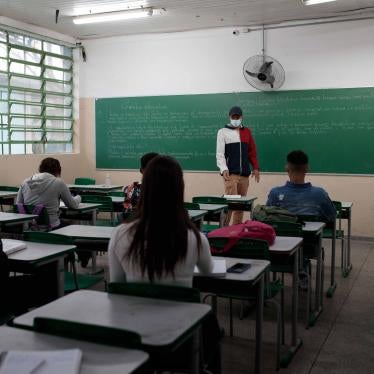
    During a recent eight-day investigation in the Cordillera Autonomous Region on northern Luzon island, Human Rights Watch found five cases in which the military, in violation of Philippine and international law, had used parts of functioning schools as barracks or bases for military detachments since 2009. This military use of schools lasted for periods ranging from three months to more than a year.
  • Journal Article
    Oct 31, 2011
    The past two decades have seen increased awareness, attention and action in response to the plight of children affected by armed conflict. However, one issue that has not received much attention, despite the regularity with which it occurs, is the phenomenon of military forces and other armed groups using school buildings. Of particular concern is when armed groups occupy and convert schools into military bases on a medium- or long-term basis.
  • Press release
    Jul 20, 2011
    Governments should improve protections for students and teachers during wartime by explicitly outlawing attacks on schools and curtailing their use by the military.
  • Press release
    Jul 15, 2011
    The rights of ethnic Georgian returnees to Abkhazia are hostage to nearly two decades of political conflict.
  • Press release
    Jul 12, 2011
    Armed forces and non-state armed groups should immediately stop targeting schools, teachers and students for attack and comply with new United Nations Security Council measures to protect education in armed conflict, the Global Coalition to Protect Education from Attack (GCPEA) said today.
  • Press release
    May 9, 2011
    Libyan government forces have launched what appear to be repeated indiscriminate attacks on mountain towns in western Libya.
  • Press release
    Feb 14, 2011

    Separatist insurgents in Thailand's southern border provinces should immediately end attacks on civilians.