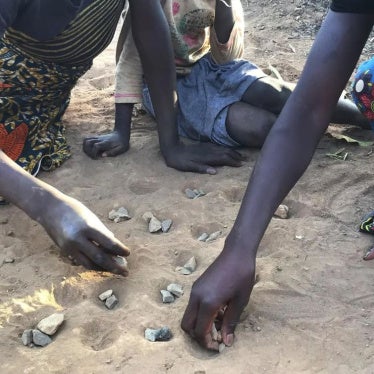


• Men and children work in the mines outside of Bagega. They dig deep to find the rock and then crush these rocks to extract the gold ore. Inside the rocks are deposits of other metals, including lead, which has poisoned many of the children in the village.
    High-level Nigerian government participation is needed at an upcoming international conference to make progress in ending a lead poisoning epidemic among children in Zamfara State, Human Rights Watch said today.

Reports

Environment

  • May 6, 2012
    High-level Nigerian government participation is needed at an upcoming international conference to make progress in ending a lead poisoning epidemic among children in Zamfara State, Human Rights Watch said today.
  • Mar 9, 2012
    Many residents of Fukushima prefecture still lack basic information and clear answers about the level of radiation in their food and environment. Although the explosion at the Daiichi plant is considered the most severe radiation crisis worldwide since Chernobyl, many residents of Fukushima prefecture report that they have not been able to have their children tested for radiation exposure. They also told Human Rights Watch that the government provides contradictory information about the impact of radiation on human health.
  • Feb 7, 2012
    Thousands of children in northern Nigeria need immediate medical treatment and dozens of villages remain contaminated two years into the worst lead poisoning epidemic in modern history, Human Rights Watch said today while releasing a video on the issue. Four hundred children have died, according to official estimates, yet environmental cleanup efforts have not even begun in numerous affected villages.
  • Oct 27, 2011
    Governments around the world should protect the health of millions of artisanal gold miners working with mercury, Human Rights Watch said today. Human Rights Watch submitted recommendations to governments ahead of negotiations for an international, legally binding convention on mercury.
  • Oct 4, 2011

    Burmese President Thein Sein burnished his perception as a reformist last week by suspending one of the country's largest -- and potentially most destructive -- foreign investment projects. The Myitsone hydro-electric dam, the largest of seven dams to be constructed by the Beijing-controlled China Power Investment Corporation, would have flooded an area of more than 700 square kilometers, and displaced tens of thousands of villagers in northern Kachin State, close to the state capital of Myitkina. Several thousand have already been displaced by the first dam, built to provide the electricity for the larger ones in the series.

  • Jun 20, 2011
    The trajectory of China's lead poisoning epidemic is reminiscent of other Chinese public health crises over the last decade, with the repeating themes of corruption, cover up and harassment. Lead poisoning can cause permanent physical and cognitive disability, and at stake here are millions of children: China's future.
  • Jun 15, 2011
    Chinese government officials in provinces with high rates of industrial pollution are restricting access to lead testing, withholding and falsifying test results, and denying children treatment, Human Rights Watch said in a report released today.
  • Feb 10, 2011

    Human Rights Watch recently released a report that details brutal gang rapes and other abuses allegedly carried out by employees of Barrick Gold in Papua New Guinea. Barrick, a Canadian firm, is the world's largest gold producer and Porgera is one of the world's largest gold mines. Now the company is scrambling to put things right, investing in new mechanisms for oversight and accountability and firing some of its private security personnel while others are being hauled away by the police.

  • Feb 1, 2011
    Private security personnel employed at a gold mine in Papua New Guinea have been implicated in alleged gang rapes and other violent abuses, Human Rights Watch said in a report released today. The Porgera mine has produced billions of dollars of gold in its twenty years of operation, and  is operated and 95 percent owned by Barrick Gold, a Canadian company that is the world's largest gold producer.
  • Jan 24, 2011
    Too many governments are accepting the rationalizations and subterfuges of repressive governments, replacing pressure to respect human rights with softer approaches such as private “dialogue” and “cooperation,” Human Rights Watch said today in releasing its World Report 2011. Instead of standing up firmly against abusive leaders, many governments, including the European Union, adopt policies that do not generate pressure for change.