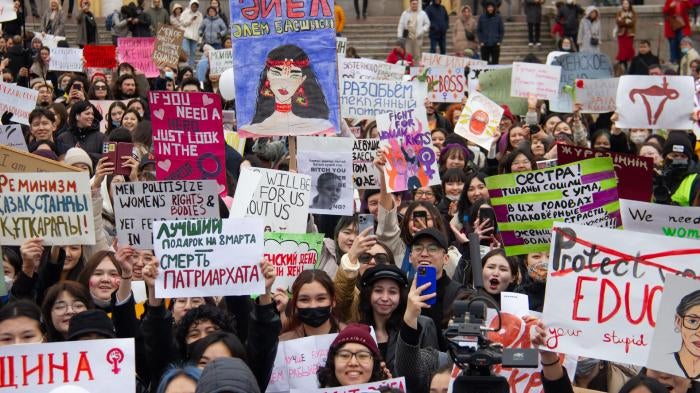

• Despite great strides made by the international women’s rights movement over many years, women and girls around the world are still married as children or trafficked into forced labor and sex slavery. They are refused access to education and political participation, and some are trapped in conflicts where rape is perpetrated as a weapon of war. Around the world, deaths related to pregnancy and childbirth are needlessly high, and women are prevented from making deeply personal choices in their private lives. Human Rights Watch is working toward the realization of women’s empowerment and gender equality—protecting the rights and improving the lives of women and girls on the ground.

  • The farmland provided to Senolia S., upon her resettlement to Cateme, was reclaimed by its original cultivators. She did not receive any replacement land or additional assistance and finally scraped enough money together to rent a plot of rocky, untilled land.
    Many of the 1,429 households resettled to make way for Vale and Rio Tinto’s international coal mining operations in Tete province, Mozambique have faced serious disruptions in their access to food, water, and work. The Mozambican government’s speed in approving mining licenses and inviting billions of dollars in investment has outstripped the creation of adequate safeguards to protect directly affected populations.

Reports

Women's Rights

  • May 23, 2013
    Many of the 1,429 households resettled to make way for Vale and Rio Tinto’s international coal mining operations in Tete province, Mozambique have faced serious disruptions in their access to food, water, and work. The Mozambican government’s speed in approving mining licenses and inviting billions of dollars in investment has outstripped the creation of adequate safeguards to protect directly affected populations.
  • May 22, 2013
    In January 2012, my investigations determined that some 400 women and girls were locked away in Afghan prisons and juvenile detention facilities for the 'moral crime' of running away from home or having sex outside of marriage.
  • May 20, 2013
    Victoria J. married in 2009 at age 14, and became pregnant shortly after. “I started labour in the morning on a Friday …. The nurse kept checking and saying I would deliver safely. On Monday she said I was weak.
  • May 14, 2013
    President Mauricio Funes of El Salvador should ensure that a woman who faces substantial risk of death if her pregnancy continues can obtain an abortion without criminal penalty, Human Rights Watch said today in a letter to Funes.
  • May 14, 2013
    We write to you urgently about the case of Salvadoran citizen “Beatriz,” a 22-year-old woman whose life is in grave danger as a result of her pregnancy. We are greatly concerned that the El Salvadoran government has not complied with the precautionary measures granted to Beatriz by the Inter-American Commission on Human Rights. Fifty days after she first sought relief from your government, Beatriz is still awaiting a life-saving medical treatment.
  • May 13, 2013
    Human Rights Watch deeply mourns the death of Cynthia Brown, a colleague, friend and mentor for more than 30 years. She died on May 12, 2013, in New York City, after battling cancer. She was 60 years old.
  • May 13, 2013
    In Yemen, South Sudan, and other parts of the world, instead of going to school or spending time with their friends and families, girls, some as young as 8, are married -- often to much older men. If the girls don’t want to marry, their families generally force them. After they are wed, life often changes for the worse.
  • May 10, 2013
    The approaching one-year anniversary of the London Olympics is a reminder that change is possible, even in countries that have long resisted it.
  • May 10, 2013
    Members of the Seleka rebel coalition, which ousted President François Bozizé of the Central African Republic on March 24, 2013, have committed grave violations against civilians, including pillage, summary executions, rape, and torture.
  • May 9, 2013
    Every industrialized nation in the world—except the United States—guarantees paid leave for new mothers.