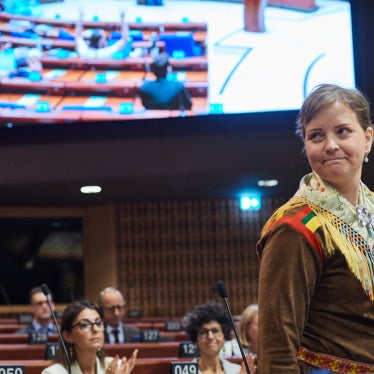
Two resolutions adopted by the United Nations Human Rights Council during the past 16 months represent potential advances and setbacks for the global lesbian, gay, bisexual and transgender rights movement. One is concerned with defending sexual orientation and gender identity; the other with protecting traditional values. Together they represent divergent views on the universality and indivisibility of human rights.
The U.N. Human Rights Council recently passed a resolution on “traditional values of humankind” as a vehicle for “promoting human rights and fundamental freedoms.” It sounds innocuous, but its implications are ominous. Indeed, it is an immediate threat to the rights of many vulnerable groups – including women and lesbian, gay, bi-sexual and transgender (LGBT) people. And it flies in the face of the founding principles of universality and indivisibility enshrined in the Universal Declaration of Human Rights.
I’ve interviewed hundreds of victims and witnesses of human rights abuses in Uganda, but I was genuinely surprised at the fear I heard recently when I met with activists in the country. “If you preach human rights, you are anti-development, an economic saboteur,” a colleague told me. “You aren’t going to talk about land, oil, and good governance. This is just the beginning, but the tensions have been accumulating.”
Over the last eight months, Human Rights Watch has interviewed more than 200 current and former sex workers in New York, Los Angeles, Washington and San Francisco. The interviews were part of an investigation into barriers to H.I.V. prevention for sex workers, who, worldwide, are more than 10 times as likely to be infected as the general population. What we found was shocking: While public health departments spend millions of dollars promoting and distributing condoms, police departments are harassing sex workers for carrying them and using them as evidence to support arrests.
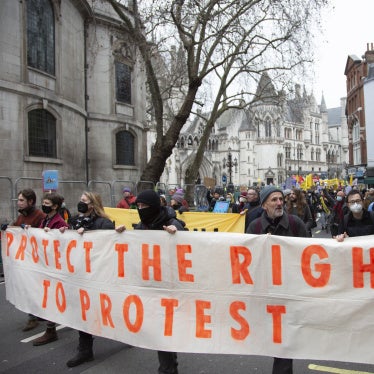
Two years ago, I was asked to speak at the opening of the first Baltic Pride Parade in Vilnius, Lithuania. It was a chilling experience. When I arrived in that European Union member state, the organisers greeted me with disappointment. A court had issued an order banning the parade, which was to be a proud celebration of the lesbian, gay, bisexual, and transgender community. Members of parliament had also written an open letter claiming that a Pride Parade would be harmful to children and an affront to Lithuania's moral standards. Fortunately, the Vilnius appeals court decided otherwise - upholding the supremacy of the rights to freedom of assembly and expression over prejudice.
At a news conference shortly after she was sworn in as Malawi’s president, Joyce Banda announced her government’s intention to decriminalise homosexuality. It is unclear how she will achieve this, but the move is in stark contrast to the approach of her predecessor, Bingu wa Mutharika, who openly condemned it.
Ukraine is about more than Yulia Tymoshenko and a soccer tournament. That is surely running through the minds of Ukrainian officials as the European football championships, hosted by Ukraine and Poland, start.
Since the end of apartheid in South Africa, lesbian, gay, bisexual and transgender (LGBT) communities have made unprecedented legal gains under the rubric of the bill of rights. In 2004, 10 years after South Africa's transition to democracy, I undertook a year-long research project on the impact of the 1996 constitution on the lives of sexual and gender minorities living outside urban centres. Existing discriminatory laws had been scrapped, and new legislation put into effect. The question, though, was what the constitution actually meant to LGBT communities in small towns and rural areas.
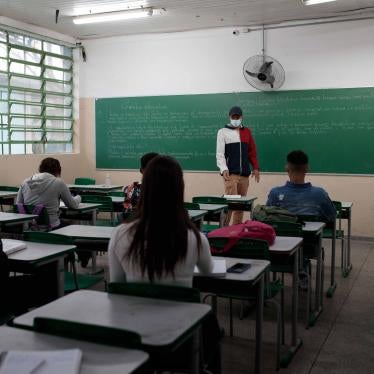
If Navi Pillay, the UN high commissioner for Human Rights, were to speak in St. Petersburg and say that the best way to combat homophobia is to discuss it at school, she would risk being arrested! It’s something to think about as we prepare to celebrate the annual International Day against Homophobia and Transphobia (IDAHOT) on May 17.
If the love of your life had major surgery or a serious illness, you would want to be by their side. You'd want to take some time off work without losing your job, and give them the care they need. But if you're gay in America, you have no such right under federal law.
Over the last eight months, Human Rights Watch has interviewed more than 200 current and former sex workers in New York, Los Angeles, Washington and San Francisco. The interviews were part of an investigation into barriers to H.I.V. prevention for sex workers, who, worldwide, are more than 10 times as likely to be infected as the general population. What we found was shocking: While public health departments spend millions of dollars promoting and distributing condoms, police departments are harassing sex workers for carrying them and using them as evidence to support arrests.