Hungary’s troubling record on rights is putting Europe to the test. How to respond to Budapest’s continued refusal to heed repeated calls for reform following critical assessments by a growing number of expert bodies has turned into a major preoccupation for Europe’s policymakers and parliamentarians.
Prime Minister David Cameron’s two-day visit to Kazakhstan this weekend happens to overlap with a Supreme Court hearing concerning the conviction of a prominent opposition leader in a seriously flawed and politically motivated trial. It should be both easy and timely for Cameron to publicly raise concern about the imprisoned opposition leader, Vladimir Kozlov, at the highest levels. But will he?
After the Turkish government’s forcible evacuation of Taksim Gezi Park on June 15, bringing to an end the 19-day occupation, police cordoned off the park. Regular police officers now guard its entrance from the square, seated on white plastic garden chairs in a long line at the top of the main steps. The park is sealed off with tape as though it were a crime scene.
While world leaders managed to produce a joint communique on Syria at the end of the G8 summit, the closing media remarks made it clear that Vladimir Putin hasn’t actually moved an inch on the issue. The Russian president once again lashed out at the European Union and the United States for considering arms shipments to the Syrian opposition, suggesting it will further destabilize Syria. At the same time, he made it clear that Russia will continue supplying a range of weapons to the Syrian government, arguing that this will help stabilize the region while preventing a foreign intervention.
President Ilham Aliev of Azerbaijan is visiting Brussels this week for negotiations on the Southern Gas Corridor, which someday might transport gas from the Caspian Sea region to European markets. This oil-rich country in the south Caucasus plays a significant role in the European Union's energy security. That should in no way impede José Manuel Barroso, the European Commission's president, from being very clear that the need to meet human-rights standards will be a part of any relationship with the EU.
On Tuesday (18 June), the German chancellor and the US president will embrace each other. Eyes will be shining as both sides praise the German-American friendship. After all, this visit from Washington is an election campaign present for Angela Merkel, and the president can hope for symbolic pictures to build his own legend.
Even in the basement of the courthouse, safe behind a closed door, I’m sure the defendant could still hear the women screaming at him. I certainly could hear the women, standing just metres away, and I definitely felt their violent rage as one hit me in the arm, shouting at me - “What are you drawing in your notebook, girl, what are you drawing?” - as I walked out of the courthouse.
It has been a long and eventful week in Istanbul. It will be hard for many who were there to forget the scenes reminiscent of war on the streets around Taksim Square and Gezi Park, the site of the protests, on Tuesday evening and into the night. After apparently conciliatory tweets from Istanbul governor Hüseyin Avni Mutlu to the young protesters occupying Gezi Park just a day earlier, and following indications that the prime minister was ready to sit down to talks over the protests on Wednesday, both leaders made an astonishing about-face.
Spend a night in Istanbul’s Taksim Square, and it becomes very clear why protesters are there. They feel that the government ignores them, overlooks them and excludes them. They say their voices are not heard, and that the government serves its own constituency, telling everyone else how to live and what not to say.
When I heard the news about the murder of British soldier Lee Rigby in Woolwich on May 22, my first reaction was horror. My second was dread. Sadly, my fears that anger would be targeted at Muslim communities across the UK have been confirmed.
Sevan Nişanyan, a Turkish-Armenian journalist, wrote a blog entry last September stating that critical comments about religion don’t constitute hate speech. “Making fun of an Arab leader who claimed he contacted God hundreds of years ago and received political, financial and sexual benefits is not hate speech,” he said. “It is an almost kindergarten-level test of what is called freedom of expression.”
The Extractive Industries Transparency Initiative (EITI) was founded in 2003 with the goal of strengthening governance by increasing transparency over revenues from the oil, gas, and mining sectors. EITI has contributed to much greater disclosures of information and helped spur dialogue in many countries. But EITI has not made progress toward its ultimate purpose of enhancing accountability in resource-rich countries. An independent evaluation commissioned by EITI in 2011 concluded, “EITI has not been a significant driver of change. While transparency has improved, accountability does not appear to have changed much.” The evaluation attributed this problem to the absence of a coherent strategic vision, explaining that without clarity on how publicizing credible data on natural resource revenues would lead to better governance, EITI would not be able to direct its efforts to where they would be most likely to deliver results.
Here’s a story to break your heart – thousands of Afghan refugee boys who roam Europe alone, without parents, without enough help from European governments, and at risk of destitution, detention, and death.
The Spanish government's violent campaign against the grassroots Platform for Mortgage Victims is a dangerous turn against freedom of speech and association. These attacks must stop.
The European Union has placed human rights, democracy and the rule of law firmly at the core of its structure, and so its willingness to defend those values is crucial to its credibility. Faced with a deteriorating situation on these three fronts in Hungary, Brussels has failed to show the necessary resolve.
We had been anticipating the inspection for a while. Such is the atmosphere in today’s Russia that many nongovernmental organizations can expect the knock at the door at some point. When they finally came to us, however, the visit was tinged with farce as well as stress.
Last year was very tough for Greece, and there for few prospects that 2013 will be easier. Millions of people have been directly affected by the sweeping austerity measures arising from the economic crisis. The country is convulsed by political tensions, with the rise of the far-right Golden Dawn party the most worrying example. And there are severe social problems, linked in part to the huge influx in recent years of irregular migrants from outside the European Union.
Eight years have passed after one of the worst massacres in the former Soviet Union since its collapse. On May 13, 2005, security forces in the city of Andijan, Uzbekistan, opened fire on protesters, the vast majority unarmed, killing hundreds of men, women and children as they tried to flee. No one has been held accountable, and the authoritarian president, Islam Karimov, has defied calls for an independent investigation.
Listening to Theresa May’s statement to Parliament today, it seems the British government is leaving no stone unturned in its efforts to deport Abu Qatada to Jordan to face terrorism charges.
A public debate at the UN on April 10 will serve up a revisionist denial of the worst killings in Europe since the end of World War II: the ethnic slaughter in the former Yugoslavia that horrified the world in the 1990s. While the session's ostensible purpose is to take "a closer look at the long-term impact of international criminal justice, in particular as it relates to reconciliation..." it is unlikely much thoughtful discussion will occur.
If Vladimir Putin had hoped for an easy time during his two-day Germany visit this week, he must be disappointed. There were some positive headlines on the Russian president’s visit, of course. The Hanover Trade Fair, which he opened on Sunday, featured 170 Russian companies – a record for the fair and a sign of the growing power of Russian business.
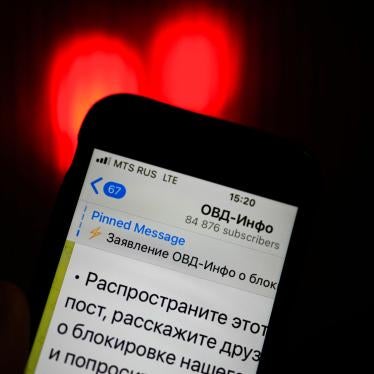
The Russian authorities’ inspections of the offices of German political foundations and hundreds of non-governmental organizations in Russia in recent days, including Human Rights Watch, have refocused attention in Germany on the crackdown on Russian civil society since Vladimir Putin returned to the presidency last May.
Italy has changed in the last three decades from a country of emigration to one of immigration and asylum. Its reaction has been chaotic and confused, and sometimes downright cruel. Nowhere is this better demonstrated than in Italy’s response to boat migration.
The Chinese call it jin zhuan, or golden brick. The Russians have suggested calling it briuki, an acronym meaning trousers in Russian. And what about the ambiguous S? It originally was just a plural for the emerging economies of Brazil, Russia, India, and China, places where a Goldman Sachs analyst was urging greater investment. Now it stands for South Africa, which joined in 2010 despite having an economy roughly on the order of China’s sixth-largest province.
Official communiqués on the BRICS summit in Durban are promising new initiatives on trade, economic development and technical co-operation. But Russia wants more from its partners than just trade. With concern rising in Europe over the worst crackdown on Russian democracy since the Soviet Union collapsed more than 20 years ago, Vladimir Putin is coming to Africa to find supporters of its world view.
British journalism often looks impressive from afar, with trusted media organizations like the BBC and Economist springing to mind. Closer up, its image is far more tarnished, particularly for newspapers, with a murky stew of phone-hacking, bribery and insider influence.
“The Constitution is not a game!” crowds chanted during a March 9 demonstration in Budapest against constitutional changes adopted on March 11. Hopefully those chants were heard in Brussels. It’s high time the EU took resolute action to hold the Hungarian government accountable for their ongoing assault on human rights and the rule of law.
Bakinskaya Street is located on a sloping hillside in Veseloye village within the city limits of Sochi, the Russian city where, less than a year from now, the 2014 Winter Olympics will launch.
An Afghan migrant is stabbed in the heart on the streets of Athens. Black-shirted paramilitaries linked to Hungary’s third-largest political party march through a Roma neighborhood shouting, “You will die here.” A neo-Nazi gang commits a string of murders of Turkish immigrants in Germany. An ideologue driven by hatred of “multiculturalism” kills 67 mostly young people on a Norwegian Island.
The Arab uprisings have been a poignant reminder of how the Internet can promote free expression and assembly, but also how governments can try abuse it. The medium used by demonstrators to organize protests and bring medical supplies to Tahrir Square, for example, was also used by the government to pinpoint human rights defenders for arrest, harassment, and even torture.
The countdown to the 2014 Winter Games in Sochi is officially under way. Exactly one year from today a colossal project few thought possible in 2007 – building a state-of-the-art winter sports venue in the Caucasus mountains and the on the subtropical Black Sea coast – will become reality.
Les mêmes causes produisent les mêmes effets (“The same causes produce the same effects”). It’s a phrase I’ve heard Ivorian lawyers, taxi drivers, and civil society leaders utter repeatedly in recent months to describe Côte d’Ivoire’s uneven prospects for reconciliation so long as President Alassane Ouattara’s government makes little progress toward impartial justice and addressing abuses by the security forces. But the phrase applies just as aptly to the failure of Côte d’Ivoire’s most important partner, France, to publicly make human rights issues a priority in its diplomatic relationship.
Some say we should put Britain's complicity in torture and human rights abuse in Libya behind us. We cannot do so. Lessons have not been learned, victims still await justice, while the 'secret courts bill' would help ensure future abuses remain hidden.
The new Somali government, in power since September and much feted by international donors, seems to think they can silence the discussion of sexual violence by the security forces by clamping down on women reporting rape and journalists. The UK - a key donor to Somalia - needs to send an urgent message to the contrary before Saturday's hearing date.
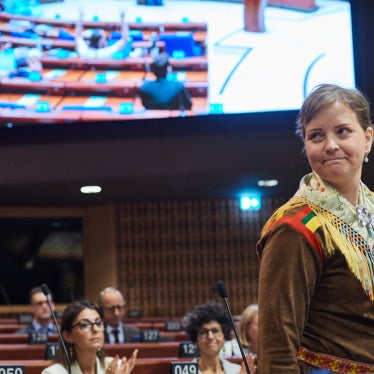
Azerbaijan’s abysmal rights record came under a rare spotlight last week. One of Europe’s foremost human rights bodies, the Council of Europe’s Parliamentary Assembly, devoted an entire afternoon to debating two much-awaited reports on the country.
Every year, hundreds of boys travel alone, at great risk, from Afghanistan to Italy. They‘re looking for refuge, for an education, for an opportunity to escape the war zone in their country. And yet Italy turns away many of them, barring their entrance and taking no steps for their protection or care.
Recent Twitter conversations between the wannabe-jet-set daughter of Uzbekistan’s authoritarian ruler and critics of the country’s atrocious human rights record may have been unusual and amusing. They may have even brought a rare blip of international media attention to a reclusive regime the world normally seems happy to ignore.
Last year was very tough for Greece, and there are few prospects that 2013 will be easier. Millions of people have been directly affected by the sweeping austerity measures arising from the economic crisis. The country is convulsed by political tensions, with the rise of the far-right Golden Dawn party the most worrying example. And there are severe social problems, linked in part to the huge influx in recent years of irregular migrants from outside the European Union.
A prominent columnist calls for a “final solution” for Hungary’s Roma population. A member of parliament calls for drawing up a list of Jewish people involved in Hungarian politics. Two-thirds of those asked in an opinion poll say they wouldn’t let their child be friends with a Romani child. Another poll suggests a similar number believe Jewish people have too much influence. One doesn’t have to be a student of history to be worried about the growing climate of intolerance in Hungary.
If Obama wants to bolster his legacy in his second term, he can and should get tough on some of the United States' most unsavory friends and allies. Here are eight leaders to start with.
A public debate at the UN on April 10 will serve up a revisionist denial of the worst killings in Europe since the end of World War II: the ethnic slaughter in the former Yugoslavia that horrified the world in the 1990s. While the session's ostensible purpose is to take "a closer look at the long-term impact of international criminal justice, in particular as it relates to reconciliation..." it is unlikely much thoughtful discussion will occur.
Official communiqués on the BRICS summit in Durban are promising new initiatives on trade, economic development and technical co-operation. But Russia wants more from its partners than just trade. With concern rising in Europe over the worst crackdown on Russian democracy since the Soviet Union collapsed more than 20 years ago, Vladimir Putin is coming to Africa to find supporters of its world view.