
![]() | ![]() ![]() | |
|
| ||
|
|
Democratic People's Republic of Korea Unusual cruelty By Kay Seok Published in The Guardian China forcibly repatriates North Korean women living with Chinese men - even if they have children. The suffering this policy causes goes largely unreported May 23, 2008 Commentary Also available in
Printer friendly version South Korea: Olympic Torch Spotlights China Rights Crisis President Lee Should Press Beijing to Stop Deporting North Korean Refugees South Korean President Lee Myung-bak should use the occasion of the Olympic torch’s passage in Seoul on April 27 to urge Beijing to stop arresting and repatriating North Korean refugees in China, Human Rights Watch said today. The torch relay, which up to now has been dogged by protests over China’s human rights abuses at home and in Tibet, will also pass through the North Korean capital Pyongyang on April 28, one place where protests are not expected. April 25, 2008 Press Release Also available in
Printer friendly version North Korea’s Transformation: Famine, Aid and Markets Published in Review of North Korea Economy This essay is an extended version of "How Famine Changed North Korea," an oped published on the Washington Post on February 28, 2008. Its Korean translation was published on the April 2008 edition of Korea Development Institute’s monthly magazine, Review of North Korea Economy. April 15, 2008 Commentary Also available in
Printer friendly version China: Educate Children of North Korean Women Policies Marginalize Children, Force Family Breakups Many children of North Korean women living in China are denied legal identity and access to education, Human Rights Watch said in a new report released today. To comply with international standards and its own laws, China should ensure all children can go to school, without preconditions such as requiring them to show household registration papers. China should also stop arresting and summarily repatriating North Korean women who have had children with Chinese men. April 13, 2008 Press Release Also available in
Printer friendly version Denied Status, Denied Education Children of North Korean Women in China
HRW Index No.: 1-56432-304-8 April 12, 2008 Report Also available in
Download PDF, 269 KB, 24 pgs Purchase online Read Press Release How China breaks up refugees' homes By Kay Seok, North Korea researcher at Human Rights Watch Published in The International Herald Tribune April 9, 2008 Commentary Also available in
Printer friendly version How Famine Changed N. Korea By Kay Seok, North Korea researcher for Human Rights Watch Published in The Washington Post February 26, 2008 Commentary Also available in
Printer friendly version South Korea: Defend Human Rights By Brad Adams, Asia director at Human Rights Watch Published in The Korea Times We congratulate you on your election as South Korea's next president. With only a month left until you take office, we are writing to draw your attention to urgent human rights issues on the Korean Peninsula. January 23, 2008 Commentary Also available in
Printer friendly version Silence Is Complicity By Kay Seok, North Korea researcher at Human Rights Watch Published in The Wall Street Journal The second ever inter-Korea summit, between South Korea's President Roh Mu-hyun and North Korean leader Kim Jong Il in early October, produced a media frenzy. Journalists reported on every move and statement by the two leaders, including Kim's casual proposal to extend Mr. Roh's stay by one day, and Mr. Roh's polite but awkward refusal to do so. November 19, 2007 Commentary Also available in
Printer friendly version Burma: Security Council Should Impose Arms Embargo Weapons Sales by India, China and Russia Fuel Abuses, Strengthen Military Rule The United Nations Security Council should impose and enforce a mandatory arms embargo on Burma because of continuing massive violations of human rights, Human Rights Watch said today. India, China, Russia, and other nations are supplying Burma with weapons that the military uses to commit human rights abuses and to bolster its ability to maintain power. October 10, 2007 Press Release Also available in
Printer friendly version Give North Koreans food By Kay Seok Published in International Herald Tribune On Monday, Kim Jong Il of North Korea and South Korean President Roh Mu-hyun will hold a three-day meeting in Pyongyang. It will be only the second North-South summit - Kim Jong Il met Roh's predecessor, Kim Dae-jung, in 2000. September 27, 2007 Commentary Also available in
Printer friendly version Value Oriented Diplomacy: Expectations for Japan on Human Rights This May, the Japanese Foreign Ministry published its “2007 Diplomatic Blue Book,” which adds a new goal to Tokyo’s international actions: “value oriented diplomacy.” After five decades of focusing on the United Nations, the United States, and Asia, the book says Japan will now also pursue a foreign policy to realize universal values, such as freedom, democracy, basic human rights, and rule of law. Foreign Minister Taro Aso insisted that it is “a responsibility for Japan, as a developed democratic nation.” August 24, 2007 Commentary Also available in
Printer friendly version The US-Korea Free Trade Agreement Annex 22-B: A Missed Opportunity on Workers’ Rights in North Korea This 13-page briefing paper looks at Annex 22-B of the US-Korea Free Trade Agreement (FTA) and how it flouts the spirit of the recently amended workers’ rights provisions. It also makes recommendations on how to amend Annex 22 in order to effectively protect, in law and practice, the basic labor rights of the workers producing goods under the existing agreement. August 2, 2007 Background Briefing The rights of North Korean refugees By Sophie Richardson, Asia Advocacy Director at Human Rights Watch Published in JoongAng Daily The fact that Kim and his family face certain persecution back home makes them refugees in international refugee law. July 9, 2007 Commentary Also available in
Printer friendly version Grotesque indifference By Kay Seok, North Korea researcher Published in International Herald Tribune 'China hopes to see the DPRK [North Korea], our neighbor, enjoy economic and social progress with its people living happily," said Qin Gang, China's foreign ministry spokesperson, at a recent press briefing. Qin's aspirations for North Korea sound like those of many others who wish to alleviate the suffering of some of the world's most brutalized people. May 15, 2007 Commentary Also available in
Printer friendly version North Korea's Cruelty Published in The Washington Post North Korea is again dominating headlines by signing a deal to close its main nuclear reactor and allow international inspectors to return in exchange for energy and economic assistance. As North Korea watchers cautiously welcome this possible step toward a nuclear-free Korean Peninsula, a deeply disturbing development has garnered almost no attention: Pyongyang's hardening policy toward North Korean border-crossers. March 17, 2007 Commentary Also available in
Printer friendly version Audio Commentary: North Korea - Border-Crossers Harshly Punished on Return The minimum punishment even for first-time offenders is a year in prison and the maximum is now 5 years in prison. And it’s worth noting that prisons in North Korea are quite harsh. (Run time: 4:13) March 6, 2007 Audio Clip North Korea: Border-Crossers Harshly Punished on Return China Should Grant UNHCR Access to North Koreans in Border Area In an ominous hardening of policy, North Korea appears to be punishing its citizens with longer sentences in abusive prisons if they are caught crossing the border to China or have been forcibly repatriated by Beijing, Human Rights Watch said in a new briefing paper released today. March 5, 2007 Press Release Also available in
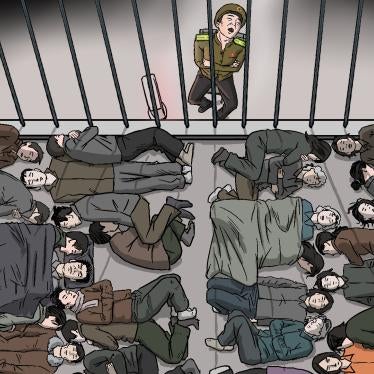
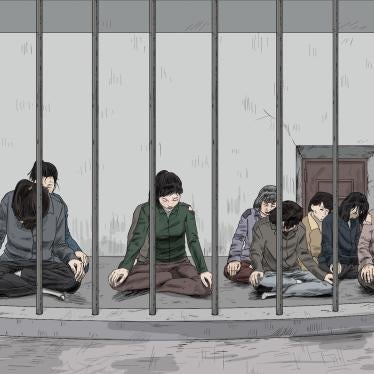
Printer friendly version North Korea Harsher Policies against Border-Crossers The North Korean government has hardened its policy towards its citizens it catches crossing the border into China without state permission, or whom China has forcibly repatriated. Until around November 2004 those who crossed the border—often to find food—were typically released after questioning or served at most a few months in forced labor camps, a relatively light punishment by North Korean standards for what is considered an act of treason.1 Recent interviews by Human Rights Watch show that this relative leniency is over: in late 2004 North Korea announced a new policy of harshly punishing border crossers with prison sentences of up to five years. Anyone imprisoned in North Korea is liable to face abusive conditions including beatings, forced labor, and starvation far worse than among the population at large. March 5, 2007 Background Briefing Also available in
Principled Leadership: A Human Rights Agenda for UN Secretary-General Ban Ki-moon By Peggy Hicks There is an urgent need today for the new Secretary-General to speak out forcefully in defense of human rights. January 11, 2007 World Report Essay Also available in
|
View the "Crisis Guide" by the Council on Foreign Relations ![]() ![]()
| |||||||||||||||
|
Contribute to Human Rights Watch
Home | About Us | News Releases | Publications | About HRW | Info by Country | Global Issues | Campaigns | Free Mailing Lists | Community | Store | Film Festival | Search | Site Map | Contact Us | Press Contacts | Privacy Policy © Copyright 2006, Human Rights Watch 350 Fifth Avenue, 34th Floor New York, NY 10118-3299 USA |