Voice Over
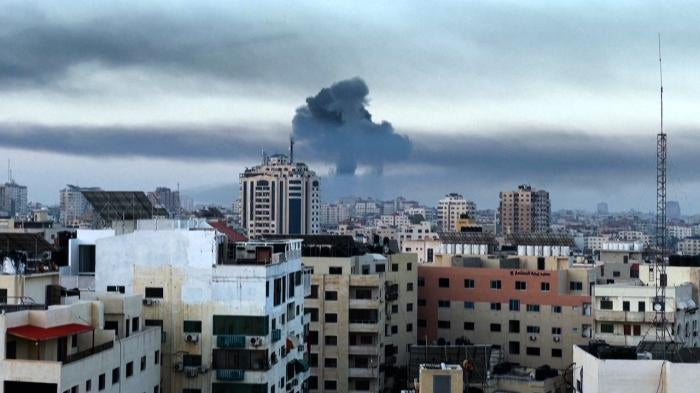
On May 10, 2021, eleven days of hostilities began between the Israeli military and Palestinian armed groups, including Hamas, in the Gaza Strip and Israel.
The fighting took place amid escalating repression in occupied East Jerusalem and the prolonged closure of the Gaza Strip. These policies and practices reflect the Israeli government’s crimes against humanity of apartheid and persecution.
Human Rights Watch conducted in-depth investigations into three Israeli strikes that killed 62 Palestinian civilians and involved serious violations of the laws of war and apparent war crimes.
In the northeastern corner of the Gaza Strip outside Beit Hanoun town shortly after 6 p.m. on May 10, a guided missile struck near four houses belonging to the extended al-Masri family.
Members of the family were packing processed barley for animal feed into sacks at the time.
Youssef Atallah al-Masri (Witness)
My brother Ibrahim and I were around 150-200 meters away when they struck our children.
We were facing the events, we saw it with our own eyes when they were hit. I ran to them right away. I found our children scattered. They were scattered on the floor ripped to pieces, blood and brain fragments.
Voice Over
Israeli authorities have said that the attack involved a misfired Palestinian rocket coming from the west, but have produced no evidence to back up this claim.
Witnesses saw a munition approaching them from the east, from Israel.
Based on munition remnants found at the scene of the attack and witnesses' descriptions, we determined that the 6 children and 2 adults were most likely killed by a type of guided missile used to attack military vehicles or personnel in the open.
Six days after the attack, the Israeli authorities also included the photo of one man killed in the Beit Hanoun attack on a list of militant group “activists” they said had been killed in unspecified locations.
Human Rights Watch’s interviews with witnesses who knew him indicate the man was a civilian.
Our research uncovered no evidence of a military target at or near the site. We therefore found the attack to be unlawful.
Mohammad Attalah al-Masri (Witness)
It was a scene I could never expect. Everyone cries and screams every day. Do you know what my wife wants? She wants me to sell the house. She cannot accept how her children were all killed.
Voice Over
Al-Shati refugee camp, located northwest of Gaza City, is one of the most densely
populated places in the world.
At about 1:40 a.m. on May 15, an Israeli airstrike destroyed a three-story building in the camp killing two women and eight of their children.
Alaa Abu Hattab (Witness)
I lived with my wife and 5 children in the house. Our home was filled with love, peace and happiness. We had been living here for 30 years. There was no prior notice, no phone call, no order to vacate. That night I went to buy bread for dinner. All of a sudden there were sounds of explosions in the area. I found that my own home had been struck.
Voice Over
The Israeli military said it struck the building because senior Hamas officials were there. It also separately said that they had targeted a bunker under or near the building.
None of the witnesses Human Rights Watch interviewed were aware of any militants or other military targets in or near the building. The Israeli authorities have presented no such evidence.
Alaa Abu Hattab (Witness)
I had a reality, I had a dream here. I had a family here. Now I have no family and no home. My only daughter and I are on the street. They destroyed everything in my life. They destroyed my life entirely.
Voice Over
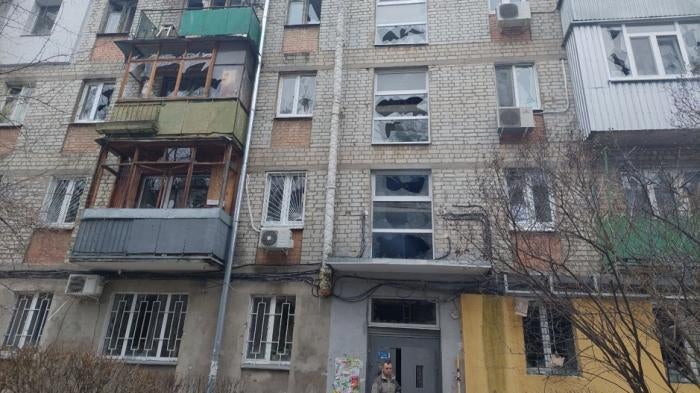
At about 1 a.m. on May 16, the Israeli military launched a four-minute attack in the heart of Gaza City along five streets, including al-Wahda Street, causing three multi-story residential buildings to collapse.
Omar ABu El-Ouf (Survivor)
Me, my father and mother, and my brother and sister, we started hearing the sound of loud explosions. After the second missile landed, the house started to sway right and left as if it were about to fall down and collapse. I pulled my sister by the arm towards the hallway and held her in order to shield her, and suddenly, we saw the third missile coming from the window and the hallway’s entire wall collapsed, and the whole floor suddenly disappeared, and everything fell on us. And afterwards, the fourth missile came down on us. And destroyed everything.
Voice Over
Human Rights Watch determined that the three buildings collapsed after missiles struck the road or sidewalk next to the buildings. The Israeli military said that they targeted tunnels used by armed groups. Later, they said the attack had targeted an underground command center, but without providing any details or evidence.
Omar ABu El-Ouf (Survivor)
Why did they kill my family? Why did they kill my father and mother? Why did they turn me into an orphan? Who will in the end give me justice?
Voice Over
The attacks killed 44 civilians, including 14 women, 12 men and 18 children. It also injured about 50 others.
The Israeli military used powerful weapons in a heavily populated residential area putting the lives of scores of civilians at risk. Since then, they have produced no evidence of a military target in the vicinity to justify the attack. If there was a military target, they have also not shown that it was important enough to justify the risk to civilians. As a result, these attacks were unlawful.
The UN says that Israeli airstrikes in May killed at least 129 civilians, including 66 children.
The Israeli military said that Palestinian armed groups in Gaza fired more than 4,360 rockets and mortars towards Israel between May 10 and 21, resulting in 12 civilian deaths, including 2 children.
Several Palestinians also died in Gaza when rockets fired by armed groups fell short and landed in Gaza. Rockets that Palestinian armed groups fire at Israel are inherently indiscriminate when directed toward areas with civilians. Their use in such circumstances violates the laws of war and amounts to war crimes.
For years, Israeli and Palestinian authorities have systematically failed to credibly investigate alleged war crimes.
The International Criminal Court prosecutor should investigate Israeli attacks in Gaza that evidently killed civilians unlawfully, rocket attacks by Palestinian armed groups against Israel that violate the laws of war, and other grave abuses including the crimes against humanity of apartheid and persecution.