
![]() | ![]() ![]() | |
|
| ||
|
|
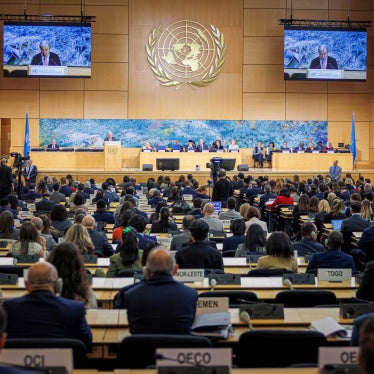
Tunisia UN: Mixed Results for New Review Process States Avoid Serious Discussion of Rights in Algeria, Tunisia The first session of the new country review mechanism of the UN Human Rights Council was undermined by inconsistencies and the timidity of some governments in reviewing others, Human Rights Watch said today. On April 18, 2008 the council concluded a two-week session in which it examined the records of 16 countries as part of the new Universal Periodic Review (UPR) process. April 18, 2008 Press Release Also available in
Printer friendly version Human Rights Watch Letter to Saudi Minister of Interior Prince Nayef bin Abd al-‘Aziz Al Sa’ud on Tunisian Detainee Human Rights Watch is writing this open letter to you about a Tunisian man being held in a jail in al-Medina who in our view would be at risk of persecution and of torture if returned to Tunisia. April 11, 2008 Letter Also available in
Printer friendly version Universal Periodic Review of Tunisia Human Rights Watch's Submission to the Human Rights Council The government uses the threat of terrorism and religious extremism as a pretext to crack down on peaceful dissent. There are continuous and credible reports of torture and ill-treatment being used to obtain statements from suspects in custody. Sentenced prisoners also face deliberate ill-treatment. April 7, 2008 Written Statement Printer friendly version Human Rights Council Begins Universal Periodic Review Will Assess India, the Philippines, South Africa, the United Kingdom and 12 Others The UN Human Rights Council will begin a new review process on April 7, 2008. The Universal Periodic Review (UPR) is the most innovative and ambitious instrument of the council and was set up to assess the human rights performance of all 192 UN member states over a four-year cycle. April 6, 2008 Memorandum Printer friendly version Letter to the Secretary General of the Organisation of the Islamic Conference Urging the Organisation to Improve and Strengthen the 1999 OIC Convention on Combating International Terrorism Human Rights Watch writes to urge Dr. Ihsanoglu to use his position as Secretary General of the Organisation of the Islamic Conference to support measures at the upcoming Summit of the Organisation of Islamic Conference in Dakar, Senegal on March 13-14 that would improve and strengthen the 1999 OIC Convention on Combating International Terrorism. In particular, we urge the OIC to consider two amendments to the Convention in order to narrow its overbroad definition of terrorism and to make absolutely clear that there is no sanction in Islam for deliberately attacking civilians, whatever the circumstances or justifications. March 11, 2008 Letter Also available in
Printer friendly version European Court of Human Rights Reaffirms the Absolute Prohibition on Return to Torture The European Court of Human Rights today reaffirmed that the ban on deporting people to countries where they are at risk of torture or ill-treatment is absolute and unconditional. February 28, 2008 Press Release Also available in
Printer friendly version Arab League: Reject Proposal to Restrict Satellite Broadcasts Information Ministers’ New ‘Principles’ Would Extend Repression of Free Speech Arab governments should publicly reject those elements of a proposed regional policy on satellite television broadcasting that would seriously restrict freedom of expression and information, Human Rights Watch said today. February 26, 2008 Press Release Also available in
Printer friendly version Letter to H.E. Mohammed Nejib Hachana, Tunisian Ambassador in Washington D.C., on the publication of Human Rights Watch's World Report 2008 January 31, 2008 Letter Also available in
Printer friendly version Human Rights Watch letter to Tunisian President Zine el-Abidine Ben Ali on the Detention of Samir Ben Amor Human Rights Watch is writing to protest the detention by police of human rights attorney Samir Ben Amor on December 7. We regard this detention as an effort to intimidate Ben Amor and other members of the International Association in Support of Political Prisoners (Association Internationale de Soutien aux Prisonniers Politiques, AISPP), a five-year-old independent, Tunis-based human rights organization. December 18, 2007 Letter Also available in
Printer friendly version Tunisia: Stop Harassing ‘Unrecognized’ Rights Group Police Warn Lawyer Not to Work for Political Prisoner Association Tunisian authorities should immediately halt their ongoing harassment of an independent human rights association on the pretext that it lacks legal status, Human Rights Watch said today in a letter to President Zine el-Abidine Ben Ali. December 18, 2007 Press Release Also available in
Printer friendly version Tunisia: Allow Rights Activists to Attend US Conference Government Consistently Violates Basic Right to Leave Country The Tunisian government should immediately reverse its decision to bar two prominent human rights defenders from leaving the country, a group of leading nongovernmental organizations said today. Tunisia’s travel ban has obstructed a scheduled visit next week by eight activists to Washington, DC. November 10, 2007 Press Release Also available in
Printer friendly version Close Guantanamo – But Don't Send Detainees Back to Countries that Torture By Eric Goldstein, research director for the Middle East and North Africa Division Published in The Huffington Post The United States can begin to regain its moral authority in combating terrorism when the Guantanamo Bay detention facility is closed. But that's only if the government stops sending detainees back to places like Tunisia. September 10, 2007 Commentary Printer friendly version Ill-Fated Homecomings A Tunisian Case Study of Guantanamo Repatriations
HRW Index No.: E1904 September 5, 2007 Report Also available in
Download PDF, 230 KB, 43 pgs Purchase online Read Press Release Audio: A Study of Guantanamo Repatriations With John Sifton, Counterterrorism researcher and Stacy Sullivan, US media director During the last week of July, two Human Rights Watch researchers traveled to Tunisia to investigate the fate of two men sent to home countries after being detained in Guantanamo Bay, Cuba by US authorities. The men described how they were abused and intimidated by local Tunisian officials. The United States now says that 150 of the 355 Guantanamo Bay detainees are eligible for release to home countries, but Human Rights Watch has urged the US to provide detainees advance notice of any pending transfers, along with an opportunity to challenge transfers before a federal court. September 5, 2007 Audio Clip A Fate Worse Than Guantanamo By Jennifer Daskal, senior counterterrorism counsel Published in The Washington Post In mid-June, a group of U.S. soldiers entered the cells of Abdullah al-Hajji and Lofti Lagha at Guantanamo Bay, Cuba, where they had been held without charge for five years. The Americans cuffed the detainees' hands, shackled their ankles, muffed their ears and blindfolded them before loading them onto a military plane for the flight home. September 2, 2007 Commentary Printer friendly version Tunisia: 21 Political Prisoners Released Government Should Free All Jailed for Peaceful Opposition The release of 21 political prisoners in Tunisia is a welcome step, but the government should release dozens more held for nonviolent political activities, Human Rights Watch said today. July 28, 2007 Press Release Also available in
Printer friendly version Human Rights Watch letter to Tunisian Minister of Justice Béchir Tekkari on Daniel Zarrouk In response to May 10, 2007 letter from Tunisian government Human Rights Watch thanks you for the letter sent by your chef de cabinet, Mr. Lotfi ad-Douas, dated May 10, 2007 in response to the letter of April 25 that Human Rights Watch addressed to President of the Republic Zine el-Abidine Ben Ali. July 24, 2007 Letter Also available in
Printer friendly version Leading Human Rights Groups Name 39 CIA ‘Disappeared’ Detainees Three Groups File Lawsuit Seeking Information about ‘Ghost’ Detention In the most comprehensive accounting to date, six leading human rights organizations today published the names and details of 39 people who are believed to have been held in secret US custody and whose current whereabouts remain unknown. The briefing paper also names relatives of suspects who were themselves detained in secret prisons, including children as young as seven. June 7, 2007 Press Release Also available in
Printer friendly version Off the Record U.S. Responsibility for Enforced Disappearances in the “War on Terror” This 21-page briefing paper, published by six leading human rights organizations, includes the names and details of 39 people who are believed to have been held in secret US custody abroad and whose current whereabouts remain unknown. The briefing paper also names relatives of suspects who were themselves arrested and detained, including children as young as seven. The list of missing people includes nationals from countries including Egypt, Kenya, Libya, Morocco, Pakistan and Spain. They are believed to have been arrested in countries including Iran, Iraq, Pakistan, Somalia and Sudan, and transferred to secret US prisons operated by the CIA. June 7, 2007 Background Briefing France: Terror Expulsions Policy Lacks Basic Safeguards Better Human Rights Protections Needed in National Security Removal Cases The lack of safeguards in France’s policy of expelling foreign residents with alleged links to violent extremism undermines human rights and alienates communities whose cooperation is critical to the fight against terrorism, Human Rights Watch said in a report released today. June 5, 2007 Press Release Also available in
Printer friendly version |
![]() ![]()
| |||||||||||||||
|
Contribute to Human Rights Watch
Home | About Us | News Releases | Publications | About HRW | Info by Country | Global Issues | Campaigns | Free Mailing Lists | Community | Store | Film Festival | Search | Site Map | Contact Us | Press Contacts | Privacy Policy © Copyright 2006, Human Rights Watch 350 Fifth Avenue, 34th Floor New York, NY 10118-3299 USA |