
HUMAN RIGHTS
WATCH Middle East and North Africa FrenchSpanishRussianKoreanArabicHebrewspacer
RSSPortugueseGermanChinesePersianMore Languagesspacer
   
Kuwait

Kuwait: Halt Dress-Code Crackdown
Authorities Should Repeal Repressive Law, Free Detainees
New arrests show that Kuwait has resumed enforcing a repressive dress code that criminalizes “imitating the appearance of the opposite sex,” Human Rights Watch said today. It called on the government to investigate allegations of ill-treatment of people detained and to repeal the offending provision, which violates Kuwait’s human rights obligations.
March 31, 2008    Press Release
Also available in  arabic 
Printer friendly version

Letter to the Secretary General of the Organisation of the Islamic Conference
Urging the Organisation to Improve and Strengthen the 1999 OIC Convention on Combating International Terrorism
Human Rights Watch writes to urge Dr. Ihsanoglu to use his position as Secretary General of the Organisation of the Islamic Conference to support measures at the upcoming Summit of the Organisation of Islamic Conference in Dakar, Senegal on March 13-14 that would improve and strengthen the 1999 OIC Convention on Combating International Terrorism. In particular, we urge the OIC to consider two amendments to the Convention in order to narrow its overbroad definition of terrorism and to make absolutely clear that there is no sanction in Islam for deliberately attacking civilians, whatever the circumstances or justifications.
March 11, 2008    Letter
Also available in  arabic  french 
Printer friendly version

UAE: Meetings Should Address Migrant Workers’ Rights
When labor ministers from 22 Asian and Middle Eastern countries meet in Abu Dhabi this week to discuss Asian contract migrant workers, they should address widespread violations of migrant workers’ rights, Human Rights Watch said today.
January 18, 2008    Press Release
Also available in  arabic 
Printer friendly version

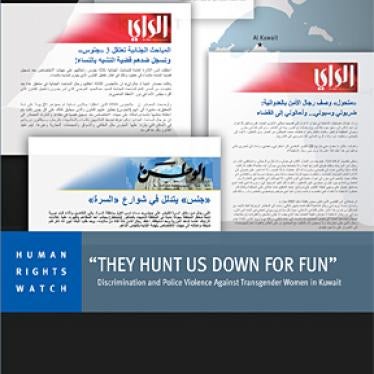
Kuwait: Repressive Dress-Code Law Encourages Police Abuse
Arrests Target Transgender People
Authorities should immediately release more than a dozen persons jailed under Kuwait’s new dress-code law, Human Rights Watch said today. The law, approved by the National Assembly on December 10, 2007, criminalizes people who “imitate the appearance of the opposite sex.”
January 17, 2008    Press Release
Also available in  arabic 
Printer friendly version

Letter to Governments in Asia and the Middle East on International Migrants' Day
Migrants’ Groups Call for Key Reforms
We are writing on December 18, 2007, International Migrants’ Day, to call upon you to implement key reforms to respect and uphold migrants’ rights. On January 21-22, 2008, the United Arab Emirates will host the latest round of the “Colombo Process,” a series of regional consultative processes focused on Asian contract migrant workers. We believe this meeting could provide an important stepping stone to establishing regional minimum standards regarding recruitment, employment, and protection of migrant workers.
December 17, 2007    Letter
Printer friendly version

Asian Migrant Workers Abandoned to Abuse
Migrants’ Groups Call for Key Reforms on International Migrants Day
Governments in Asia and the Middle East must take stronger action to fight rampant abuse against migrant workers, several migrants’ and human rights groups said in a joint letter on the eve of December 18, International Migrants’ Day.
December 17, 2007    Press Release
Printer friendly version

Exported and Exposed
Abuses against Sri Lankan Domestic Workers in Saudi Arabia, Kuwait, Lebanon, and the United Arab Emirates
The 131-page report documents the serious abuses that domestic workers face at every step of the migration process. It also shows how the Sri Lankan government and governments in the Middle East fail to protect these women. The report is based on 170 interviews with domestic workers, government officials, and labor recruiters conducted in Sri Lanka and in the Middle East.

HRW Index No.: C1916
November 14, 2007    Report
Also available in  sinhala 
Download PDF, 905 KB, 133 pgs
Purchase online
Read Press Release

Middle East: Sri Lankan Domestic Workers Face Abuse
Labor Laws Leave Migrant Women Exposed
Sri Lankan domestic workers face serious abuses, including violence, harassment and exploitation when they migrate to work in the Middle East, Human Rights Watch said in a report released today. Human Rights Watch said the governments of Sri Lanka, Kuwait, Lebanon, Saudi Arabia and the United Arab Emirates should do more to protect women from labor exploitation and violence when they migrate to the Middle East, Human Rights Watch said in a report released today.
November 13, 2007    Press Release
Also available in  arabic  chinese  japanese  sinhala  spanish 
Printer friendly version

Iraq: Neighbors Stem Flow of Iraqis Fleeing War
US and UK Bear Special Duty to Aid Refugees
Iraq’s neighbors are closing off escape routes to Iraqi asylum seekers, just as the international community has begun to respond to the 2 million refugees from the war, Human Rights Watch said in a briefing paper released today.
April 17, 2007    Press Release
Also available in  arabic  french 
Printer friendly version

Jordan: Bush and Abdullah Must Address Iraqi Refugee Crisis
More Than 1 Million in the Region in Need of Protection, Aid
After fleeing violence and persecution in Iraq, hundreds of thousands of Iraqis living in Jordan face a daily threat of arrest, fines and deportation because the Jordanian government treats them as illegal immigrants rather than refugees, Human Rights Watch said in a report released today. When US President George W. Bush meets King Abdullah in Amman tomorrow, he must offer to assist Jordan in protecting Iraqi refugees and insist Amman stops sending them back into mortal danger.
November 28, 2006    Press Release
Also available in  arabic 
Printer friendly version

The United States' "Disappeared": The CIA's Long-Term "Ghost Detainees"
In the aftermath of the September 11, 2001 attacks on the United States, the Bush administration has violated the most basic legal norms in its treatment of security detainees. Many have been held in offshore prisons, the most well known of which is at Guantánamo Bay, Cuba. As we now know, prisoners suspected of terrorism, and many against whom no evidence exists, have been mistreated, humiliated, and tortured. But perhaps no practice so fundamentally challenges the foundations of U.S. and international law as the long-term secret incommunicado detention of al-Qaeda suspects in “undisclosed locations.”
October 12, 2004    Background Briefing
Also available in  arabic  chinese  german  spanish 

U.S. State Department Trafficking Report Undercut by Lack of Analysis
The U.S. State Department's third annual trafficking in persons report fails to meaningfully evaluate governments' efforts to combat trafficking in persons, Human Rights Watch said today.
June 11, 2003    Press Release
Printer friendly version

Saudi Arabia/GCC States: Ratify Migrant Rights Treaty
Millions of migrants who work in Saudi Arabia and neighboring countries lack real legal protection, Human Rights Watch said today. In letters to the six states of the Gulf Cooperation Council (GCC) -- Bahrain, Kuwait, Oman, Qatar, Saudi Arabia and the United Arab Emirates -- Human Rights Watch strongly urged their leaders to endorse the International Convention on the Protection of the Rights of All Migrant Workers and Members of Their Families.
April 11, 2003    Press Release
Also available in  arabic 
Printer friendly version

Kuwait: Child Soldiers Global Report 2001
From the Coalition to Stop the Use of Child Soldiers
There are no indications of under-18s in government armed forces.
June 12, 2001    Multi Country Report

Kuwait: New Report Charges Serious Discrimination
New Parliament Urged to Revoke Laws that Violate Rights
Human Rights Watch called on Kuwait to revoke laws that discriminate against women and long-term non-citizens of Kuwait. In a report issued before the opening of the Kuwaiti National Assembly on October 28, Human Rights Watch also called on Kuwait to amend its Penal Code and Printing and Publications Law to protect freedom of expression.
October 25, 2000    Press Release
Also available in  arabic 
Printer friendly version

Promises Betrayed: Denial of Rights of Bidun, Women, and Freedom of Expression
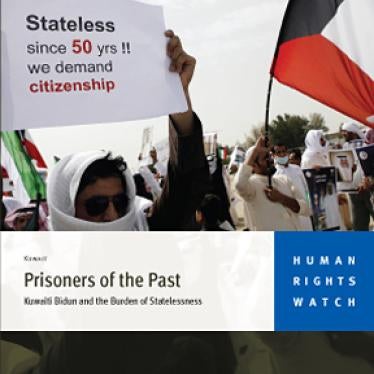
Human Rights Watch today called on Kuwait to revoke laws that discriminate against women and long-term non-citizens of Kuwait. In a report issued before the opening of the Kuwaiti National Assembly on October 28, Human Rights Watch also called on Kuwait to amend its Penal Code and Printing and Publications Law to protect freedom of expression. The 38-page report, "Promises Betrayed: Denial of Rights of Bidun, Women, and Freedom of Expression," details Kuwaiti laws and practices which systematically discriminate against women and stateless Bidun, and laws which criminalize free expression by journalists, academics, and writers. These laws contravene Kuwait's international treaty obligations, including the six human rights treaties that Kuwait has signed since 1968. Human Rights Watch said that Kuwaiti women face severe discrimination in both public and private life. Under Kuwaiti penal law, men who kill female relatives in so-called "honor crimes" serve a maximum three-year sentence and are not prosecuted for murder. Women are banned from voting and standing for election, cannot contract their own marriage or divorce without the agreement of a male guardian or judge, and are barred in practice from many public positions, including serving as judges.
October 1, 2000    Report
Also available in  arabic 
Purchase online

Kuwait: Landmine Monitor Report 2000
Key developments since March 1999: Landmines are still being found in Kuwait in both coastal and desert areas, and mine clearance operations are ongoing. In 1999 the Kuwait Institute for Scientific Research established the "Kuwait Environmental Information System" that records and plots the locations of mines and UXO recovered. Previously unknown, it appears Kuwait has a stockpile of antipersonnel mines numbering more than 45,000. The United States also apparently stockpiles antipersonnel mines in Kuwait.
August 1, 2000    Multi Country Report

U.N. Body Criticizes Kuwait's Rights Record
Treaty Review Cites 23 Areas of Concern
Human Rights Watch welcomed the conclusions of the United Nations Human Rights Committee's review of Kuwait implementation of the International Covenant on Civil and Political Rights (ICCPR), and called on the government of Kuwait to take immediate steps to implement the Committee's recommendations.
July 31, 2000    Press Release
Also available in  arabic 
Printer friendly version

Civil and Political Rights Violations in Kuwait
Human Rights Watch welcomes Kuwait's submission of its first periodic report on implementation of the International Covenant on Civil and Political Rights (ICCPR) but wishes to draw to the attention of the Human Rights Committee certain deficiencies relating to the report and to Kuwait's application of the Covenant.
July 15, 2000    Background Briefing

Kuwaiti Court Ruling Limits Free Expression
Writers, Journalists, Academics, and Publishers at Risk
Human Rights Watch called on the Kuwaiti government to repeal laws unduly restricting freedom of expression.
March 27, 2000    Press Release
Also available in  arabic 
Printer friendly version


  1 2   Next >>


Display only
> Briefing Papers and Publications


Overview of Human Rights Developments

2000
1995
1994
1993
1992
1991
1991
1990


XML/RSS


HRW Logo Contribute to Human Rights Watch

Home | About Us | News Releases | Publications | About HRW | Info by Country | Global Issues | Campaigns | Free Mailing Lists | Community | Store | Film Festival | Search | Site Map | Contact Us | Press Contacts | Privacy Policy

© Copyright 2006, Human Rights Watch    350 Fifth Avenue, 34th Floor    New York, NY 10118-3299    USA