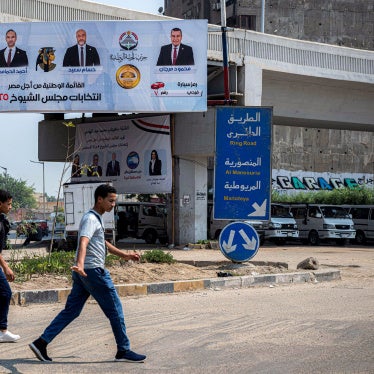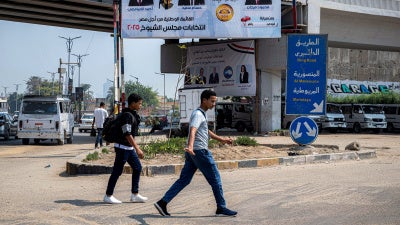
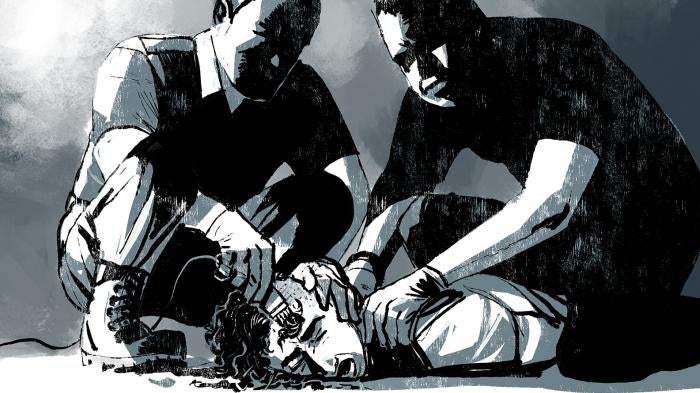
• Egypt’s troubled transition continued after Muslim Brotherhood candidate Mohamed Morsy became the country’s first democratically elected president. He retired Egypt’s ruling generals, effectively ending military rule, but became mired in controversy after he issued a decree in November to prevent judicial review of his decisions. This provoked outrage and judicial protests, causing him to withdraw the decree – but only after he initiated a national referendum that approved a new constitution that undermines key rights. Meanwhile, prosecutions of journalists and bloggers curtail space for free expression, civilians face military trials, police abuse remains extensive, and there has been no accountability for abuses committed by the police and military over the past two years.
  • President Mohamed Morsy of Egypt should immediately release the report by a fact-finding committee he created to investigate police and military abuses against protesters from January 2011 to June 2012. The committee submitted its report to the president in December, but the president has not made it public

Featured Content

Reports

Egypt

  • Apr 12, 2013
    President Mohamed Morsy of Egypt should immediately release the report by a fact-finding committee he created to investigate police and military abuses against protesters from January 2011 to June 2012. The committee submitted its report to the president in December, but the president has not made it public
  • Apr 10, 2013

    Egyptian authorities should bring to justice those responsible for the sectarian violence that left five Christians and one Muslim dead on April 5, 2013, in the town of Khosus, Human Rights Watch said today. The authorities should also investigate police failure to intervene effectively to prevent an escalation of violence outside the main Coptic cathedral in Cairo on April 7, after a funeral service for the Christians killed at Khosus.

  • Apr 9, 2013
  • Mar 30, 2013
    Libya should ensure that two Libyans with ties to the previous government of Muammar Gaddafi who were extradited from Egypt on March 26, 2013, are treated humanely and granted their full due process rights. Libya should grant humanitarian and human rights organizations access to them to monitor their detention conditions and treatment and respect for their basic rights as detainees – including giving them access to a lawyer and promptly taking them before a judge.
  • Mar 2, 2013
    The newly appointed investigative judge looking into the January violence in Port Said should fully examine police responsibility for unlawful killings during the episode, the Cairo Institute for Human Rights Studies, the Egyptian Initiative for Personal Rights (EIPR), the Alkarama Foundation, and Human Rights Watch said today. Forty-two people, including two police officers, died after a court, on January 26, 2013, recommended sentencing 21 Port Said residents to death for killings after a soccer match a year earlier. The confirmation of this sentence and verdict against the remaining 52 defendants is scheduled for March 9.
  • Feb 25, 2013
    Dear Minister Ahmad Mekki, Human Rights Watch has reviewed the February 16 final version of the draft “Law on the Protection of the Right to Peacefully Demonstrate in Public Places” approved by the cabinet and submitted to the Shura Council. The following is a legal analysis of the most problematic provisions and recommendations for revisions in light of Egypt’s obligations under international human rights law.
  • Feb 25, 2013
    The government-proposed draft law in Egypt concerning public demonstrations would severely limit the right to peaceful public assembly and is open to abuse by police, Human Rights Watch said today in a letter to the president and the Justice Ministry.
  • Feb 4, 2013
    As rioting resumes in Egypt, militias reign ominously in parts of Libya, and relentless slaughter proceeds in Syria, some are beginning to question whether the Arab Spring was such a good idea after all. But would we really want to condemn entire nations to the likes of Mubarak, Gadhafi and al-Assad? As we know from the fall of military dictatorships in Latin America and the demise of the Soviet Union, building a rights-respecting democracy on a legacy of authoritarian rule is not easy. However, there are steps that both the people of the region and the international community can take to make a positive outcome more likely.
  • Feb 4, 2013
    The top priority is bringing an end to the slaughter. But we must ensure that, after Assad, revenge does not lead to abuses.
  • Jan 31, 2013
    The latest crisis in Egypt highlights the urgent need for the government to finally begin reforming the security sector and ensuring accountability for past abuses, Human Rights Watch said today while releasing its World Report 2013. Egypt gained its first democratically elected president in 2012, but overall the year was marked by a series of missed opportunities to institute human rights reforms, Human Rights Watch said.