• Women in Tahrir Square chant slogans against Mubarak on February 1, 2011.
    Egypt’s newly elected parliament should urgently reform the arsenal of laws used by the Mubarak government to restrict freedoms, Human Rights Watch said in a report released today outlining priority areas for legislative and institutional reform. These laws were used to curb free expression and criticism of government, limit association and assembly, detain people indefinitely without charge, and shield an abusive police force from accountability.

Featured Content

Reports

Egypt

  • Feb 5, 2012
    Egyptian authorities should drop all charges against unregistered nongovernmental organizations (NGOs) and stop the criminal investigation of such groups. Authorities should not take action against NGOs until Egypt’s new parliament proposes legislation consistent with international legal standards, Human Rights Watch said. The organizations under investigation are not registered under the Mubarak-era Associations Law, in many cases because the government failed to respond to their requests to register.
  • Jan 25, 2012

    As Egypt marks the first anniversary of the Jan. 25 civilian revolt that eventually toppled the 30-year rule of Hosni Mubarak, there's no agreement – on how to celebrate or even whether rejoicing is in order.

  • Jan 24, 2012

    The Egyptian military’s announcement on January 24, 2012, that it will lift the state of emergency except in cases of “thuggery” is an invitation to continued abuse, Alkarama and Human Rights Watch said today. The two rights groups said that the government should use the regular penal code and civilian criminal courts to address alleged criminal activity. It should also repeal Law 34, which criminalizes participation in strikes during a state of emergency.

  • Jan 16, 2012
    Egypt’s newly elected parliament should urgently reform the arsenal of laws used by the Mubarak government to restrict freedoms, Human Rights Watch said in a report released today outlining priority areas for legislative and institutional reform. These laws were used to curb free expression and criticism of government, limit association and assembly, detain people indefinitely without charge, and shield an abusive police force from accountability.
  • Dec 29, 2011
    The undersigned organizations are deeply concerned about reports of attacks against NGOs in Egypt. Egyptian security forces, in uniform and in civilian clothes, as well as public prosecutors, are reported to have stormed the offices of six NGOs this Thursday 29 December 2011: the Arab Center for Independence of Justice and Legal Professions (ACIJP) the Budgetary and Human Rights Observatory, Future Centre for Judicial Studies, the Cairo and Assuit offices of the National Democratic Institute (NDI), the International Republic Institute (IRI), and Freedom House. Egyptian public TV and radio stations announced later on the same day that security forces have raided the offices of 17 organizations, mostly human rights organizations. However, none of the news sources have identified these organizations or the reasons behind storming their offices.
  • Dec 22, 2011
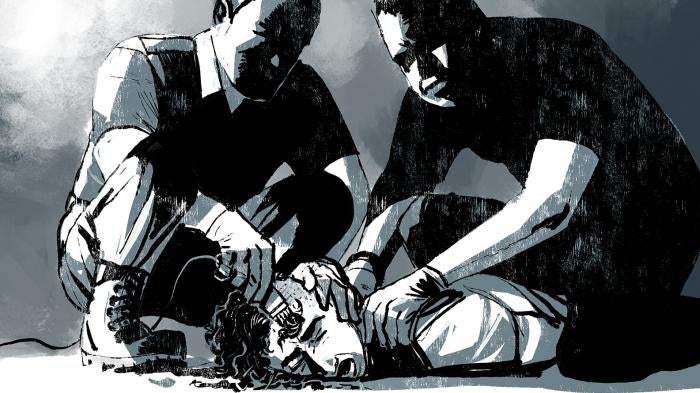
    There is an escalating pattern of physical attacks by Egyptian military and police officers against women and male protesters, journalists, and activists in Cairo, some of which are sexual in nature. News reports and images of protesters in Cairo being stripped, beaten, and dragged through the street in the past several days are just the latest incidents.
  • Dec 9, 2011
    The breakneck pace of developments in Egypt over the last few weeks would leave anyone reeling and confused about what Egyptians want. Do they support the latest protesters’ demands—ultimately backed by the United States and European Union—for a quick transition to civilian rule? Or are they sick of the protests and happy to put their trust in SCAF to guide the transition? Or are they indifferent so long as the Brotherhood has a path to power?
  • Dec 2, 2011
    Dozens of eye injuries from rubber bullets have marked the crackdown on protesters in Tahrir Square. “Eye-hunters,” Egyptians are calling the armed police who aim at head-level.
  • Nov 27, 2011

    The weeks before Egypt’s parliamentary elections are scheduled to start on November 28, 2011, have been marked by repeated violations of free expression and free assembly. Over the past nine months, military and police officers have forcibly dispersed peaceful protests, arrested demonstrators and bloggers for criticizing the military, and failed to uphold the rule of law in policing operations. 

  • Nov 23, 2011

    The military’s brutality has brought crowds to Tahrir Square. They can’t dismiss us as a minority any more.