Reports

France’s Persistent Education Shortcomings in Mayotte

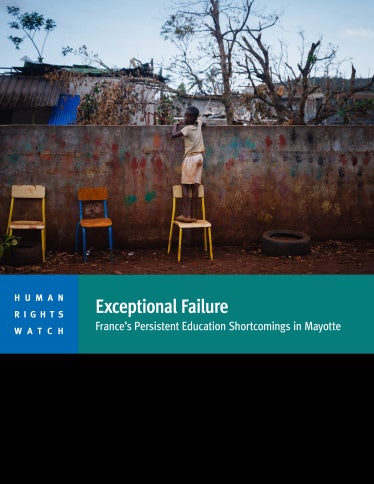
The 73-page report, “Exceptional Failure: France’s Persistent Education Shortcomings in Mayotte,” finds that Mayotte’s municipalities often impose significant and arbitrary barriers to school enrollment, including by demanding documentation not required by law. Children who are enrolled often attend overcrowded schools ill-equipped to meet their basic needs, such as access to drinking water, sanitation, nutritious food, and a safe learning environment. Children living in informal settlements known as bangas, are particularly affected, as are children from migrant families.

A boy looks over a school fence
A woman looks out of the window of a damaged building

Search

  • October 14, 2025

    How Low Taxes Drove Sri Lanka’s Economic Crisis and Squandered its Education Lead

    The 101-page report, “Tax Giveaways, Struggling Schools: How Low Taxes Drove Sri Lanka’s Economic Crisis and Squandered its Education Lead,” describes how Sri Lanka’s successive governments have adopted policies that resulted in inadequate revenues, contributing not only to Sri Lanka defaulting on its debt but also to a decades-long decline in public education spending as a share of Gross Domestic Product (GDP) to among the lowest in the world. It also documents the impacts of inadequate funding on children’s right to education. Moreover, low corporate and personal tax revenues have led to an average of 80 percent of taxes coming from goods and services, which generally are regressive because they claim a higher share of poorer people’s income.
     

    cover in English
  • February 18, 2025

    Sexual Violence against Girls in Guatemala

    The 85-page report, “‘Forced to Give Up on Their Dreams’: Sexual Violence against Girls in Guatemala,” documents the numerous barriers that girls who are survivors of sexual violence face accessing essential health care, education, social security, and justice. Guatemalan law classifies any sexual activity involving a child under 14 as sexual violence. Guatemala’s National Registry of Persons (RENAP) reported that between 2018 and 2024, 14,696 girls under 14 gave birth and became mothers, in many cases against their will.

    English report cover
  • September 24, 2024

    Academic Freedom in Hong Kong Under the National Security Law

    The 76-page report, “‘We Can’t Write the Truth Anymore’: Academic Freedom in Hong Kong Under the National Security Law,” documents that long-protected civil liberties, including the rights to freedom of expression, assembly, and association, have been under assault in Hong Kong’s eight publicly funded universities. As these universities have become increasingly repressive, students and faculty widely self-censor, fearful of being targeted for harassment, retribution, and even prosecution for what they say and do both in the classroom and on campus.

    Report cover in English
  • July 24, 2024

    Ecuador’s Slow Progress Tackling and Preventing School-Related Sexual Violence

    The 60-page report, “‘Like Patchwork’: Ecuador’s Slow Progress Tackling and Preventing School-Related Sexual Violence,” documents significant gaps in the government’s response to prevent and tackle abuses in Ecuador’s education system. Many schools still fail to report abuses or fully implement required protocols. Judicial institutions do not adequately investigate or prosecute sexual offenses against children, affecting survivors’ ability to find justice.

    Report cover in English
  • June 20, 2024

    Forced Russification of the School System in Occupied Ukrainian Territories

    The 63-page report “Education under Occupation: Forced Russification of the School System in Occupied Ukrainian Territories,” documents violations of international law by the Russian authorities in relation to the right to education in formerly occupied areas of Ukraine’s Kharkivska region, and other regions that remain under Russian occupation. Russian authorities have forced changes to the curriculum and retaliated against school staff who refused to make such changes with threats, detention, and even torture. Human Rights Watch also found that occupying authorities threatened parents whose children were learning the Ukrainian curriculum online.

    Report cover in English
  • June 19, 2024

    Discriminatory Censorship Laws Harm Education in Florida

    In the 86-page report, “‘Why Do They Hate Us So Much?’: Discriminatory Censorship Laws Harm Education in Florida,” the groups say that Florida leaders are reshaping elementary, middle, and high school classroom content through new laws and policies that censor, distort, and discriminate. Such laws restrict classroom instruction about race in US history, sexual orientation, and gender identity, ban books reducing the information available to students, and promulgate inaccurate and misleading civics and history standards.

    Report cover in English
  • June 12, 2024

    Fees as a Discriminatory Barrier to Pre-Primary Education in Uganda

    The 68-page report, “Lay a Strong Foundation for All Children”: Fees as a Discriminatory Barrier to Pre-Primary Education in Uganda,” documents how lack of access to free pre-primary education leads to poorer performance in primary school, higher repetition and drop-out rates, and widening income inequality. Fewer than 1 in 10 Ugandan children ages 3-5 are enrolled in a registered and licensed pre-primary school – known locally as “nursery” school – and 60 percent attend no school at all until they reach primary school. Pre-primary education refers to early childhood education before a child’s entry into primary school, which in Uganda is at age 6.

    English report cover
  • February 13, 2024

    Pregnant Girls’ and Adolescent Mothers’ Struggles to Stay in School in Mozambique

    The 52-page report, “‘Girls Shouldn’t Give Up On Their Studies’: Pregnant Girls’ and Adolescent Mothers’ Struggle to Stay in School in Mozambique,” documents numerous barriers faced by adolescent girls and women who are pregnant or parenting, and the problems they face when trying to stay in school. Students also lack or are denied access to sexual and reproductive health information, especially comprehensive sexuality education, as well as adolescent-responsive sexual and reproductive health services, including a wide range of contraceptive options and safe, legal abortion to the fullest extent allowed by law.

    Mozambique pregnant girls education report cover
  • December 6, 2023

    The Taliban’s Impact on Boys’ Education in Afghanistan

    The 19-page report, “‘Schools are Failing Boys Too’: The Taliban’s Impact on Boys’ Education in Afghanistan,” documents Taliban policies and practices since they took over the country in August 2021 that are jeopardizing education for Afghan boys. This includes the dismissal of female teachers, increased use of corporal punishment, and regressive changes to the curriculum. While the Taliban’s bans on secondary and higher education for girls and women have grabbed global headlines, the serious harm done to the education system for boys has gained less notice.
    202310asia_afghanistan_boysschool_cover
  • August 8, 2022

    Human Rights Watch / ACLU Joint Submission Regarding the United States’ Record Under the International Convention on the Elimination of All Forms of Racial Discrimination

    The United Nations Committee on the Elimination of Racial Discrimination should direct the United States government to take immediate, tangible measures to dismantle structural racism in the United States, Human Rights Watch and the American Civil Liberties Union said today, releasing a joint report to the committee.

    202208us_cerd_report_cover
  • May 25, 2022

    Children’s Rights Violations by Governments that Endorsed Online Learning During the Covid-19 Pandemic

    The 99-page report, “’How Dare They Peep into My Private Life?’: Children’s Rights Violations by Governments that Endorsed Online Learning during the Covid-19 Pandemic,” is grounded in technical and policy analysis conducted by Human Rights Watch on 165 education technology (EdTech) products endorsed by 49 countries. It includes an examination of 294 companies found to have collected, processed, or received children’s data since March 2021, and calls on governments to adopt modern child data protection laws to protect children online.

    video content
    202205crd_edtech_cover
  • May 12, 2022

    Efforts to Ban Gender and Sexuality Education in Brazil

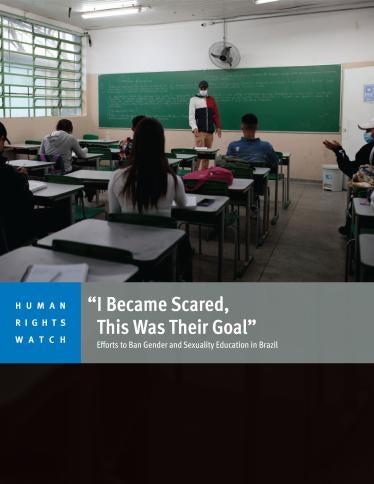
    The 77-page report, “‘I Became Scared, This Was Their Goal’: Efforts to Ban Gender and Sexuality Education in Brazil,” analyzes 217 bills and laws presented between 2014 and 2022 designed to explicitly forbid the teaching or sharing of gender and sexuality education, or ban so-called “gender ideology” or “indoctrination,” in municipal and state schools. Human Rights Watch also documented a political effort to discredit and restrict gender and sexuality education, bolstered by the administration of President Jair Bolsonaro, who has personally amplified this message for political effect, including as recently as March 2022.

    202205lgbt_americas_brazil_education_cover
  • December 16, 2021

    Armed Separatist Attacks on Students, Teachers, and Schools in Cameroon’s Anglophone Regions

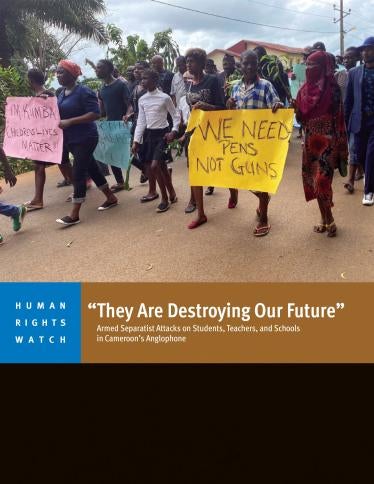
    The 131-page report, “They Are Destroying Our Future: Armed Separatist Attacks on Students, Teachers, and Schools in Cameroon’s Anglophone Regions,” documents scores of education-related attacks by armed separatist groups in the English-speaking North-West and South-West regions between March 2017 and November 2021. The groups have killed, beaten, abducted, threatened, and terrorized students and education professionals; harassed and intimidated families into keeping their children out of school; and burned, destroyed, damaged, and looted school buildings.

    video content
    202112africa_cameroon_education_protest_cover
  • September 14, 2021

    Neglecting the Rights of LGBT Youth in South Korean Schools

    The 76-page report, “‘I Thought of Myself as Defective’: Neglecting the Rights of LGBT Youth in South Korean Schools,” finds that bullying and harassment, a lack of confidential mental health support, exclusion from school curricula, and gender identity discrimination are particularly pressing concerns for LGBT students. The South Korean government should implement antidiscrimination protections and ensure that LGBT youth have supportive resources to safeguard their health and education

    video content
    202109lgbt_southkorea_cover
  • June 30, 2021

    How China’s Long Reach of Repression Undermines Academic Freedom at Australia’s Universities

    The 102-page report, “‘They Don’t Understand the Fear We Have’: How China’s Long Reach of Repression Undermines Academic Freedom at Australia’s Universities,” describes Chinese government surveillance of pro-democracy students from the mainland and Hong Kong in Australian universities. Students are broadly aware that such surveillance takes place, leaving them fearful. Many alter their behavior and self-censor to avoid threats and harassment from classmates, and being “reported on” to authorities back home.

    video content
    202106australia_china_campusintimidation_cover