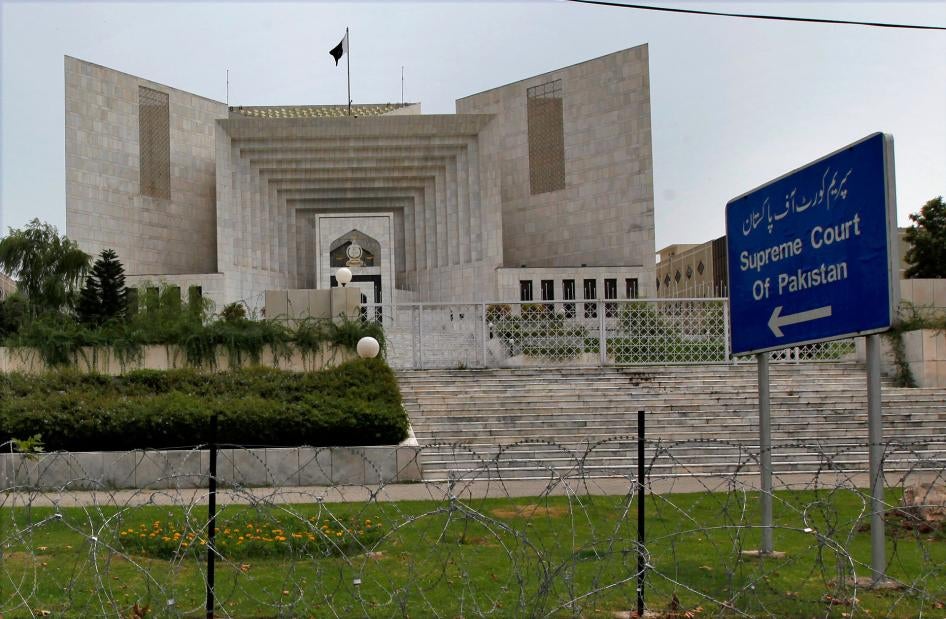
On September 21, the Pakistan Supreme Court directed a medical board to examine two death row prisoners with psychosocial disabilities, or mental health conditions, seeking expert opinion on mental health as a mitigating factor in capital punishment cases.
Ghulam Abbas and Kanizan Fatima Bibi, who had been convicted of murder, had filed for review of a 2015 Supreme Court decision that upheld their death sentences on the basis that there was insufficient evidence of their disability. The claimants and the Punjab provincial government argued that the court ignored the prisoners’ mental health condition at the time of the judgment.
Kanizan Fatima is one of the few women on death row in Pakistan. According to her lawyers, she has not spoken for 14 years and is unable to eat, drink, or take care of herself without assistance. She has been in prison for 31 years.
Ghulam Abbas has spent more than 14 years on death row. Human rights organizations have urged that his mental health condition should be comprehensively assessed. Abbas’ lawyers say that medical records show that he had received mental health medication in prison.
The Supreme Court’s decision to review its earlier ruling is an important development and presents a valuable opportunity for reform. The death penalty is inherently cruel, inhumane, and irreversible. Executing an individual with psychosocial disabilities would also violate Pakistan’s international legal obligations. The United Nations Human Rights Committee and UN special experts have determined that the execution of a person with a psychosocial disability violates the right to be free from cruel, inhuman, or degrading punishment.
The unfairness and high risk of error present in capital prosecutions in Pakistan has been documented extensively. Executing people with psychosocial disabilities is an affront to human decency and serves no criminal justice purpose. Pakistan should strengthen its judicial institutions to prevent unjust sentencing and move towards a complete moratorium on the death penalty.
|
Dispatches
Pakistan Court’s Mental Health Ruling Promises Reform
Protect Rights of Prisoners with Disabilities, Impose Death Penalty Moratorium
Every piece on our website is resource intensive. If you donate whatever you can today, we will use it to continue investigating abuses and advocate for change in 100+ countries.
Topic
More Reading
-
September 14, 2020
Blaming the Victim for Sexual Violence in Pakistan
-
September 10, 2020
Pakistan’s Hypocrisy on Press Freedom
Reports
-
September 8, 2026
Too Old and A Woman
Systemic Age and Gender Discrimination Against Women at Work in South Korea

-
February 18, 2026
After the Storm
Climate Change, Planned Relocation, and People with Disabilities in Siargao, Philippines
Most Viewed
-
October 13, 2026
Saudi Arabia: Death Penalty for Facebook Comment

-
May 17, 2021
“Years Don’t Wait for Them”

-
June 14, 2018
Africa: Pregnant Girls, Young Mothers Barred from School
-
September 8, 2016
Nepal: Child Marriage Threatens Girls’ Futures
-
October 13, 2026
India: End Crackdown on Protesters, Arbitrary Detentions