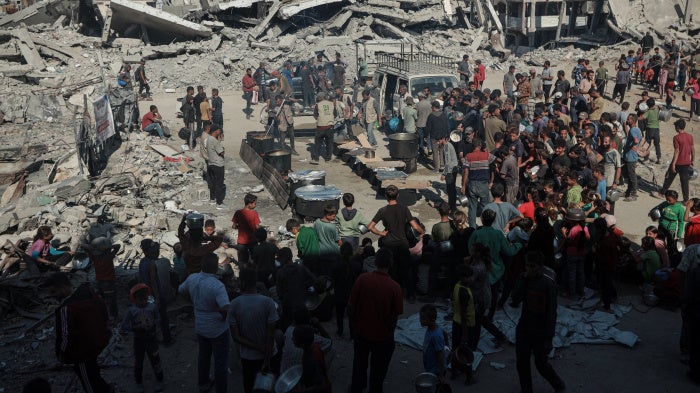
In 2025, Israeli forces escalated their atrocities, including war crimes, crimes against humanity and acts of genocide, and ethnic cleansing against Palestinians in Gaza, killing, maiming, starving and forcibly displacing Palestinians and destroying their homes, schools, and infrastructure at a scale unprecedented in the recent history of Israel and Palestine. A report issued in September by the UN Commission of Inquiry finding that Israel committed genocide in Gaza underscored the growing consensus among human rights organizations and experts around the atrocities in Israel’s genocidal campaign in Gaza that resulted in the killing of more than 69,000 Palestinians, including more than 19,000 children, and injuring of more than 170,000, according to Gaza’s Health Ministry.
On March 18, Israeli authorities broke a ceasefire that had been in place for about two months. They carried out daily attacks for the nearly seven months that followed, until Israel and Hamas entered a US-brokered ceasefire on October 10, 2025. The ceasefire involved the release of the remaining living hostages in Gaza, who had been held by Hamas and other Palestinian armed groups for more than two years, and hundreds of Palestinians in Israeli detention, most held without trial or charge. Throughout the year, Israeli war crimes and crimes against humanity, including of apartheid and persecution, against Palestinians have persisted.
The International Criminal Court (ICC) continued its investigation of crimes within the court’s mandate committed since 2014. In February 2025, ICC judges terminated proceedings against Mohammed Deif, the commander-in-chief of Hamas’ military wing, for the October 7, 2023, attacks that included war crimes and crimes against humanity after confirming his death. In July, ICC judges rejected Israel’s request to withdraw the 2024 warrants against Netanyahu and former Defense Minister Yoav Gallant for war crimes and crimes against humanity in Gaza. Although ICC judges are yet to decide on Israel's challenge to the court's jurisdiction, they have confirmed that the arrest warrants against Israeli officials remain valid.
Gaza
Israeli forces killed more than 400 people, mostly children and women, on March 18 when it resumed its assault on Gaza and more than 13,500 were killed between March 18 and October 10, according to Gaza’s Health Ministry. The health ministry also registered more than 350 Palestinians killed during the first two months of the ceasefire. The ministry’s casualty figure for Gaza likely undercounts the number of people directly killed as a result of the hostilities, as shown in models by doctors and epidemiologists, and also does not include the likely thousands that have died from dehydration, malnutrition, and disease, or are buried under the rubble.
For more than 11 weeks, between early March and mid-May, Israeli authorities imposed a total blockade on Gaza – in order, they said, to pressure Hamas to release hostages – allowing in no food, medicine or other aid. Since mid-May, sweeping restrictions on aid remained in place, and a flawed US-backed militarized aid distribution system run by private contractors under the auspices of the Gaza Humanitarian Foundation (GHF) began operating, until the October ceasefire.
In August, the world’s foremost experts on food insecurity, the Integrated Phase Classification (IPC), declared a famine in Gaza City and the surrounding areas and found that all of Gaza’s population are “currently facing or projected to face crisis or worse levels of acute food insecurity between 16 August and 30 September 2025.” As of October 11, 463 Palestinians, including 157 children, died as a result of malnutrition, according to Gaza’s Health Ministry. Israeli forces killed hundreds of Palestinians seeking food aid—between May 27 and August 19, 1,857 Palestinians were killed seeking food aid, 1,021 at or near GHF sites, according to the UN.
Israeli authorities continued to deprive people in Gaza of electricity and adequate water needed for survival, including by restricting piped water, forcing water pumps, desalination, wastewater, and sewage facilities offline, blocking fuel needed to run electricity generators, attacking water and sanitation workers and warehouses, preventing repairs, and blocking the entry of equipment and parts. According to an assessment by humanitarian organizations between August 17 and September 5, 49 percent of the population had access to less than the minimum emergency standard of 6 liters of drinking water per day. Lack of water and sanitation contributed to a public health disaster, with the majority of households experiencing lice and mites and affected by skin conditions such as rashes and scabies due to poor hygiene and overcrowding. Israel’s denial of water to the Palestinian population of Gaza amounts to the crime against humanity of extermination and the genocidal act of inflicting conditions of life calculated to bring about the destruction of the group in whole or part. Its continued use of starvation of civilians as a weapon of war, a war crime, and deprivation of basic services also violate binding provisional measures issued by the International Court of Justice (ICJ) in South Africa’s genocide case against Israel, which remains ongoing.
In September, following threats by Israel’s Defense Minister to destroy Gaza City unless Hamas released the hostages and laid down its arms, replicating the razing of Rafah, and pursuant to a plan to demolish what remains of Gaza’s civilian infrastructure and further concentrate the Palestinian population, Israeli forces ordered the displacement of residents of the city and surrounding areas and began their assault, destroying high-rise buildings and homes. In total, by October more than 1.2 million people had been displaced since March 18 and, as of September 17, 82 percent of Gaza was within an Israeli-militarized zone or under displacement order, according to OCHA. Israeli forces since October 2023 have forcibly displaced nearly all of Gaza’s population, often multiple times, in acts that Human Rights Watch has found to amount to war crimes and crimes against humanity.
Israeli forces carried out strikes in areas outside the militarized zone or under displacement orders, including a June 30 strike on the seaside al-Baqa café that reportedly killed between 24-36 people.
Israeli attacks and demolitions by combat engineers and military bulldozers damaged 78 percent of all Gaza’s buildings, as of July 8, rendering much of the Strip uninhabitable and clearly constituting ethnic cleansing in large parts of Gaza.
Virtually all of Gaza’s schools—97 percent—were damaged or destroyed, with the vast majority (76 percent) directly hit, and 92 percent in need of “full reconstruction or major rehabilitation work to become functional again.” Israeli forces repeatedly struck schools turned shelters, including in unlawfully indiscriminate attacks, killing at least 836 people sheltering there as of July 18, according to UNRWA.
Israeli authorities also carried out 793 attacks on health care facilities in Gaza, as of September 11, killing 983 people, according to the World Health Organization. Consecutive strikes on Nasser Hospital on August 25 killed at least 22 people, including health workers, emergency response crews, and five journalists. As of October 12, only 14 of 36 hospitals, 10 of 16 field hospitals, 64 of 181 primary healthcare centers, and 109 of 359 medical points remained partially functional. The collapse of the healthcare system deprived the estimated 50,000 pregnant women and girls in Gaza of access to adequate care, and increased the risk of serious health complications during pregnancy, birth, and post-partum. It also severely limited access to assisted reproductive services. Human Rights Watch has documented apparently unlawful attacks on hospitals and ambulances, arbitrary detention and torture of health care workers, restrictions on medical evacuations, and war crimes committed while Israeli forces occupied hospitals. Prominent doctor Hussam Abu Safiya, director of Kamal Adwan hospital, was arrested by Israeli forces in December 2024 and reportedly faced assault in detention.
Israeli forces also repeatedly deliberately killed Palestinians journalists, including an August 10 strike that killed Al Jazeera correspondents Anas al-Sharif and Mohammad Qreiqeh and four other media workers. Israeli forces killed 220 journalists in Gaza in less than two years, according to Reporters Without Borders.
On March 23, Israeli forces apparently deliberately killed 15 Palestinian paramedics and rescue workers in Rafah, whose bodies were found in a mass grave. They repeatedly struck police forces, security for aid convoys, and officials involved in running civilian affairs in Gaza, and empowered Palestinian militias under their control, contributing to a breakdown in public order. They also repeatedly struck known aid worker locations and imposed new registration requirements, making it more difficult for international organizations to operate.
Israeli forces have also remained in control of large parts of Gaza and continued to carry out demolitions of civilian infrastructure and deadly attacks against Palestinians after the ceasefire came into effect.
Hamas and Palestinian Armed Groups
Armed groups in Gaza held for most of the year 48 Israeli and foreign nationals hostage, all of whom are among the more than 250 hostages held since October 2023 in acts that Human Rights Watch has found to amount to war crimes and crimes against humanity. In August, Palestinian armed groups released videos of hostages depicting emaciated men showing signs of starvation. On October 13, the groups released the 20 remaining living hostages and in subsequent days returned the bodies of all but one of those who had been killed.
Following the ceasefire, Hamas’ armed wing carried out apparently summary killings of some people it accused of working with the Israeli army.
West Bank
Israeli forces launched operations in January that emptied three refugee camps in the northern West Bank—Jenin, Tulkarem, and Nur Shams—of their residents, displacing around 32,000 people, the largest displacement in the West Bank since 1967, and blocking them from returning with few exceptions, acts that amount to war crimes, ethnic cleansing and crimes against humanity.
Across the West Bank, Israeli forces killed 182 Palestinians in 2025, as of October 7, with a total of 969 since October 7, 2023, according to OCHA. As of September 8, Palestinians killed 11 Israeli civilians and 6 soldiers in the West Bank in 2025.
Israeli settler violence reached a more than 18-year-high in 2025, with more incidents resulting during the first nine months resulting in casualties or property damage (2,660) than in any other since at least 2006, according to OCHA. Israeli settlers killed 7 Palestinians in total during this period, including in July Odeh Hathalin, who worked on the Oscar-winning film “No Other Land.”
Israeli authorities continued to rarely prosecute those responsible for violence against Palestinians.
Israeli authorities provided security, infrastructure, and other services to more than 730,000 settlers in the occupied West Bank, which includes East Jerusalem.
In 2025, Israeli authorities had already, as of mid-September, advanced plans to build a total of 25,000 housing units in settlements in the West Bank, an all-time record, according to the Israeli group Peace Now. In August, Israeli authorities gave final approval to build 3,400 housing units in the heart of the West Bank, threatening to further fragment Palestinians. As of mid-October, 58 settlement “outposts” were established, which are not authorized but receive government and military support to take over land in the West Bank. The transfer of civilians into occupied territory is a war crime.
Israeli authorities apply Israeli civil law to settlers but govern West Bank Palestinians under military law, deny them basic due process, and try them in military courts.
The difficulty in obtaining Israeli building permits in East Jerusalem and the 60 percent of the West Bank under Israel’s exclusive control (Area C) has driven Palestinians to build structures at risk of demolition for being unauthorized.
In 2024 and the first nine months of 2025, Israeli authorities demolished, according to OCHA, 2,577 Palestinian homes and other structures in the West Bank, including East Jerusalem, for lacking building permits, which authorities make nearly impossible for Palestinians to obtain in areas under Israel’s exclusive control. During this same period, demolitions or state-supported settler violence displaced nearly 8,000 people from their homes, in addition to the nearly 32,000 displaced during the 2025 raids in the northern West Bank.
Freedom of Movement
Israeli authorities heightened movement restrictions against Palestinians in 2025. An early 2025 survey by OCHA found 849 movement obstacles across that West Bank that permanently or intermittently restricted the movement of Palestinians. Israeli authorities continued to require Palestinian ID holders to hold difficult-to-obtain, time-limited permits to enter Israel and large parts of the West Bank, including East Jerusalem. Israel continued construction of the separation barrier, 85 percent of which falls within the West Bank, and which will isolate 9 percent of the West Bank when complete.
Abuses by the Palestinian Authority
In 2025, the Palestinian Authority (PA) escalated its repression of dissent, arbitrarily arresting and torturing critics and opponents with impunity. During the first eight months of 2025, the Palestinian statutory watchdog, the Independent Commission for Human Rights, received 356 complaints for arbitrary arrests, including detention without trial or charge, and 79 complaints of torture and ill-treatment during detention by the PA.
During the first three weeks of January, the PA continued security operations in the Jenin refugee camp that began December 5, killing and endangering camp residents, limiting access to food, water and electricity, damaging homes and leading to scores of arrests and other abuses. The PA in January suspended Al Jazeera from broadcasting in the occupied territory and a Palestinian court restricted access to several Al Jazeera websites. Israeli authorities also in January extended its closure orders against Al Jazeera in the West Bank.
There was no change to personal status laws for Muslims and Christians that discriminate against women.
Israel
Laws passed by the Knesset to block UNRWA from operating in Israel and the occupied territory came into effect in early 2025. Since then, Israeli authorities have blocked UNRWA’s international staff from entering Gaza, blocked UNRWA, which had been the larger provider of aid, from distributing aid in Gaza, and issued closure orders for UNRWA-operated schools in East Jerusalem, blocking them opening in September 2025 and impacting nearly 800 children, some of whom have been unable to enroll in other schools. An October 22 ICJ advisory opinion, following public hearings in April and May which forty states and international organizations participated in, found that Israel’s claim that UNRWA lacks impartiality is unfounded and its obstruction of the agency’s critical work is at odds with international law.
Detention, Torture, and Ill-Treatment of Palestinians
Israeli authorities, as of October 1, detained more than 11,000 Palestinians, including 3,544 Palestinians in administrative detention without charge or trial and largely based on secret evidence, and 2,673 Palestinians from Gaza under the “Unlawful Combatants” law, a more restrictive form of administrative detention. On October 10, as part of the ceasefire agreement, Israeli authorities released nearly 2,000 Palestinian detainees, most from Gaza held under the “Unlawful Combatants Law.” As of June 30, Israeli authorities were detaining 360 Palestinian children. Israel denied independent access to detention facilities, including to the ICRC, since October 7, 2023.
Israeli authorities arbitrarily detained, tortured, inflicted sexual violence on, and denied adequate food and medical care to detained Palestinian men, women, and children. At least 75 Palestinians have died in detention since October 7, 2023, with Israel often withholding their bodies.
Regional Hostilities
Israeli forces withdrew from most of southern Lebanon in early 2025 following a November 2024 ceasefire with Lebanese armed groups, but its forces remained in Lebanon in at least five locations along the border. In 2025, Israeli forces launched attacks or engaged in hostilities in Yemen, Syria, Iran, Qatar and Tunisia. Israel carried out attacks in Houthi-controlled areas of Yemen that killed civilians and damaged and destroyed critical civilian infrastructure, while the Houthis launched attacks that struck civilian objects in Israel—both likely war crimes. The 12-day hostilities between Israel and Iran in June 2025 killed over 1,000 people in Iran and 30 people in Israel, according to authorities, and involved serious violations of the laws of war by both parties.
Key International Actors
Although the United States brokered the October 10 ceasefire agreement, the Trump administration has indicated support for war crimes by Israeli forces and taken actions that deepen US complicity in those crimes and make the US a party to the armed conflict. Meanwhile, the European Commission proposed a suspension of the trade pillar of the EU-Israel Association Agreement, following a review that found Israel in violation of the agreement’s human rights clause, but the measure was not adopted lacking support from enough EU governments. The UK suspended free-trade negotiations with Israel. Several states also issued sanctions against violent settlers and senior Israeli officials, halted arms transfers, and banned trade with Israel’s illegal settlements. In September, the UN General Assembly adopted the New York Declaration on a “two-state solution,” spearheaded by France and Saudi Arabia. The Declaration includes an annex calling for concrete measures, including targeted sanctions, the suspension of bilateral agreements and banning settlement trade. States, though, have largely failed to act upon their pledges and obligations to stop Israel’s crimes against Palestinians.
International Justice
ICC prosecutors and judges faced political pressure, intimidation, or US sanctions in connection to their investigation in Palestine. The US in July also imposed sanctions on a UN expert and in September on three leading Palestinian human rights organizations, Al-Haq, Al Mezan Center for Human Rights, and the Palestinian Centre for Human Rights, under its ICC-related sanctions program. In July, it sanctioned another leading Palestinian human rights group, Addameer, under a separate sanctions program.
The judicial systems in several countries including France, Germany, Belgium and Brazil opened investigations or received criminal complaints from civil society groups under the principle of universal jurisdiction, focusing on alleged international crimes by Israeli forces in Gaza.